


Hong Kong Financial Secretary Antony Leung (梁錦松) announced his resignation yesterday just hours after the government said Security Secretary Regina Ip (葉劉淑儀) had quit.
Hong Kong Chief Executive Tung Chee-hwa (
Leung came under pressure to resign after it was revealed he had bought a luxury car just weeks before he announced in March the government's budget in which taxes on such cars were hiked.
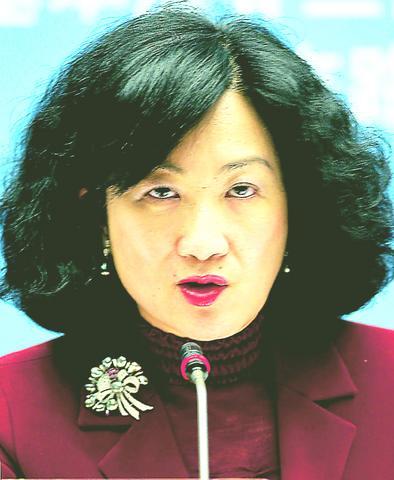
PHOTO: AP
Leung issued a short statement that made no mention of the car scandal but said he had carried out his duties with "a clear conscience at all times."
Ip's resignation came amid a crisis that exploded over an anti-subversion bill that was halted by massive public discontent.
Ip said her departure was "entirely due to personal reasons" but also expressed concerns that the national security bill was "not completed as scheduled" despite her persistent efforts.
Critics said Ip's resignation was inevitable after her handling of the contentious bill threw Hong Kong's government into its biggest crisis since the handover from to Chinese sovereignty on July 1, 1997.
"As a Chinese national and the secretary for security, I sincerely believe I have a responsibility to actively promote this highly important legislative task," Ip said.
Tung said Ip had proposed stepping down on June 25 for personal reasons and that he argued she should stay, suggesting she take leave "to get some rest and sort out her personal matters before making up her mind."
"But regrettably I could not change her decision," Tung said.
Ever since the handover, Hong Kong has been constitutionally required to outlaw subversion in a national security bill, but critics say the government went way too far with a measure that could clamp down on local freedoms of speech, press and assembly.
Ip rejected such worries and pushed hard to have the bill passed on July 9 as scheduled, but the government backed down following the July 1 protest by a half million people.
After the massive march, Tung's government was forced to water down parts of the bill, but he first tried to get it passed on schedule. That effort collapsed as legislative support dried up, and the bill was shelved. It now remains in limbo.
Earlier in the day, Beijing's top representative to Hong Kong warned pro-democracy politicians that their opposition to the national security bill will harm the economy, a state-run Chinese newspaper reported yesterday.
"Hong Kong is a city of business, not of politics," Gao Siren (
Gao warned that "extremely politicized" acts would harm economic development and contradict "the fundamental interests of Hong Kong," the China Daily reported.
Gao is the head of Beijing's government liaison office in Hong Kong.
Gao did not elaborate on what actions he was criticizing, but the China Daily called his remarks an obvious reference to pro-democracy figures who oppose the anti-subversion law.
Meanwhile, in a poll published yesterday, Tung's approval rating fell from 45.7 percent last month to 35.4 percent.
The ratings for all but two of Tung's 14 ministers have slumped below 50 percent with the biggest plunge in popularity being that of Ip, whose personal rating fell from 53 percent early last month to 34.6 percent this month.
Ip was often derided by the unflattering nickname "Broomhead" by critics.
The monthly poll by the University of Hong Kong's Public Opinion Program is based on more than 1,000 telephone interviews.
Also see story:
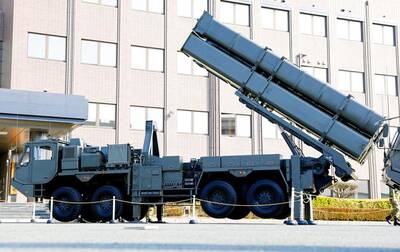
Japan has deployed long-range missiles in a southwestern region near China, the Japanese defense minister said yesterday, at a time when ties with Beijing are at their lowest in recent years. The missiles were installed in Kumamoto in the southern region of Kyushu, as Japan is attempting to shore up its military capacity as China steps up naval activity in the East China Sea. “Standoff defense capabilities enable us to counter the threat of enemy forces attempting to invade our country ... while ensuring the safety of our personnel,” Japanese Minister of Defense Shinjiro Koizumi said. “This is an extremely important initiative for
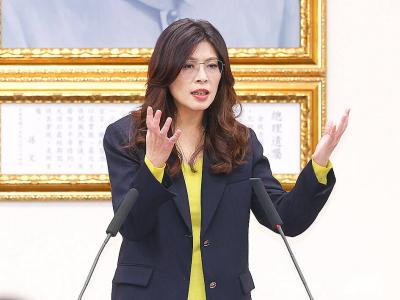
Chinese Nationalist Party (KMT) Chairwoman Cheng Li-wun (鄭麗文) today accepted an invitation from Chinese President Xi Jinping (習近平) to lead a delegation to China next month, saying she hopes to promote the peaceful development of cross-strait relations and bring stability to the Taiwan Strait. “I am grateful and happy to accept this invitation,” Cheng said in a statement from the KMT chairperson’s office. Cheng said she hopes both sides can work together to promote the peaceful development of cross-strait relations, enhance exchange and cooperation, bring stability to the Taiwan Strait and improve people’s livelihoods. At today's news conference, Cheng said any efforts to
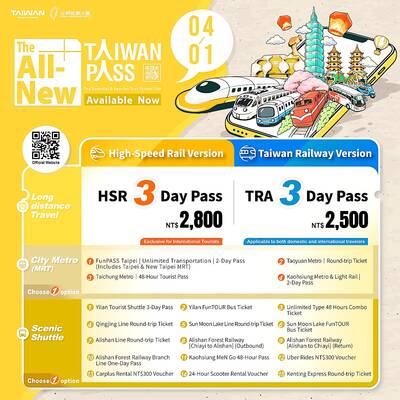
MORE POPULAR: Taiwan Pass sales increased by 59 percent during the first quarter compared with the same period last year, the Tourism Administration said The Tourism Administration yesterday said that it has streamlined the Taiwan Pass, with two versions available for purchase beginning today. The tourism agency has made the pass available to international tourists since 2024, allowing them to access the high-speed rail, Taiwan Railway Corp services, four MRT systems and four Taiwan Tourist Shuttles. Previously, five types of Taiwan Pass were available, but some tourists have said that the offerings were too complicated. The agency said only two types of Taiwan Pass would be available, starting from a three-day pass with the high-speed rail and a three-day pass with Taiwan Railway Corp. The former costs NT$2,800
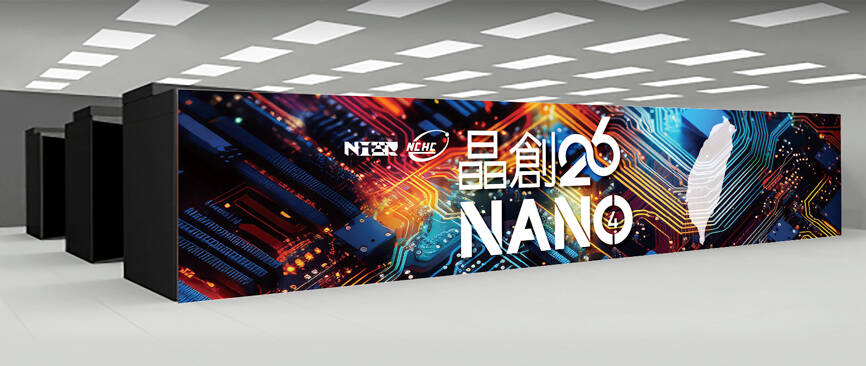
The nation’s fastest supercomputer, Nano 4 (晶創26), is scheduled to be launched in the third quarter, and would be used to train large language models in finance and national defense sectors, the National Center for High-Performance Computing (NCHC) said. The supercomputer, which would operate at about 86.05 petaflops, is being tested at a new cloud computing center in the Southern Taiwan Science Park in Tainan. The exterior of the server cabinet features chip circuitry patterns overlaid with a map of Taiwan, highlighting the nation’s central position in the semiconductor industry. The center also houses Taiwania 2, Taiwania 3, Forerunner 1 and


 RSS
RSS