


Premier Yu Shyi-kun yesterday appointed Lin Chuan (林全), head of the Directorate-General of Budget, Accounting and Statistics, as the new minister of finance and Lee Chin-lung (李金龍), former director of the Council of Agriculture's (COA) Bureau of Animal and Plant Health Inspection and Quarantine, as head of the COA.
For the time being, Liu San-chi (
Lee, however, will decide who will take over his position at the quarantine bureau.
Yu, who officially approved the resignations of former minister of finance Lee Yung-san (李庸三) and Council of Agriculture chairman Fan Chen-tsung (范振宗) on Monday, made the announcement at a press conference yesterday afternoon.
Yu said that the past three days felt like years as the media paid close attention to the potential candidates for the two positions.
"I'm glad it's over now," he said.
According to Yu, he did not inquire about Lee Chin-lung's willingness to take over the COA until 4:30pm yesterday.
"In addition to his academic achievements, Lee has complete and extensive experience in the civil service since he joined the Council of Agriculture 23 years ago," Yu said.
Lee, 55, comes from Yu's hometown of Ilan County and is one of Yu's high-school classmates. Lee joined the Council of Agriculture in 1979 as a technician. He was promoted to be the COA's secretary general in 1992 and appointed director of the Animal and Plant Quarantine Bureau in 1998.
Holding a doctorate in horticulture from Hannover University in Germany, he has also been teaching horticulture at National Chungshing University since 1980 and at National Taiwan University since 1985.
Lee said that the first thing on his agenda is to listen to the voices of farmers and fishermen with an open mind, especially at the national summit to discuss agricultural financing on Saturday.
Yu praised Lin as an "outstanding scholar with impressive practical experience in the profession of finance."
"He's not only an eloquent speaker but also a hard worker and an idealist who dares to safeguard his ideas," Yu said.
Lin, 51, served as director of the Bureau of Finance for the Taipei City Government between 1995 and 1998 when President Chen Shui-bian (陳水扁) was the city mayor. He was appointed the head of the Directorate-General of Budget, Accounting and Statistics in 2000.
Lin graduated from the University of Illinois with a doctorate in economics, and also teaches economics and finance at National Taiwan University and National Chengchi University.
Lin, who was consulted about the position two days ago, said that he has mixed feelings about taking up the job.
"I feel sad about leaving my co-workers at the current job and [I'm] in a ... funk about the new job," he said.
In the face of future challenges, Lin said that he will set priorities for various tasks and seek improvement as maintaining stability.

‘NO SECURITY RISK’: The Railway Bureau reassured the public that the technicians’ activities were limited to technical guidance and did not involve sensitive systems The Railway Bureau yesterday said it had invited eight Chinese technicians to assist with an airport MRT construction project. The bureau issued the confirmation after an Internet user said Chinese nationals had entered the construction zone of Taiwan Taoyuan International Airport’s Terminal 3 project. They asked why “individuals from an enemy state” were allowed access to such a major national infrastructure project, which raised serious concerns over Taiwan’s industrial safety, sensitive systems and information security. The bureau’s Northern Region Engineering Branch Office said subcontractor Taiwan Handle Industrial Co (台灣手把工業) of the Taoyuan airport MRT’s “Contract No. CU05 Project A14 Station Civil, MEP &

The National Chungshan Institute of Science and Technology yesterday showcased its locally developed variants of the Vision 60 robotic patrol dog, which it plans to deploy on the nation’s outlying territories in the South China Sea. The variants were produced under the Joint Lab project — created by the institute and domestic companies — and assembled with domestically produced motors, lenses and artificial intelligence (AI) systems alongside licensed tech from the US, Missile and Rocket Systems Research Division deputy director Jen Kuo-kang (任國光) told the media event at a military base in Taipei’s Dazhi (大直) area. Taiwan has built up its strengths
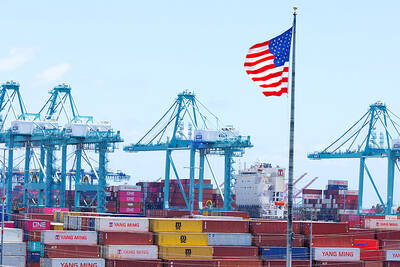
NOT IMMEDIATE: Taiwan has a chance to appeal the proposed 10 percent tariff before it starts, while other countries face a 12.5 percent tariff from the trade office Taiwan is among 60 economies determined by the US to have failed to impose or enforce a ban on the importation of goods produced with forced labor, according to a notice released on Tuesday by the Office of the US Trade Representative (USTR), which proposed imposing an additional 10 percent or more tariff on them. The USTR in a statement said that following an investigation, it had determined under Section 301 of the Trade Act of 1974 that the failure of the 60 economies to impose and effectively enforce a prohibition on the importation of goods produced with forced labor is

RIGHT DIRECTION: Taiwan’s efforts to prevent forced labor include a proposal to ‘fully prohibit’ employers from withholding workers’ documents, an official said Taiwan is to establish a mechanism to restrict imports of goods linked to forced labor, the Executive Yuan said yesterday, after the US proposed imposing additional tariffs on Taiwanese goods over labor concerns. “The Ministry of Labor and the Ministry of Economic Affairs are to establish an interministerial review procedure,” Executive Yuan spokesperson Michelle Lee (李慧芝) said at a news briefing in Taipei. “The government is to use the Foreign Trade Act [貿易法] as the legal basis to restrict imports of goods produced with forced labor” and bring its supply chain governance more in line with international standards on human rights, resilience


 RSS
RSS