


A passenger plane, trailing smoke from its left engine, plunged into Manila Bay shortly after taking off from the Philippine capital yesterday, with 18 of the 34 people aboard killed or missing and presumed dead.
Sixteen people, including two Australians, were rescued.
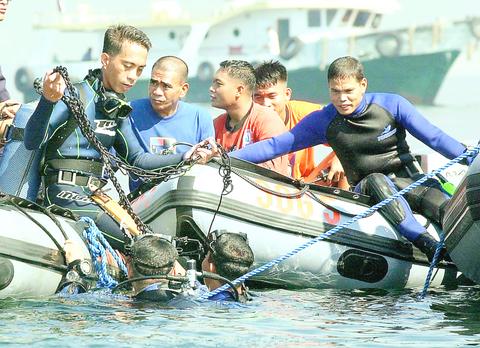
PHOTO: AFP
One Filipino survivor said he held onto one of the passengers to push himself up through the water but did not immediately realize he was clinging to a dead person.
Hours after the Fokker plane crashed into murky waters around 11m deep, only 14 bodies -- some still strapped in their seats -- had been recovered by rescue teams.
They included the bodies of two Australians and one British national, officials said.
Coast guard chief Vice-Admiral Ruben Lista said rescuers had shifted from a search-and-rescue phase to "search and retrieval operations," suggesting all hope of finding four others still missing had been abandoned. They included two other Australians and another British national.
Amateur video footage showed a trail of smoke from the left engine on the high-winged Fokker 27 plane just before it crashed into the bay, after taking off from Manila for the gambling center of Laoag, 400km north of the capital.
The plane had been airborne for three minutes when it crashed about 1km from shore after apparently suffering engine trouble, the Air Transport Office (ATO) said, discounting sabotage as a cause.
A woman who had been walking along Manila Bay with her children told local radio she saw the plane crash.
Tail split off
"First I saw black smoke, then suddenly the tail portion split off and the rest of the plane sank into the bay. I saw one man waving a white piece of cloth. Later, I could not see him any more," she said.
Four of the dead were children, including an 11-year-old boy whose body was found still bound to his seat. The plane carried 29 mostly Filipino passengers and five crew.
The survivors included the pilot and co-pilot.
Australian survivor Steve Thompson, 25, his arms and legs covered in bandages, told reporters the pilot warned passengers to brace themselves before the plane went down.
"The plane crashed, that's what happened. I really don't want to talk about it," he said.
A police tally showed another Australian, Bryan Forester, also survived.
"We understand that there were at least six Australians on board the aircraft, five from Sydney and one from Brisbane," the Australian embassy in Manila said in a statement.
The embassy only referred to one Australian survivor who had been identified so far and said he had been treated in hospital and released.
More than two dozen boats, including Navy craft, outrigger canoes belonging to fishermen and pleasure craft from the nearby Manila Yacht Club, converged on the crash site but the waters only yielded soaked luggage and metal fragments.
Recovery effort
Divers pulled the dead body of a young boy from the sea and tenderly lifted him into the lap of a rescuer in an inflatable dinghy, who cradled the body as the boat moved away.
"My husband took three of the women [survivors] and we loaded them into our car," said Nerissa Abrico who was jogging along the bay when she witnessed the crash.
"I was cradling one of them because she was so weak ... . She said all she kept thinking about were the children on the plane."
Laoag is popular with tourists from China and Hong Kong. It has one of the largest casinos in the Philippines and has direct air links with Hong Kong.
This was the second crash of a Fokker aircraft within a week. Twenty of the 22 passengers and crew died at Luxembourg's international airport on Nov. 6 when a twin-engine Fokker 50 smashed into a field in thick fog.
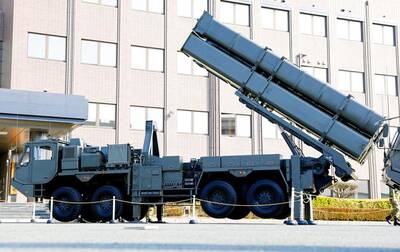
Japan has deployed long-range missiles in a southwestern region near China, the Japanese defense minister said yesterday, at a time when ties with Beijing are at their lowest in recent years. The missiles were installed in Kumamoto in the southern region of Kyushu, as Japan is attempting to shore up its military capacity as China steps up naval activity in the East China Sea. “Standoff defense capabilities enable us to counter the threat of enemy forces attempting to invade our country ... while ensuring the safety of our personnel,” Japanese Minister of Defense Shinjiro Koizumi said. “This is an extremely important initiative for

Chinese Nationalist Party (KMT) Chairwoman Cheng Li-wun (鄭麗文) today accepted an invitation from Chinese President Xi Jinping (習近平) to lead a delegation to China next month, saying she hopes to promote the peaceful development of cross-strait relations and bring stability to the Taiwan Strait. “I am grateful and happy to accept this invitation,” Cheng said in a statement from the KMT chairperson’s office. Cheng said she hopes both sides can work together to promote the peaceful development of cross-strait relations, enhance exchange and cooperation, bring stability to the Taiwan Strait and improve people’s livelihoods. At today's news conference, Cheng said any efforts to
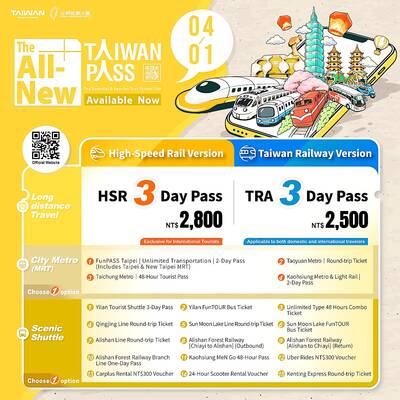
MORE POPULAR: Taiwan Pass sales increased by 59 percent during the first quarter compared with the same period last year, the Tourism Administration said The Tourism Administration yesterday said that it has streamlined the Taiwan Pass, with two versions available for purchase beginning today. The tourism agency has made the pass available to international tourists since 2024, allowing them to access the high-speed rail, Taiwan Railway Corp services, four MRT systems and four Taiwan Tourist Shuttles. Previously, five types of Taiwan Pass were available, but some tourists have said that the offerings were too complicated. The agency said only two types of Taiwan Pass would be available, starting from a three-day pass with the high-speed rail and a three-day pass with Taiwan Railway Corp. The former costs NT$2,800

The nation’s fastest supercomputer, Nano 4 (晶創26), is scheduled to be launched in the third quarter, and would be used to train large language models in finance and national defense sectors, the National Center for High-Performance Computing (NCHC) said. The supercomputer, which would operate at about 86.05 petaflops, is being tested at a new cloud computing center in the Southern Taiwan Science Park in Tainan. The exterior of the server cabinet features chip circuitry patterns overlaid with a map of Taiwan, highlighting the nation’s central position in the semiconductor industry. The center also houses Taiwania 2, Taiwania 3, Forerunner 1 and


 RSS
RSS