


It was a mixed bag of results for Taiwan at the Asian Games yesterday, a day which brought an unexpected silver medal in rowing.
Losses to China in soccer and to Japan in women's volleyball were disappointing but not unexpected.
There was also a narrow victory in the first round of the tennis competition.
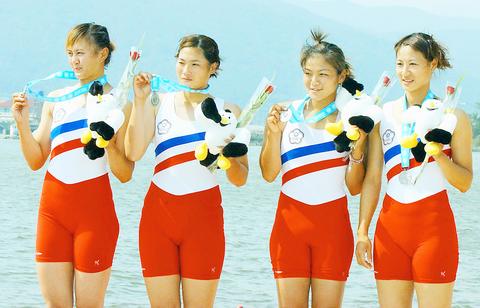
PHOTO: AFP
In judo Taiwan was unable to follow up its success of the previous day when it won two bronzes, losing before the medal stages. In the evening baseball game, Japan whipped Taiwan 8-3.
On the third full day of competition at the 14th Asian Games, Taiwan took its tally of medals to six, with three silvers and three bronzes.
In the women's four-oars without coxswain, an impressive Chinese foursome surged ahead of the chasing pack on the Nakdong River to finish nearly 20 seconds ahead of Taiwan after a distance of 2,000m, with a time of seven minutes, 44 seconds. Uzbekistan was third.
Right from the start the result never looked in question as China went into the lead, followed by Taiwan.
After 500m, it had secured a five-second advantage, but Chiang Chien-ju (江倩茹), Chi Yao-hsuan (紀瑤璇), Yu Cheh-chun (游貞純) and Su Hui-ching (蘇慧青) put their backs into it and kept up with the Chinese foursome up to the halfway mark.
After this point, China increased the pressure and pulled away from the Taiwan foursome, which was unable to keep up the pace.
Even so, it was a creditable performance from Taiwan, which took the bronze medal at the previous Asian Games in Bangkok four years ago.
Coach Hung Jui-chang (洪瑞昌) said the team's success was due in large part to a two-month training program in Australia and help from sports specialists there.
"We planned for the silver or bronze medal because we knew China was the strongest team and nobody here can compare with them," Hung said.
He added that he expected Taiwan could snatch another two medals in the four-man oars and women's doubles today.
In women's volleyball, a clearly outmatched Taiwan was beaten in three sets by gold-medal hopeful Japan, at Gijiang Gym. Though spirited, the nation's volleyballers did not have the reach, speed or strength of their rivals.
The first set went 25-20, but Japan raced ahead in the second to close 25-16. Taiwan put up a fight in the third set to prolong the match, but was eventually downed 28-26.
Spectator and secretary-general of the Chinese Taipei Volleyball Association, International Referee Chang Chin-jong (Jan Ching-chuan, 詹清泉), said Taiwan did have a good team four years ago but other countries had improved since then.
"We really don't have the height. Now the good teams are Thailand, South Korea, Japan and of course China. They have all really strengthened their teams and are too strong for Taiwan."
It was much the same in soccer at Gudeok Stadium, where Taiwan took on women's soccer giants China in a Group A match.
The pattern was set as early as the seventh minute when defender Fan Yunjie took advantage of a mix-up in the Taiwan penalty area following a corner, to tap the ball in from close range.
Although China did not score any more goals and the result was 1-0, the Reds ran rings around the blue shirts of Taiwan and should have scored many more.
The red machine's slick passing movements and rock-solid defense in turn bamboozled and frustrated the Taiwanese women. If it had not been for the valiant Huang Shou-mei (黃守每) in goal it could have been a landslide loss.
In the second half in particular, three-time Asian Games champion China was completely dominant, with much of the match played in Taiwan's half.
Before walking out of the press conference in what appeared to be a fit of pique, Taiwan's coach Chang Yao-chuan (張耀川) admitted that China was the stronger team on the day. "We were too slow and they were just a bit special," he said.
Taiwan did better in tennis, beating Hong Kong by two matches to one in the second round of the men's team competition, at the Geumjeong sports complex.
First up was former Taiwan Boys' Champion Jimmy Wang (Wang yeu-tzuoo, 王宇佐), who started with a will but then folded like a flower at the end of the match.
Taking the first set 7-6, he narrowly lost the second 6-4 and then completely wilted in the decider, 6-1. It was not the start that Taiwan wanted but Wang could point to a swollen blister on his right toe that explained his dramatic loss in form.
"The blister affected my running and kept me from being able to chase down the ball, so it was hard out there today for me," Wang said.
The 17-year-old is expected to have a bright future ahead of him on the men's tennis tour, but has taken time out from competition and building his game at the Nick Bottlieri Tennis Academy in the US to represent his country.
"I'm at a very important stage in my tennis career," he said. "But I'm happy to play for Taiwan and with the people I know instead of against them. It's a good experience for me and I hope it will help take me to the next level [of playing]."
Wang said the Games had been "fun" so far though he did not rate South Korean food that highly. He is planning to bulk up in order to compete against the giants of today's game.
In the second match, Lu Yen-hsun (盧彥勳) managed to batter Yu Hiu-tung in two sets (6-2, 6-2) to even the three-match series against Hong Kong.
Then, in the final match Steve Cheng (Cheng Wei-jen, 鄭為仁) and Lu powered to a two-sets victory over John Hui Kin-yip and Wayne Wong Wing-lun, to give Taiwan the edge over Hong Kong in the men's team event.
The Taiwan duo were pumped throughout the match, working well together and digging deep when it mattered, especially in the second set when they were three games down.
Cheng managed to find his serve and combined perfectly with his partner at times in rallies to cause the Hong Kong pair to lose heart.
"I was really pleased with our game and we worked well together. My first serve was iffy to begin with but I got it right just in time."
Taiwan's judokas were unable to keep up their winning ways at Gudeok Gym, with both Shih Yu-shuang (
Much of Taiwan must have been watching with anticipation when Taiwan took the field against Japan at Sajik Baseball Stadium.
Their hopes were dashed, however, when Japan came back from two down in the sixth inning, scoring five runs and another three in the eighth, with Takeshi Koyama hitting two runs in two at-plate appearances, including a home run and three RBIs.

The National Chungshan Institute of Science and Technology yesterday showcased its locally developed variants of the Vision 60 robotic patrol dog, which it plans to deploy on the nation’s outlying territories in the South China Sea. The variants were produced under the Joint Lab project — created by the institute and domestic companies — and assembled with domestically produced motors, lenses and artificial intelligence (AI) systems alongside licensed tech from the US, Missile and Rocket Systems Research Division deputy director Jen Kuo-kang (任國光) told the media event at a military base in Taipei’s Dazhi (大直) area. Taiwan has built up its strengths

RIGHT DIRECTION: Taiwan’s efforts to prevent forced labor include a proposal to ‘fully prohibit’ employers from withholding workers’ documents, an official said Taiwan is to establish a mechanism to restrict imports of goods linked to forced labor, the Executive Yuan said yesterday, after the US proposed imposing additional tariffs on Taiwanese goods over labor concerns. “The Ministry of Labor and the Ministry of Economic Affairs are to establish an interministerial review procedure,” Executive Yuan spokesperson Michelle Lee (李慧芝) said at a news briefing in Taipei. “The government is to use the Foreign Trade Act [貿易法] as the legal basis to restrict imports of goods produced with forced labor” and bring its supply chain governance more in line with international standards on human rights, resilience

NOT IMMEDIATE: Taiwan has a chance to appeal the proposed 10 percent tariff before it starts, while other countries face a 12.5 percent tariff from the trade office Taiwan is among 60 economies determined by the US to have failed to impose or enforce a ban on the importation of goods produced with forced labor, according to a notice released on Tuesday by the Office of the US Trade Representative (USTR), which proposed imposing an additional 10 percent or more tariff on them. The USTR in a statement said that following an investigation, it had determined under Section 301 of the Trade Act of 1974 that the failure of the 60 economies to impose and effectively enforce a prohibition on the importation of goods produced with forced labor is

TIT-FOR-TAT: The US allegedly revoked the visa of a Chinese national working at Xinhua News Agency in the US in response to Beijing’s expulsion of Vivian Wang The Presidential Office yesterday condemned China for expelling a New York Times correspondent from Beijing following the newspaper’s interview with President William Lai (賴清德), saying the move highlighted Beijing’s suppression of press freedom and its threat to international news media. Taiwan has noted a series of recent incidents in which Beijing used similar tactics to “threaten and pressure international media outlets and journalists,” Presidential Office spokeswoman Karen Kuo (郭雅慧) said in a statement. “This concerns not only press freedom and freedom of expression, but also the safety of journalists, and Taiwan and relevant partners are paying close attention to the situation,” she


 RSS
RSS