


Ready, steady, go.
Asia's 14th Games got off to a good start last night in Busan, South Korea, with a spectacular opening ceremony and a united Korea parading around a packed stadium in front of an estimated 60,000 people.
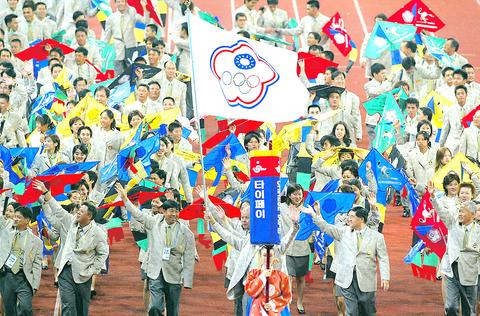
PHOTO: REUTERS
Taiwan's delegation of 359 athletes, 110 coaches and 51 officials marched behind the Chinese Taipei flag, led by track and field athlete Chen Tien-wen.
It was a colorful beginning to the Games, pregnant with symbolism and intended to give a dynamic new vision of Asia.
Proceedings started with what was termed a twilight preliminary, which featured an energetic and popular drumming performance similar to the Broadway show Stomp, the purpose of which was to hype the crowd.
Goody bags on spectator seats contained a flashlight and wooden spoons, which the audience smacked together to make a deafening noise similar to heavy rain on a tin roof.
A helicopter hovered overhead, spoons clacked and firework traces shot up in the air over the roof of the stadium, followed by a lone nabal or Korean trumpet of welcome and then hundreds of dancers in traditional costume flooded the pitch.
After which an honor guard was formed around the track for the 44 teams and 6,707 athletes taking part in the Games. At the head of the parade was tiny Nepal because its name comes first in the Korean alphabet.
As the crowd clapped and cheered, Taiwan's 520-member delegation joined the march, dressed in olive gray suits and darker trousers, carrying kite flags and interacting happily with the crowd.
But the biggest roar of the night was saved for last as a united Korea -- led by two athletes from the divided countries -- carried the Hanbando, a plain white flag with a light blue map of the Korean peninsula. The South and North Koreans marched, some hand-in-hand, to frenzied applause, flag-waving and flashes from the torches provided free in goody bags.
Then, South Korean President Kim Dae-jung welcomed the President of the Olympic Committee of Asia Sheikh Ahmad Al-Fahad Al-Sabah and they officially opened the Games.
Kim said, "While wishing for the enhancement of harmony and peace in Asia, I declare the 14th Asian Games being held in the beautiful maritime city of Busan open."
After the Asian Games flag was raised and the Athletes' Oath was taken on behalf of all the athletes it was time for the flame to arrive, which had been lit separately at Mount Hallasan in the south and Mount Baekdusan in the north. The two flames were then "united" in South Korea before going on a nationwide tour and ended up last night lighting the Busan Asiad Main Stadium cauldron.
On that note of symbolism the opening ceremony was over and just the flame remained, where it will stay until the end of the Games on Oct. 14.
It was not the end of the program, however, which continued in a dramatic and no less symbolic fashion. The theme was to be a "new vision [of a] new Asia."
The lights dimmed, tens of thousands of torches were held aloft and the cauldron containing the flame was raised, exploded and turned green.
A bridge was constructed across the pitch and the story was enacted of an ancient Korean king from Busan, who was said to have been born from an egg around 2,000 years ago.
According to the legend, a princess crossed the sea in order to marry the king and they had many children and were happy ever after, establishing a golden age in the region.
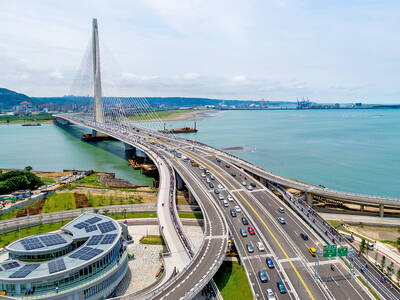
The Ministry of Transportation and Communications yesterday inaugurated the Danjiang Bridge across the Tamsui River in New Taipei City, saying that the structure would be an architectural icon and traffic artery for Taiwan. Feted as a major engineering achievement, the Danjiang Bridge is 920m long, 211m tall at the top of its pylon, and is the longest single-pylon asymmetric cable-stayed bridge in the world, the government’s Web site for the structure said. It was designed by late Iraqi-British architect Zaha Hadid. The structure, with a maximum deck of 70m, accommodates road and light rail traffic, and affords a 200m navigation channel for boats,
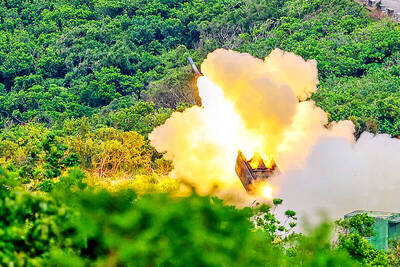
PRECISION STRIKES: The most significant reason to deploy HIMARS to outlying islands is to establish a ‘dead zone’ that the PLA would not dare enter, a source said A High Mobility Artillery Rocket System (HIMARS) would be deployed to Penghu County and Dongyin Island (東引) in Lienchiang County (Matsu) to force the Chinese military to retreat at least 100km from the coastline, a military source said yesterday. Taiwan has been procuring HIMARS and Army Tactical Missile Systems (ATACMS) from the US in batches. Once all batches have been delivered, Taiwan would possess 111 HIMARS units and 504 ATACMS, which have a range of 300km. Considering that “offense is the best defense,” the military plans to forward-deploy the systems to outlying islands such as Penghu and Dongyin so that

WHAT WAS ALL THAT FOR? Jaw Shaw-kong said that Cheng Li-wen had pushed for more drastic cuts and attacked him, just for the outcome to be nearly identical to his bill The legislature yesterday passed a supplementary budget bill to fund the purchase of separate packages of US military equipment, with the combined amount of spending capped at NT$780 billion (US$24.8 billion). The Chinese Nationalist Party (KMT) and Taiwan People’s Party (TPP) used their legislative majority to pass the bill, which runs until 2033 and has two main funding provisions. One was for NT$300 billion of arms sales already approved by the US for Taiwan on Dec. 17 last year, the other was for NT$480 billion for another arms package expected to be announced by Washington. The bill, which fell short of the NT$1.25

‘CLEAR MESSAGE’: The bill would set up an interagency ‘tiger team’ to review sanctions tools and other economic options to help deter any Chinese aggression toward Taiwan US Representative Young Kim has introduced a bill to deter Chinese aggression against Taiwan, calling for an interagency “tiger team” to preplan coordinated sanctions and economic measures in response to possible Chinese military or political action against Taiwan. “[Chinese President] Xi Jinping [習近平] has directed the People’s Liberation Army to be ready to invade Taiwan by 2027. China has a plan. America should have one too,” Kim said in a news release on Thursday last week. She introduced the “Deter PRC [People’s Republic of China] aggression against Taiwan act” to “ensure the US has a coordinated sanctions strategy ready should


 RSS
RSS