


The Control Yuan yesterday confirmed that records of interviews with former president Lee Teng-hui (李登輝) quoted him as saying that he had feared a coup d'etat if he rejected the proposal of his premier Hau Pei-tsun (郝柏村) and top military officials to buy Lafayette-class frigates.
In response, the Ministry of National Defense spokesman Major General Huang Sui-sheng (黃穗生) told a routine press conference, yesterday, "The armed forces belong to the whole country, not to any single party or individual. There is absolutely no chance of a coup d'etat happening in Taiwan."
Hau issued a statement yesterday accusing the former president of "using [the fear of] a coup d'etat as an excuse."
A Chinese-language newspaper revealed the classified internal interview records yesterday. According to the records made on Nov. 11 last year, Control Yuan members recorded that while answering questions about the decision-making process of purchasing French-made Lafayette-class frigates rather than the initially preferred Ulsan-class vessels from South Korea, Lee told the task force, "How could I say no to them? They had already decided. If I refused to let them do so, it was entirely possible that there would have been a coup d'etat."
In response to the report, the President of the Control Yuan Fredrick Chien (錢復) had a meeting with members of the task force which was responsible for the investigation of the frigate scandal at that time and held a news briefing to clarify the matter afterward.
Chao Ron-yaw (趙榮耀), who spoke for the task force, said, "The record of the interview with Lee quotes him making such remarks." Adding a note of caution, however, he added, "But, the Control Yuan members who conducted the interview could not recall whether the former president made such remarks or not."
Declining to comment further, Chao however, added that since the document is classified, the Control Yuan would probe how the newspaper got the document and who might be responsible for their disclosure.
The report quoted Lee's remarks in the document as saying that, in 1991, when the navy was negotiating with the French about the price of the Lafayette frigates, "They nevertheless reported to me about the progress we made on buying Korean-made naval vessels." It also quoted him saying, "These people lied to me whenever they had a chance."
According to the news story, Lee accused Hau and former navy commander-in-chief Yeh Chang-tung (葉昌桐) of deceiving him because they owned the power of military.
The interviews were conducted on Nov. 11 last year in Lee's house. Kang Ning-hsiang (
Lee couldn't be reached yesterday to comment on the matter.
Hau released a statement saying that he felt "regret" and was "distressed."
He stressed that as president, Lee had the power to make the final decision. "But he used to say he knows nothing about this, and now he uses a coup d'etat as an excuse. I feel sorry for our armed forces for having such a commander-in-chief."
Hau also said he protested what Lee said. "Launching a coup is a serious crime involving treason. If Lee suspected that I had any intention of doing so, he should have investigated me immediately. How come he honored me with a national medal when I retired from the post as premier."
The investigation report released this March by the Control Yuan contained no mention of this part of Lee's interview records.
Chao stressed that opinions on which parts of the interview records should have been included in the report do not reflect the task force's conclusions about the scandal. "Our conclusions about the scandal were shown in the formal report released this March."
In the investigation report, the task force concluded that former premier Hau and top former military officials usurped the president's supreme authority over defense policy and concealed from the president policy changes that they made in the process.
The MND said it couldn't comment on the report until it had done its own investigation and the Control Yuan published the result of its investigations into certain military officials it proposed to impeach in connection with the scandal.
Without commenting on whether there was any possibility for a coup happening during Lee's presidency, the MND stressed the current state of the military, saying the armed forces were bound by the constitution and relevant laws to protect the country and be loyal to the president. The relevant laws are the Defense Law and the Organizational Law of the MND, which came into effect long after the Lafayette purchase.
Retired military officials told the Taipei Times of threats of a coup from military leaders in thrall to General Hau during the early period of Lee's presidency.
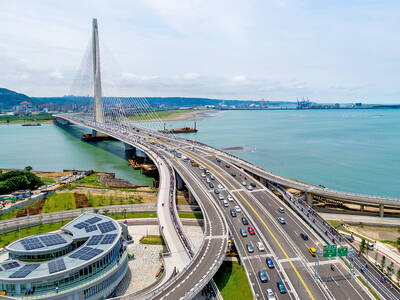
The Ministry of Transportation and Communications yesterday inaugurated the Danjiang Bridge across the Tamsui River in New Taipei City, saying that the structure would be an architectural icon and traffic artery for Taiwan. Feted as a major engineering achievement, the Danjiang Bridge is 920m long, 211m tall at the top of its pylon, and is the longest single-pylon asymmetric cable-stayed bridge in the world, the government’s Web site for the structure said. It was designed by late Iraqi-British architect Zaha Hadid. The structure, with a maximum deck of 70m, accommodates road and light rail traffic, and affords a 200m navigation channel for boats,
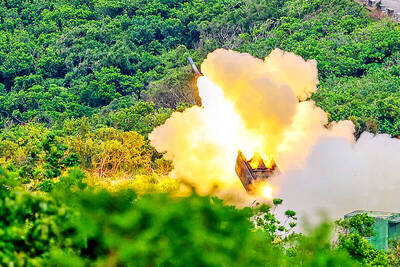
PRECISION STRIKES: The most significant reason to deploy HIMARS to outlying islands is to establish a ‘dead zone’ that the PLA would not dare enter, a source said A High Mobility Artillery Rocket System (HIMARS) would be deployed to Penghu County and Dongyin Island (東引) in Lienchiang County (Matsu) to force the Chinese military to retreat at least 100km from the coastline, a military source said yesterday. Taiwan has been procuring HIMARS and Army Tactical Missile Systems (ATACMS) from the US in batches. Once all batches have been delivered, Taiwan would possess 111 HIMARS units and 504 ATACMS, which have a range of 300km. Considering that “offense is the best defense,” the military plans to forward-deploy the systems to outlying islands such as Penghu and Dongyin so that
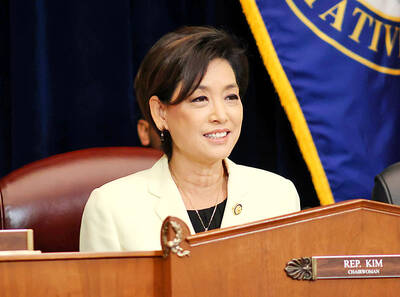
‘CLEAR MESSAGE’: The bill would set up an interagency ‘tiger team’ to review sanctions tools and other economic options to help deter any Chinese aggression toward Taiwan US Representative Young Kim has introduced a bill to deter Chinese aggression against Taiwan, calling for an interagency “tiger team” to preplan coordinated sanctions and economic measures in response to possible Chinese military or political action against Taiwan. “[Chinese President] Xi Jinping [習近平] has directed the People’s Liberation Army to be ready to invade Taiwan by 2027. China has a plan. America should have one too,” Kim said in a news release on Thursday last week. She introduced the “Deter PRC [People’s Republic of China] aggression against Taiwan act” to “ensure the US has a coordinated sanctions strategy ready should
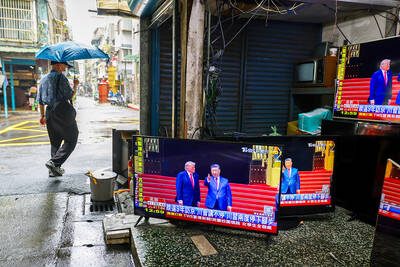
TAIWAN ISSUE: US treasury secretary Scott Bessent said on the first day of meetings that ‘it wouldn’t be a US-China summit without the Taiwan issue coming up’ There were no surprises on the first day of the summit between US President Donald Trump and Chinese President Xi Jinping (習近平), the Mainland Affairs Council (MAC) said yesterday, as the government reiterated that cross-strait stability is crucial to the Asia-Pacific region, as well as the world. As the two presidents met for a highly anticipated summit yesterday, Chinese state media reported that Xi warned Trump that missteps regarding Taiwan could push their two countries into “conflict.” Trump arrived in China with accolades for his host, calling Xi a “great leader” and “friend,” and extending an invitation to visit the White House


 RSS
RSS