


China Airlines flight CI 611 with 225 people on board crashed into the sea near Penghu yesterday afternoon after taking off from Taipei en route to Hong Kong.
The search-and-rescue effort was still underway and no survivors had been discovered as of press time last night. More than 100 bodies have been spotted, according to a China Airlines spokesman.
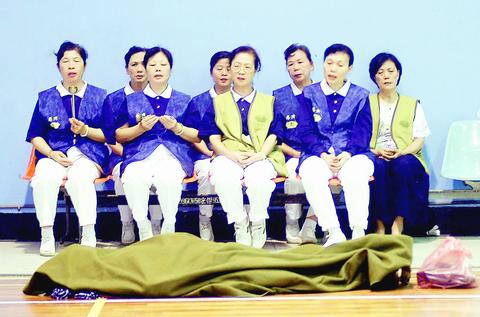
PHOTO: CHANG CHIA-MING, TAIPEI TIMES
The cause of the crash is still under investigation.
The Boeing 747-200, which took off from CKS International Airport at 3:08pm, disappeared from radar screens at around 3:30pm, when it was about 19km from Makung city, officials said.
According to China Airlines' records, the plane was carrying 206 passengers, three of whom were infants, and 19 crew members.
All 19 crew members as well as 190 passengers on board were Taiwanese, including two United Daily News reporters and a former legislator.
In addition to 14 Hong Kong, Macau and Chinese residents, foreign passengers also included one Singaporean, identified as Sim Yong-joo, and one Swiss, identified as Luigi Heer.
The air force and coast guard sent ships and helicopters to search for the plane as soon as the accident was reported, with the first body found at about 6:14pm around the port of Chihkan, located north of Penghu Island.
The Executive Yuan established an emergency command center headed by Minister of Transportation and Communications Lin Lin-san (
Showing his concern about the accident, Premier Yu Shyi-kun went to the airport in the afternoon and then rushed to the Civil Aeronautics Administration office last night to take command of the search-and-rescue efforts in person.
"This is a matter for regret," Yu said.
Yu said President Chen Shui-bian (陳水扁) had ordered the military to mobilize all possible resources to search for survivors, as long as the nation's combat readiness was not impaired.
Vice Minister of Transportation and Communications Chang Chia-juch (
Chang added that the control tower had not received any distress calls before the plane went missing.
Data indicate that the crash took place between 3:37pm and 3:40pm, when two Cathay Pacific planes in the vicinity received emergency location-indicator signals from the downed China Airlines plane, Chang said.
The Executive Yuan's Aviation Safety Council created an investigative panel last night to look into the cause of the accident.
Kay Yong (戎凱), managing director of the council, who also serves at the panel's chief investigator, said the council has contacted the US' National Transportation Safety Board and Boeing Company to help with the probe.
China Airlines officials, meanwhile, bowed and apologized to the bereaved families for the terrible air disaster.
A number of agitated relatives of the passengers rushed to the China Airlines office in Taipei to gather information related to the crash, and were upset with the company's failure to immediately provide them with details.
China Airlines Senior Vice President James Chang (
"We are regretful for such an unfortunate accident and we would like to pay our gratitude to the government for assisting with the recovery," Chang said.
With the assistance of China Airlines, around 200 relatives of the passengers flew to Makung last night to identify the bodies.
This has been the 14th air crash involving China Airlines since 1969, official statistics indicate. The company's notorious safety record once put it on the list of the world's most dangerous airlines.
The last known fatal China Airlines accident was a crash-landing in Hong Kong in 1999, killing three people.
Over 200 people were killed respectively in the 1994 crash in Nagoya and the 1998 crash in the Taoyuan in the vicinity of CKS International Airport.

‘NO SECURITY RISK’: The Railway Bureau reassured the public that the technicians’ activities were limited to technical guidance and did not involve sensitive systems The Railway Bureau yesterday said it had invited eight Chinese technicians to assist with an airport MRT construction project. The bureau issued the confirmation after an Internet user said Chinese nationals had entered the construction zone of Taiwan Taoyuan International Airport’s Terminal 3 project. They asked why “individuals from an enemy state” were allowed access to such a major national infrastructure project, which raised serious concerns over Taiwan’s industrial safety, sensitive systems and information security. The bureau’s Northern Region Engineering Branch Office said subcontractor Taiwan Handle Industrial Co (台灣手把工業) of the Taoyuan airport MRT’s “Contract No. CU05 Project A14 Station Civil, MEP &

A US uncrewed surface vessel (USV) encountered multiple Chinese warships during an autonomous transit of the Taiwan Strait, US defense company Seasats said in a statement on Wednesday. Seasats announced that a Lightfish USV had completed the first autonomous transit of the Taiwan Strait. Over five days, the USV traversed the entire length of the Strait while constantly monitoring surface vessel traffic, the company said. The Lightfish encountered multiple Chinese warships, one of which was a Chinese People’s Liberation Army Navy (PLAN) Type 056 corvette, it said. The Chinese vessels were operating “well within Taiwan’s exclusive economic zone without transmitting their identity via the

Taiwan is still in the process of assessing the possibility of recruiting workers from Eswatini, the Ministry of Foreign Affairs said yesterday, adding that its goal is to help Eswatini upgrade its vocational training centers. If there are plans to recruit workers from Eswatini, safeguarding national security, protecting public health and ensuring the employment rights of Taiwanese would be prerequisites, Department of West Asian and African Affairs Director-General Yen Chia-liang (顏嘉良) told a news conference. Key considerations would also include filling labor shortages in specific industries, and fostering bilateral professional and technical exchanges, he said. Yen was asked about the progress of labor

‘BOOMING’: ’ The number of partners we have here is incredible. You can see from their stock prices. They’re doing so well, they’re so happy,’ Jensen Huang said Nvidia Corp’s spending in Taiwan has ballooned to about US$150 billion a year, 10 times the US$10 billion to US$15 billion the company spent five years ago, Nvidia chief executive officer Jensen Huang (黃仁勳) said yesterday, suggesting Taiwan’s strategic importance in the global artificial intelligence (AI) supply chain. “Taiwan is the epicenter of the AI revolution. This is where the chips come, packaging comes. This is where the systems are made. This is where AI supercomputers were created,” Huang said at a meeting for the company’s employees in Beitou-Shilin Technology Park (北投士林科技園區) in Taipei, the planned site of Nvidia’s Taipei headquarters. “Taiwan


 RSS
RSS