


Investigators and airline executives from Singapore yesterday slammed the Taiwan report on the factors causing the crash of Singapore Airlines flight SQ006, saying the final report was incomplete and biased against the pilots of the ill-fated flight.
In the report released yesterday by Taiwan's Aviation Safety Council (ASC) , investigators concluded that the pilot's error in identifying the wrong runway -- and then attempting to take off from it -- was the probable cause of the accident which claimed 83 lives in October 2000.
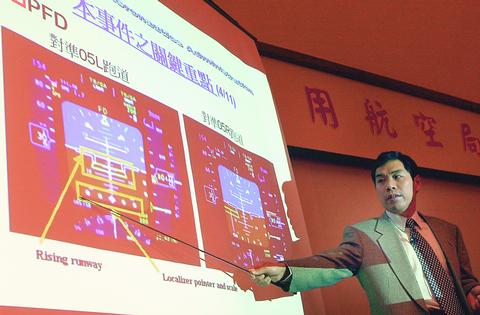
PHOTO: GEORGE TSORNG, TAIPEI TIMES
Flight SQ006 exploded into a fireball and broke into pieces when it struck construction equipment on runway 05R -- which had been closed for repairs -- during takeoff amid a fierce typhoon at Chiang Kai Shek International Airport.
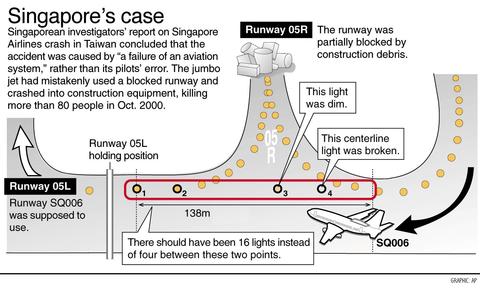
"The crew's attention was focused on the storm, low visibility and strong crosswinds, said Kay Yong (
Yong said that, in their haste to take off before the weather got worse, the pilots of the Boeing 747-400 did not properly verify they were on the correct runway or thoroughly consult airport charts and a written notification that the runway they used, was partially blocked.
"The flight crew did not use all the resources available to them," Yong said.
However, the Singaporean government and executives from the airline took a somewhat divergent view of events, claiming that lax operations at CKS airport misled the aircraft's pilots, but that Taiwan investigators had played down the airport's deficiencies.
A statement released by the Singapore Ministry of Transport said its investigation team "... finds the ASC final report incomplete, as it does not present a full account of accident... [and] downplays significant systemic factors which contributed to accident such as deficiencies in CKS airport."
The ministry claimed that many vital guidance systems at the airport do not conform to international norms including poor lighting, signage and markings of runways and taxiways -- as well as no physical barriers at the start of the closed runway 05R.
"These key factors are glossed over in the ASC's analysis of the accident," said the ministry, which released a separate 107-page report which concluded that the crash was caused by "a failure of the aviation system." In its 508-page report, the ASC categorizes pilot errors as the "probable causes" of the accident while assigning "factors related to risk" to deficiencies at CKS.
Cheong Choong Kong, deputy chairman and CEO of Singapore Airlines, found serious fault with Taiwan's report on the causes of the accident, saying that the disparity in the ASC's attributing probable cause to pilot error doesn't give due weight to CKS's significant role in the tragedy.
"There is no disputing the fact that our pilot took off from the wrong runway, but what could have led them to take off from the wrong runway? These are experienced pilots, pilots with thousands of hours of flight time -- they have a clean record, " said Cheong via videoconference from Singapore.
"We believe the deficiencies in the lightning system, in the signage and air traffic control clearance all these misled our pilots into taking off from the wrong runaway," he said.
Cheong said that one of the major deficiencies contributing to the accident was the fact that runway 05R was prominently lit with lights spaced closely together and marked as if it was operational.
The taxiway lights leading to the intended runway 05L however were - contrary to international norms - spaced several times further apart and not all of them were working, said Cheong. "Consequently, the crew could see only the taxi lights leading on to 05R."
Taiwan's Yong disputed this point, saying the correct runway was better illuminated with white lights going across the runway and down the center.
"The correct runway was lit up like a Christmas tree," he said.
But both Cheong and Singapore's transportation ministry said that runway 05R had already caused problems for other flights, with two pilots coming forward claiming that they had almost also mistakenly turned into the closed runway due to the poor lighting and markings.
An additional factor highlighted by Cheong was that the flight was cleared for takeoff at the critical moment when it was taxiing towards runway 05R reinforcing the crew's belief that they were turning onto the right runway.
Cheong said the air traffic controllers at CKS had not followed procedure in failing to adequately verify the aircraft's position before issuing the clearance to the aircraft.
Much was made by local media and the report of the crew's failure to check the Para-visual Display -- an instrument that in poor visibility can show whether the aircraft is properly aligned with the correct runway.
However, Cheong stressed that the PVD is an auxiliary instrument, which the crew felt they didn't need to examine after receiving clearance from the tower and mistakenly confirming their location visually with the bright lights leading to runway 05R.
The International Federation of Air Line Pilots' Association (IFALPA) also expressed concern with the Taiwanese report and urged prosecutors not to take any legal action against the pilots.
with Additional reporting by Chang Yu-jung
PROVOCATIVE: Chinese Deputy Ambassador to the UN Sun Lei accused Japan of sending military vessels to deliberately provoke tensions in the Taiwan Strait China denounced remarks by Japan and the EU about the South China Sea at a UN Security Council meeting on Monday, and accused Tokyo of provocative behavior in the Taiwan Strait and planning military expansion. Ayano Kunimitsu, a Japanese vice foreign minister, told the Council meeting on maritime security that Tokyo was seriously concerned about the situation in the East China and South China seas, and reiterated Japan’s opposition to any attempt to change the “status quo” by force, and obstruction of freedom of navigation and overflight. Stavros Lambrinidis, head of the EU delegation to the UN, also highlighted South China Sea
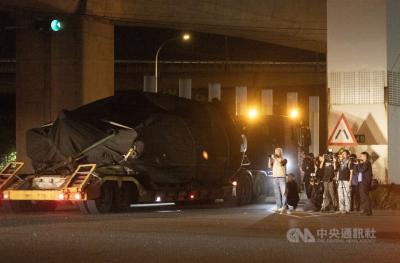
The final batch of 28 M1A2T Abrams tanks purchased from the US arrived at Taipei Port last night and were transported to the Armor Training Command in Hsinchu County’s Hukou Township (湖口), completing the military’s multi-year procurement of 108 of the tanks. Starting at 12:10am today, reporters observed more than a dozen civilian flatbed trailers departing from Taipei Port, each carrying an M1A2T tank covered with black waterproof tarps. Escorted by military vehicles, the convoy traveled via the West Coast Expressway to the Armor Training Command, with police implementing traffic control. The army operates about 1,000 tanks, including CM-11 Brave Tiger
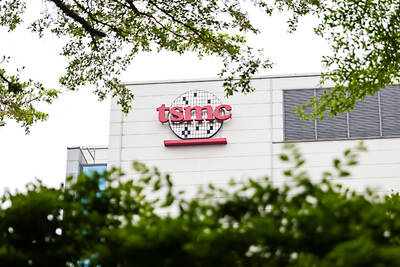
Taiwan Semiconductor Manufacturing Co (TSMC, 台積電), the world’s largest contract chipmaker, said it expects its 2-nanometer (2nm) chip capacity to grow at a compound annual rate of 70 percent from this year to 2028. The projection comes as five fabs begin volume production of 2-nanometer chips this year — two in Hsinchu and three in Kaohsiung — TSMC senior vice president and deputy cochief operating officer Cliff Hou (侯永清) said at the company’s annual technology symposium in Silicon Valley, California, last week. Output in the first year of 2-nanometer production, which began in the fourth quarter of last year, is expected to
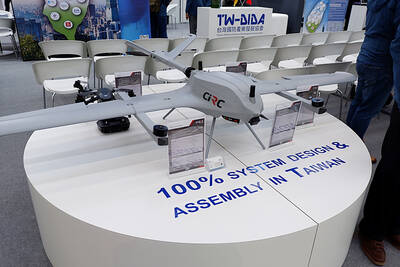
Taiwan’s drone exports surged past US$100 million in the first quarter, exceeding last year’s full-year total, with the Czech Republic emerging as the largest buyer, the Ministry of Economic Affairs said. Exports of complete drones reached US$115.85 million in the period, about 1.2 times the total recorded for all of last year, the ministry said in a report. Exports to the Czech Republic accounted for about US$100 million, far outpacing other markets. Poland, last year’s top destination, recorded about US$11.75 million in the first quarter. Taiwan’s drone exports have expanded rapidly in the past few years, with last year’s total


 RSS
RSS