


Former president Lee Teng-hui (李登輝) was exonerated by the Control Yuan yesterday of involvement in the Lafayette frigate scandal. But former premier Hau Pei-tsun (郝柏村) and top former military officials were accused of usurping the president's supreme authority over defense policy and of concealing from the president policy changes that they made in the process.
The findings are those of the Control Yuan's 500-plus page report into its investigation of the scandal, which was published yesterday.
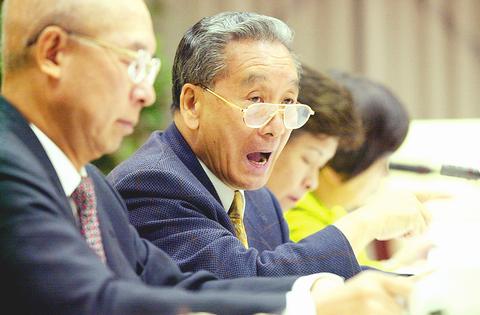
PHOTO: GEORGE TSORNG, TAIPEI TIMES
The report draws no conclusions about the 1993 murder of navy Captain Yin Ching-feng (尹清楓), saying that the deliberate destruction of evidence by the navy and Ministry of National Defense investigative task forces has resulted in the case remaining a mystery. Speculation about the case has centered around the suspected payment of kickbacks over the frigate deal.
Hau was quick to defend himself yesterday, saying he had "nothing to hide."
The report censures the defense ministry and navy headquarters for their "sloppily taken policy decision" to purchase the Lafayette frigates and gross negligence in their investigation into the Yin murder.
The defense ministry issued a statement yesterday saying it respected the Control Yuan's findings and that after formally receiving the report it would form a team to consider improvements to its systems.
The ministry also said that it will cooperate with ongoing investigations into the Yin murder so that the crime can finally be solved and "the dignity of the military maintained."
It states that Hau, who was chief of the general staff in 1989 when the decision was made, Hsia Tien (夏甸), his vice chief of the general staff, and Yeh Chang-tung (葉昌桐), commander-in-chief of the navy, breached navy plans which were the basis of government policy by taking the decision to buy the Lafayette frigates instead of a fleet of South Korean made vessels. It says that they did so without reference to Lee. "[The three] apparently had no respect for the nation's top leader [Lee]," it says.
The report adds that Hau, Hsia and Yeh deliberately concealed the decision from Lee. Under the ROC Constitution the state president has supreme authority for defense matters and serves concurrently as commander-in-chief of the armed forces.
"They [Hau, Hsia and Yeh] had decided, ... but in fact, I did not know anything," the report quotes Lee as saying during his interview with the task force.
The three were the most senior officials, apart from the president, responsible for the procurement of naval hardware.
The report says that navy headquarters, Taiwan's party to the purchase contract, had "apparently known" that the Lafayette-class frigate would not meet the armed force's needs, but, in violation of the standard procedures for military procurements, it changed its original plan and purchased the Lafayettes without the requisite budgetary approval from the Legislative Yuan.
The report confirms longstanding and widely held suspicions that commissions were paid over the deal in violation of the contract with the French arms supplier, Thomson-CSF, now called Thales, which expressly forbade such payments.
Addressing the Yin murder, the report says that the issue remains a mystery because navy and defense ministry investigative task forces "deliberately hid important evidence, misdirected the investigation, and failed in their duty to safeguard important material evidence."
The Control Yuan released a report in July last year impeaching former Vice Chief of the General Staff Yeh, former Vice Admiral Lei Hsueh-ming (
But, controversially, the Control Yuan did not impeach Hau. It did not, moreover, absolve Yeh, Lei and Yao yesterday.
Yin was the head of the navy's arms acquisition office. His body was found floating in the sea off the east coast of Taiwan in 1993. His death prompted officials to begin investigating the frigates procurement because investigators believed Yin's death was connected with it. They believe that more than US$500 million was paid in illegal commissions.
Hau wrote in a book published last October that Yin's murder was connected to kickbacks related to a minesweeping vessel contract with Germany rather than the Lafayette frigate scandal.
Members of a special Ministry of Justice Investigation Bureau (MJIB) team have been investigating the Lafayette frigate scandal since July 2000.
According to investigators at the bureau, on July 4, 1990, Lei told Hau's successor as chief of the general staff, Chen Shen-ling (陳燊齡), that the average price for each of the six Lafayette frigates was about NT$10.9 billion.
The next day, however, Lei reported to Hau that the average price was NT$12.3 billion.
That same day, the navy listed in its budget plan for the purchase a price of NT$14.386 billion for each warship.
MJIB investigators suspect that Yeh, then navy commander-in-chief, was responsible for inflating the prices.
In response to the Control Yuan's findings, Hau yesterday said that he had "nothing to hide."
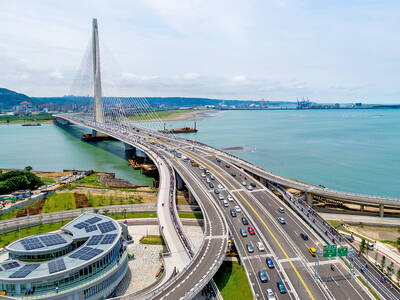
The Ministry of Transportation and Communications yesterday inaugurated the Danjiang Bridge across the Tamsui River in New Taipei City, saying that the structure would be an architectural icon and traffic artery for Taiwan. Feted as a major engineering achievement, the Danjiang Bridge is 920m long, 211m tall at the top of its pylon, and is the longest single-pylon asymmetric cable-stayed bridge in the world, the government’s Web site for the structure said. It was designed by late Iraqi-British architect Zaha Hadid. The structure, with a maximum deck of 70m, accommodates road and light rail traffic, and affords a 200m navigation channel for boats,
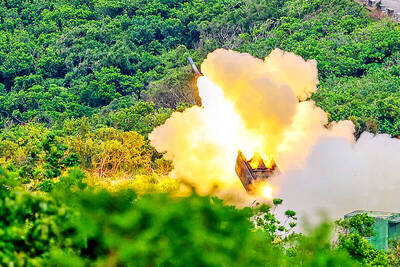
PRECISION STRIKES: The most significant reason to deploy HIMARS to outlying islands is to establish a ‘dead zone’ that the PLA would not dare enter, a source said A High Mobility Artillery Rocket System (HIMARS) would be deployed to Penghu County and Dongyin Island (東引) in Lienchiang County (Matsu) to force the Chinese military to retreat at least 100km from the coastline, a military source said yesterday. Taiwan has been procuring HIMARS and Army Tactical Missile Systems (ATACMS) from the US in batches. Once all batches have been delivered, Taiwan would possess 111 HIMARS units and 504 ATACMS, which have a range of 300km. Considering that “offense is the best defense,” the military plans to forward-deploy the systems to outlying islands such as Penghu and Dongyin so that
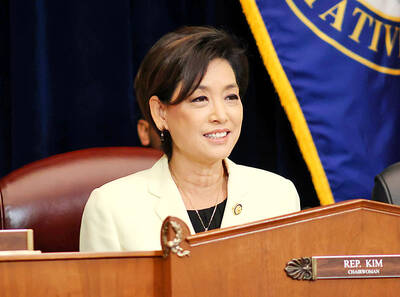
‘CLEAR MESSAGE’: The bill would set up an interagency ‘tiger team’ to review sanctions tools and other economic options to help deter any Chinese aggression toward Taiwan US Representative Young Kim has introduced a bill to deter Chinese aggression against Taiwan, calling for an interagency “tiger team” to preplan coordinated sanctions and economic measures in response to possible Chinese military or political action against Taiwan. “[Chinese President] Xi Jinping [習近平] has directed the People’s Liberation Army to be ready to invade Taiwan by 2027. China has a plan. America should have one too,” Kim said in a news release on Thursday last week. She introduced the “Deter PRC [People’s Republic of China] aggression against Taiwan act” to “ensure the US has a coordinated sanctions strategy ready should

TAIWAN ISSUE: US treasury secretary Scott Bessent said on the first day of meetings that ‘it wouldn’t be a US-China summit without the Taiwan issue coming up’ There were no surprises on the first day of the summit between US President Donald Trump and Chinese President Xi Jinping (習近平), the Mainland Affairs Council (MAC) said yesterday, as the government reiterated that cross-strait stability is crucial to the Asia-Pacific region, as well as the world. As the two presidents met for a highly anticipated summit yesterday, Chinese state media reported that Xi warned Trump that missteps regarding Taiwan could push their two countries into “conflict.” Trump arrived in China with accolades for his host, calling Xi a “great leader” and “friend,” and extending an invitation to visit the White House


 RSS
RSS