


Thirty US Special Forces members arrived in attack helicopters on the war-torn southern island of Basilan yesterday to train Filipino soldiers fighting Muslim extremists who hold two American hostages.
The arrival of the soldiers, who descended in a cloud of dust whirled up by rotor wind so fierce it ripped tops off three coconut trees, started a dangerous phase to the US mission to help the Philippines battle Abu Sayyaf rebels holding two Americans and a Filipina hostage on Basilan.
The operation opens a new front in the US war on terrorism and marks the second biggest US counter-terrorism deployment, after Afghanistan.
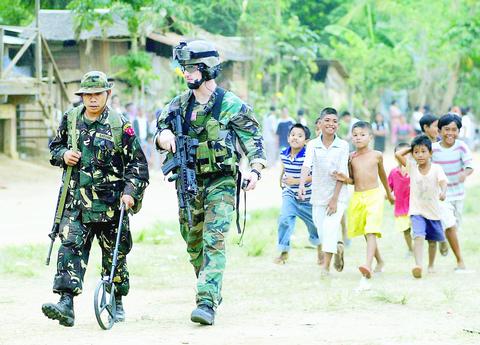
PHOTO: AP
The Special Forces members, an advance team of a contingent to number 160 in coming days, was to deploy shortly to other bases on the island, exposing them to risk of assault or ambush by some of the 80 or so ragged Muslim guerrillas who have vowed stiff opposition.
"We will take all measures to defend ourselves," said US Special Forces Lieutenant Colonel David Maxwell who arrived with his men yesterday at the Tabiawan army base, a jumble of bamboo huts, crowing roosters and grazing goats amid mahogany and coconut trees.
For security, one attack helicopter whirred overhead while the other landed in a helipad area beside a pile of rockets and crates.
Danger to US troops was underscored Saturday when one grenade exploded on the nearby island of Jolo and another in a cinema in Zamboanga city, across a strait from Basilan, killing at least five people and injuring dozens. Officials suspected the Abu Sayyaf but said the blasts won't affect the military exercise.
The Zamboanga blast was about 6km from the Philippine military's Southern Command headquarters, where more than 250 American military support personnel are staying. The US contingent is to grow to 660 in coming weeks.
Besides helping train the Philippine army in night fighting, night flying and psychological operations, Maxwell said his men will learn something too from the poorly equipped soldiers who have been fighting Muslim insurgencies for years.
The counter-terrorism trainers arrived in Zamboanga on Saturday and underwent a cultural sensitivity seminar before deploying to Basilan.
"We were informed of the unique culture here," Maxwell said. "One thing we have learned in the sensitivity seminar is not to publicly show affection. We know we should not extend our hand unless we are offered."
A Philippine militiaman guarding the Tabiawan camp with a World War II-era rifle said the sophisticated Special Forces will boost military strength but said he preferred his simple equipment and experience.
"They have the latest guns with scopes but I love my M-14 [rifle]," he said. "I wonder if those guns can do the work in the mountains."
Philippine Colonel Alexander Aleo, commander of the camp, said some of the US forces will soon deploy to a Philippine Marines base and a Philippine army base in more remote parts of Basilan, near where soldiers have recently clashed with guerrillas.
The jungle-covered mountains of Basilan have been home to American missionary couple Martin and Gracia Burnham of Wichita, Kansas, and Filipino nurse Deborah Yap since they were seized by the Abu Sayyaf in a kidnapping rampage that began last May.
Officials said the Burnhams were last sighted Jan. 27 in the Sampinit mountain area in central Basilan. Only about 80 guerrillas are thought to operate on the island, including around 30 guarding the hostages. About 5,000 Filipino soldiers have been deployed to Basilan since June last year.
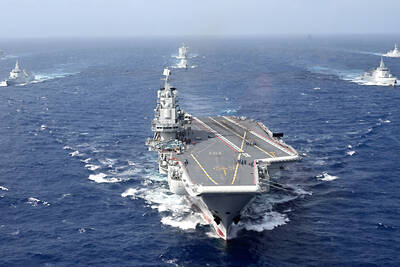
PROVOCATIVE: Chinese Deputy Ambassador to the UN Sun Lei accused Japan of sending military vessels to deliberately provoke tensions in the Taiwan Strait China denounced remarks by Japan and the EU about the South China Sea at a UN Security Council meeting on Monday, and accused Tokyo of provocative behavior in the Taiwan Strait and planning military expansion. Ayano Kunimitsu, a Japanese vice foreign minister, told the Council meeting on maritime security that Tokyo was seriously concerned about the situation in the East China and South China seas, and reiterated Japan’s opposition to any attempt to change the “status quo” by force, and obstruction of freedom of navigation and overflight. Stavros Lambrinidis, head of the EU delegation to the UN, also highlighted South China Sea
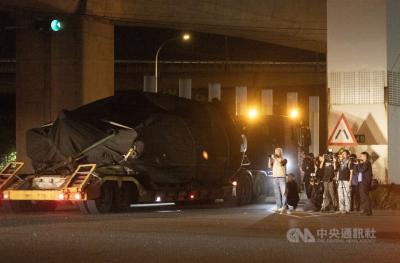
The final batch of 28 M1A2T Abrams tanks purchased from the US arrived at Taipei Port last night and were transported to the Armor Training Command in Hsinchu County’s Hukou Township (湖口), completing the military’s multi-year procurement of 108 of the tanks. Starting at 12:10am today, reporters observed more than a dozen civilian flatbed trailers departing from Taipei Port, each carrying an M1A2T tank covered with black waterproof tarps. Escorted by military vehicles, the convoy traveled via the West Coast Expressway to the Armor Training Command, with police implementing traffic control. The army operates about 1,000 tanks, including CM-11 Brave Tiger
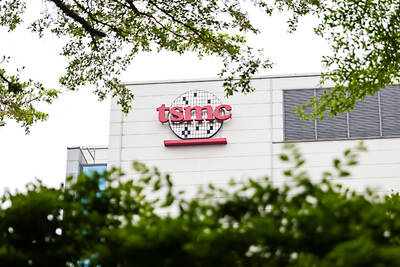
Taiwan Semiconductor Manufacturing Co (TSMC, 台積電), the world’s largest contract chipmaker, said it expects its 2-nanometer (2nm) chip capacity to grow at a compound annual rate of 70 percent from this year to 2028. The projection comes as five fabs begin volume production of 2-nanometer chips this year — two in Hsinchu and three in Kaohsiung — TSMC senior vice president and deputy cochief operating officer Cliff Hou (侯永清) said at the company’s annual technology symposium in Silicon Valley, California, last week. Output in the first year of 2-nanometer production, which began in the fourth quarter of last year, is expected to
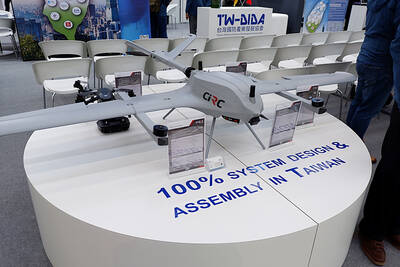
Taiwan’s drone exports surged past US$100 million in the first quarter, exceeding last year’s full-year total, with the Czech Republic emerging as the largest buyer, the Ministry of Economic Affairs said. Exports of complete drones reached US$115.85 million in the period, about 1.2 times the total recorded for all of last year, the ministry said in a report. Exports to the Czech Republic accounted for about US$100 million, far outpacing other markets. Poland, last year’s top destination, recorded about US$11.75 million in the first quarter. Taiwan’s drone exports have expanded rapidly in the past few years, with last year’s total


 RSS
RSS