


While legislative Speaker Wang Jin-pyng (
The loss of the vice-speakership was greeted with anger by the DPP.
Wang received a total of 218 votes -- a resounding 97 percent of the ballot -- making him the most popular legislative speaker in history to win re-election.
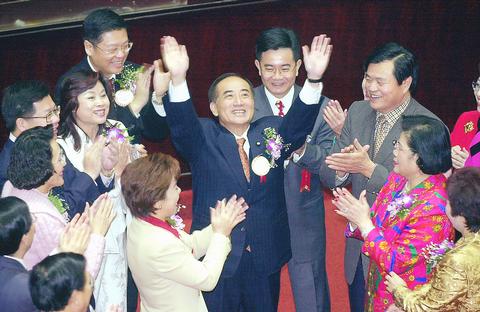
PHOTO: CHIANG YING-YING, TAIPEI TIMES
Hong, who received 108 votes in the first round, eventually lost to the KMT's Chiang Ping-kun (
A second round was held because neither candidate managed to secure enough votes to win outright.
With 225 seats in the legislature, a candidate needs to garner more than half of the total number, or 113 votes, to win.
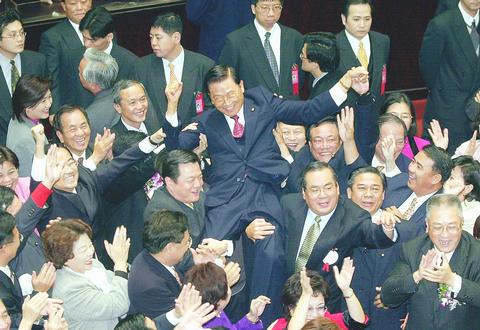
PHOTO: CHIANG YING-YING, TAIPEI TIMES
After offering his congratulations to the new speaker and vice speaker, Hong said that he hoped the new partnership would work with opposition parties to increase legislative efficiency and improve the image of the lawmaking body.
"The end of these elections marks the beginning of a brand new political climate," Hong said.
Wang declared himself victorious by the time his vote tally reached 113.
Of the seven votes Wang failed to secure, one each went to the DPP's Lu Po-chi (
When asked yesterday afternoon before the vice speaker's election whether he would endorse Hong, Wang said only that that he would "respect the choice of the people."
Before the election for speakership began at 10:30am, the DPP legislative caucus held a meeting to publicly endorse Wang in the hope that he would reciprocate the goodwill and endorse Hong's bid in the vice speakership race.
"The DPP showed a tremendous amount of goodwill by unanimously supporting Wang. By the same token, we hope to see this goodwill reciprocated," Hong said.
Hong said that the decision was made for the sake of legislative stability.
"We'd like to see Wang not just re-elected, but by an overwhelming majority. In addition, we'd like to see him remain politically neutral should he be re-elected," he said.
Asked whether the DPP caucus had reached any agreement with the KMT on the matter, Hong said that the KMT should "get the message" although they had not signed any official agreement with them.
DPP legislative whip Tsai Huang-liang (蔡煌琅) said that he was confident and optimistic that Hong would win the vice speakership yesterday afternoon.
"I'm sure there are many KMT members who agree with us that only DPP-KMT cooperation can improve the relationship between the executive and legislative branches," Tsai said.
In contrast to the DPP's act of goodwill, the KMT held a caucus meeting at midday to warn party members that they risked losing their party membership should they vote for non-KMT candidates.
"The caucus has unanimously approved supporting Chiang's bid for the vice-speakership. Those who fail to act in accordance face the consequence of having their membership revoked," said party spokesman Wu Ching-ji (
Although voting went smoothly in the morning, verbal and physical clashes erupted during the afternoon session.
Freshman legislator Chang (邱彰) quarrelled with her colleague Chiu Yi-ying (邱議瑩) and others when Chiu Yi-ying was trying to take a peek at her ballot.
The DPP's Chou Po-lun (
The DPP's Chu Hsin-yu (朱星羽) even climbed up onto the podium in a bid to sneak a peek at independent lawmaker Tsai Hau's (蔡豪) ballot while Tsai was trying to vote.
Freshman legislator Yen Ching-piao (
See Stories:
Contest reveals coalition battle
Editorial: A return to the bad old days

A signaling system malfunction disrupted high-speed rail (HSR) services beginning at 8am today, with trains temporarily reduced to three northbound and three southbound trains per hour as authorities conduct inspections. The malfunction occurred on a section of track in Miaoli County during pre-operation checks early this morning, forcing northbound and southbound trains to use a single track, the HSR operator said. The regular schedule has been replaced with three hourly trains offering only nonreserved seating in each direction, stopping at every station, it said, adding that business class cars would still have reserved seating. Departures from terminal stations are scheduled at the top

DRONE CENTRAL: Taiwan aims to become Asia’s democratic hub for drones, with most exports focused on high-quality military-grade models, an official said Taiwan’s drone industry is expected to expand significantly by 2030, producing 100,000 units per month and exporting half of them, the Ministry of Economic Affairs said yesterday. Current drone production capacity is about 15,000 units per month, but the industry can quickly scale up as demand increases, Industrial Development Administration Director-General Chiou Chyou-huey (邱求慧) told a news conference in Taipei. Taiwan’s drone output grew 2.5-fold last year to NT$12.9 billion (US$408.3 million) under a government program to develop the uncrewed vehicle sector, he said. The Executive Yuan in October last year approved plans to invest NT$44.2 billion into domestic production of uncrewed aerial

VERBOSE VESSELS: A CGA cutter and a China Coast Guard exchanged verbal barbs for more than a day in Taiwanese-controlled waters before the Chinese vessel left The Taiwanese and Chinese coast guards had a standoff near the strategically located Pratas Islands (Dongsha Islands, 東沙群島) in the north of the South China Sea, the Coast Guard Administration (CGA) said yesterday. The two sides engaged in intense radio exchanges over sovereignty claims during the 33-hour standoff. China Coast Guard vessel 3501 eventually left the restricted waters, 26.6 nautical miles (49.2km) west of the Pratas Islands, at 5pm yesterday, the CGA said. Lying approximately between southern Taiwan and Hong Kong, the Taiwan-controlled Pratas are seen by some security experts as vulnerable to Chinese attack due to their distance — more than

WARNING: China should stop engaging in actions that undermine regional peace and stability, as it would only build resentment among people across the Strait, the CGA said China has deployed more than 100 navy, coast guard and other vessels in waters from the Yellow Sea to the South China Sea and the western Pacific since US President Donald Trump and Chinese President Xi Jinping (習近平) met in Beijing, National Security Council Secretary-General Joseph Wu (吳釗燮) said yesterday. “In this part of the world, #China is the one & only PROBLEM wrecking the #StatusQuo & threatening regional peace & stability,” Wu wrote on X. In a separate post, he said Beijing was coercing Taiwan’s maritime domain, calling it illegal and provocative, after the Coast Guard Administration (CGA) expelled a


 RSS
RSS