


Premier-designate Yu Shyi-kun yesterday presented his fourth and final round of Cabinet appointees, including the new economic affairs and finance ministers, completing the reshuffled Cabinet which is to be sworn in on Feb. 1.
Lee Yung-shan (
Christine Tsung (
"Expertise, personality and suitability are my main criteria for making the nominations," Yu said, downplaying media speculation that Lee's appointment was a decision made overnight.
Just hours before midnight on Wednesday, Benny Hu (
But according to local media reports, Liu Tai-ying (劉泰英) -- Hu's former boss and current chairman of the CDIB -- opposed the appointment, prompting Yu and President Chen Shui-bian (陳水扁) to reconsider their choice and turn to former president Lee Teng-hui's (李登輝) finance wizard.
Yu stressed yesterday that he had the final say on all Cabinet appointments.
The new finance minister had turned down the offer at least three times before he finally agreed to take the post, Yu said.
Flatly denying that cronyism was also part of the decision-making process for the economic affairs and finance posts, Yu said that his ideal candidates were those with "a combination of industrial, academic and governmental backgrounds."
Assuring the media that they are suited for their new posts, Lee and Tsung yesterday outlined their qualifications for the tasks they have been assigned.
"My widespread contacts within the banking sector and academic circles will facilitate my future role as a bridge between the government and the private sector," Lee said.
Tsung said: "In the US, I had 15 years of experience working for the high-tech industry, a steel company and other traditional industries including the manufacturing sector."
Tsung added that she would soon relinquish her US citizenship before taking office.
Praising his successor, vice premier-designate Lin Hsin-yi (
Lin said he believed the two appointees would serve the people of Taiwan with a "customer-orientated" attitude.
Lee, 63, who holds a PhD in economics from the University of Wisconsin, had previously served as president of Chiao Tung Bank (交通銀行) and director of the Institute of Economics at Academia Sinica.
Tsung, 54, earned an MBA from the University of Missouri and studied management for one year at Washington University's graduate school before she worked as a marketing manager with Columbia Pictures and subsequently deputy CEO with US consumer-electronics company Electrolux.
She also served as a finance officer for the city government of Poway, near San Diego, California.
Other appointments yesterday included Lin Lin-san (林陵三) -- who will be promoted from vice minister to head up the Ministry of Transportation and Communications.
Meanwhile, Lin's predecessor Yeh Chu-lan (
Incoming Minister without Portfolio Kuo Yao-chi (
Hu Sheng-cheng (
Ouyang Min-shen (
Altogether Yu's new Cabinet contains 39 members, of which 23 posts have changed hands and 16 have been retained by members of the previous Cabinet. With an average age of 53, 31 are male and eight are female.Also See Stories:
Observers say DPP gaining confidence
Newsmakers: Huang returns to education fold
Newsmakers: New GIO head boasts diverse experience
Editorial: Economics picks boost confidence
New MOEA chief turns some heads
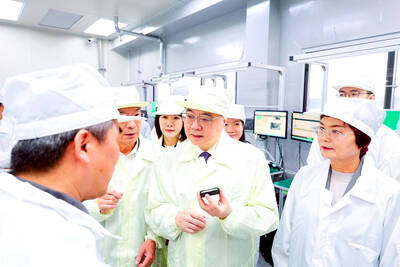
KEY INDUSTRY: The vice premier discussed a plan to create a non-red drone supply chain by next year, which has been allocated a budget of more than NT$7.2 billion The government has budgeted NT$44.2 billion (US$1.38 billion) to cultivate Taiwan’s uncrewed aerial vehicle (UAV) industry over the next five years, which would make the nation a major player in the industry’s democratic supply chain in the Asia-Pacific region, Premier Cho Jung-tai (卓榮泰) said yesterday. Cho made the remarks during a visit to the facilities of Cub Elecparts Inc (為升電裝). Democratic Progressive Party (DPP) Legislator Chen Su-yueh (陳素月) and Chinese Nationalist Party (KMT) Legislator Hsieh Yi-fong (謝依鳳) also participated in the trip. Cub Elecparts has transitioned from the automotive industry to the defense industry, which is the top priority among the nation’s
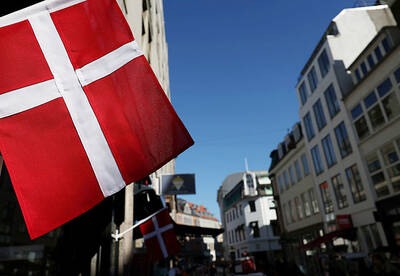
‘UNFRIENDLY’: Changing the nationality listing of Taiwanese residents to ‘China’ goes against EU foreign policy as well as democratic and human rights principles, MOFA said Taiwan yesterday called on Denmark to correct its designation of the nationality of Taiwanese residents as “China” or face retaliatory measures. The Danish government in 2024 changed the nationality of Taiwanese citizens on their residence permits from “Taiwan” to “China.” The decision goes against EU foreign policy and contravenes democratic and human rights principles, Ministry of Foreign Affairs (MOFA) spokesman Hsiao Kuang-wei (蕭光偉) said. Denmark should present a solution acceptable to Taiwan as soon as possible and correct the erroneous designation to preserve the longstanding friendship between the two nations, Hsiao said. The issue could damage Denmark’s image and business reputation in Taiwan,
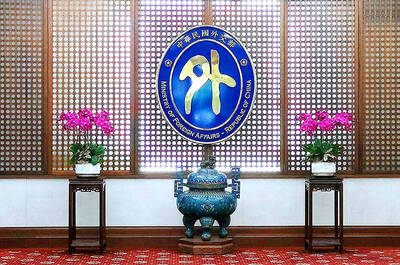
SOUTH KOREA DISPUTE: If Seoul continues to ignore its request, Taiwan would change South Korea’s designation on its arrival cards, the foreign ministry said If South Korea does not reply appropriately to a request to correct Taiwan’s name on its e-Arrival card system before March 31, the government would take corresponding measures to change how South Korea is labeled on the online Taiwan Arrival Card system, the Ministry of Foreign Affairs said yesterday. South Korea’s e-Arrival card system lists Taiwan as “China (Taiwan)” in the “point of departure” and “next destination” fields. Taipei has asked Seoul to change the wording. Since March 1, South Koreans who hold government-issued Alien Resident Certificates (ARC) have been identified as from “South Korea” rather than the “Republic of Korea,” the
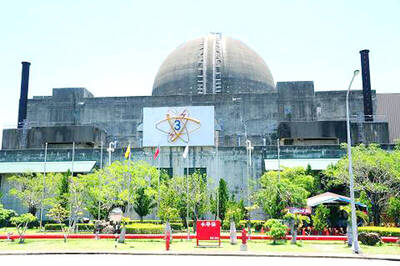
SUFFICIENT: The president said Taiwan has enough oil for next month, with reserves covering more than 100 days and natural gas enough for 12 to 14 days A restart plan for the Guosheng Nuclear Power Plant in New Taipei City’s Wanli District (萬里) and the Ma-anshan Nuclear Power Plant in Pingtung County’s Hengchun Township (恆春) would be submitted to the Nuclear Safety Commission by the end of the month, President William Lai (賴清德) said yesterday, reversing the government’s policy to abolish nuclear energy. On May 17 last year, Taiwan shut down its last nuclear reactor and became the first non-nuclear nation in East Asia, fulfilling the Democratic Progressive Party (DPP) government’s pledge of a “nuclear-free homeland.” Even without nuclear power, Taiwan can maintain a stable electricity supply until 2032,


 RSS
RSS