


Australian maverick politician Pauline Hanson, who founded the anti-Asian and right-wing One Nation Party, resigned as its leader yesterday, saying she needed time to concentrate on clearing her name of fraud allegations.
The decision took many of her party members by surprise, but political analysts had been predicting Hanson's exit after One Nation failed to win any seats in national elections late last year.
"It was my decision to hand in my resignation as national president," Hanson said yesterday. "I've constantly got these court battles and challenges, and I couldn't do the job."
Hanson, 47, and former One Nation director David Ettridge have been charged over the alleged fraudulent registration of the political party in 1997.
The pair is due in court in April. The charge carries a maximum 10-year prison sentence. Both have pleaded innocent in a pre-trial hearing.
"I do believe it's a political witch hunt, and a lot of people don't have faith in the justice system -- and I'm fighting the justice system," Hanson said.
The fraud case was one of seven pending legal challenges, Hanson said. She did not give details.
The former fish-and-chip shop owner from Queensland state entered Australian politics in 1996 as an independent legislator in the House of Representatives.
In her maiden speech, Hanson said Australia was in danger of being "swamped" by Asians, and also argued against providing welfare handouts to Aborigines, the nation's underprivileged indigenous minority.
In 1998, Hanson's newly formed One Nation party rose to prominence by attracting almost a quarter of the vote in Queensland state elections to win 11 seats in the legislature. At a 1998 federal election, the party won almost 9 percent of the vote nationally.
However, One Nation failed to win a seat in the most recent national election in November, and Hanson lost her own bid for a Senate seat. Analysts said Hanson had been marginalized as international security issues saw voters concentrating on Australia's two main parties, the Liberals and the opposition Labor Party.
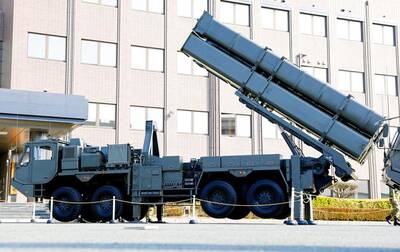
Japan has deployed long-range missiles in a southwestern region near China, the Japanese defense minister said yesterday, at a time when ties with Beijing are at their lowest in recent years. The missiles were installed in Kumamoto in the southern region of Kyushu, as Japan is attempting to shore up its military capacity as China steps up naval activity in the East China Sea. “Standoff defense capabilities enable us to counter the threat of enemy forces attempting to invade our country ... while ensuring the safety of our personnel,” Japanese Minister of Defense Shinjiro Koizumi said. “This is an extremely important initiative for

Chinese Nationalist Party (KMT) Chairwoman Cheng Li-wun (鄭麗文) today accepted an invitation from Chinese President Xi Jinping (習近平) to lead a delegation to China next month, saying she hopes to promote the peaceful development of cross-strait relations and bring stability to the Taiwan Strait. “I am grateful and happy to accept this invitation,” Cheng said in a statement from the KMT chairperson’s office. Cheng said she hopes both sides can work together to promote the peaceful development of cross-strait relations, enhance exchange and cooperation, bring stability to the Taiwan Strait and improve people’s livelihoods. At today's news conference, Cheng said any efforts to

MORE POPULAR: Taiwan Pass sales increased by 59 percent during the first quarter compared with the same period last year, the Tourism Administration said The Tourism Administration yesterday said that it has streamlined the Taiwan Pass, with two versions available for purchase beginning today. The tourism agency has made the pass available to international tourists since 2024, allowing them to access the high-speed rail, Taiwan Railway Corp services, four MRT systems and four Taiwan Tourist Shuttles. Previously, five types of Taiwan Pass were available, but some tourists have said that the offerings were too complicated. The agency said only two types of Taiwan Pass would be available, starting from a three-day pass with the high-speed rail and a three-day pass with Taiwan Railway Corp. The former costs NT$2,800

The nation’s fastest supercomputer, Nano 4 (晶創26), is scheduled to be launched in the third quarter, and would be used to train large language models in finance and national defense sectors, the National Center for High-Performance Computing (NCHC) said. The supercomputer, which would operate at about 86.05 petaflops, is being tested at a new cloud computing center in the Southern Taiwan Science Park in Tainan. The exterior of the server cabinet features chip circuitry patterns overlaid with a map of Taiwan, highlighting the nation’s central position in the semiconductor industry. The center also houses Taiwania 2, Taiwania 3, Forerunner 1 and


 RSS
RSS