


President Chen Shui-bian (
The newly established research institute, which was organized by close aides to Chen and heavyweights from academic and industry circles, is regarded as "President A-bian's brain trust."
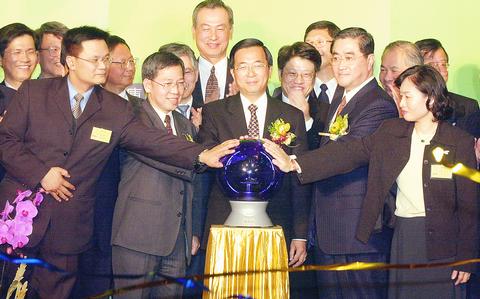
PHOTO: CHIANG YING-YING, TAIPEI TIMES
Speaking at the Taiwan Thinktank's inauguration ceremony yesterday, Chen said he believes the institute will become the government's partner and help in coming up with suggestions for policy-making.
"Taiwan must step up the pace of recruiting talent," Chen said.
Though the think tank was just launched yesterday, eight forums under its auspices have taken place over the past year, said Lin Chia-lung (林佳龍), a senior advisor to the National Security Council and a key player with the Taiwan Thinktank.
"[Up for discussion were] issues about WTO entry, government restructuring and the agenda of the Economic Development Advisory Conference," Lin said.
The inauguration ceremony took place at the Far Eastern Hotel yesterday. Chen, Premier Chang Chun-hsiung (
Chen, speaking at the ceremony, said that the date the Taiwan Thinktank was formed would be marked in history. He said he expects its formation would bridge the gap "between knowledge and policy," create "an alliance between the private sector and the government," and facilitate "an integration of talent and resources."
The president stressed that an independent think tank is an indispensable partner for a democratic government. But he also added that cooperation between the two does not mean that the government would control the think tank.
"The alliance between the private sector and the government is manifested by the process in which the industrial and academic elite can effectively participate in the policy-making process," Chen said.
"But while the government is replaced periodically, think tanks are not," Chen added.
The president also said he expects that the Taiwan Thinktank would cultivate the nation's brainpower and improve Taiwan's performance when facing global competition.
"What we call a think tank is actually a talent tank," Chen said. "We hope that the Taiwan Thinktank can help integrate the talent and resources and mobilize knowledge in the private sector. This will elevate the level of a whole generation of Taiwanese talent ... which will turn into a new generation of national leaders."
One of the think tank's founders, Ko Chen-en (柯承恩), dean of National Taiwan University's College of Management, said the establishment of the Taiwan Thinktank was the result of efforts in academic, economic and political circles to seek solutions to the challenges faced by the nation.
"Taiwan has faced unprecedented challenges. ? The government is contemplating measures to push for legislative reform while enterprises are seeking ways to set in motion business transformation," Ko said.
Ko also lamented what he termed the "sarcastic ridicule" in domestic politics, saying he expects the new think tank would instead trigger rational debate on policy.
TSU Chairman Huang told reporters that former president Lee Teng-hui (
"Former president Lee's Taiwan Advocates (群策會) is meant to combine knowledge with the government's policy. The ultimate goals are to develop the economy, stabilize politics and strengthen Taiwan, and the forums under the Taiwan Thinktank have similar missions. These two think tanks have their respective functions and are not mutually exclusive," Huang said.
Apart from Lin Chia-lung and Ko Chen-en, the 15 members of the Taiwan Thinktank's board also include Taiwan Stock Exchange Chairman Lin Jong-shong (
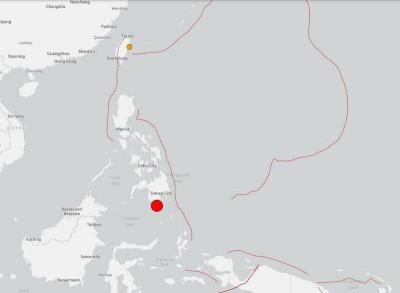
A magnitude 7.8 earthquake struck off the southern coast of Mindanao in the Philippines at 7:38am today, prompting the US Tsunami Warning System to issue an alert for neighboring countries, including Taiwan. The system issued a purple alert indicating a "tsunami threat." The potential threat zone includes Taiwan, the Philippines, Papua New Guinea, Yap and Palau. Philippine authorities were assessing the damage from the quake, with the office of civil defense seeking to verifying initial reports that 15 people had been killed and 129 injured in the region, mostly from falling debris. Arlene Hollero, disaster chief of Maasim town in the Philippines' Sarangani Province,
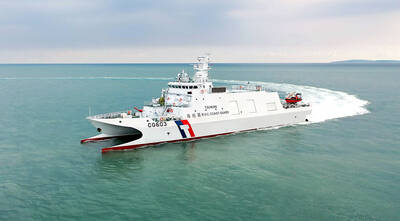
‘GRAY ZONE’ PRESSURE: Beijing’s activities are intended to create the deceitful impression that China has jurisdiction over the area around Taiwan, the CGA said Taiwan’s rights over its territorial waters and exclusive economic zone must not be violated by any country, the Mainland Affairs Council said yesterday, adding that it will not accept any unprovoked actions. The council issued the remarks in response to the China Coast Guard conducting maritime enforcement drills near eastern Taiwan and claiming to fully exercise China’s maritime administrative law enforcement authority. The Coast Guard Administration (CGA) has been closely monitoring the situation and is taking concrete steps to defend the nation’s sovereignty and secure its waters, the council said. China has no sovereign rights over the waters off eastern
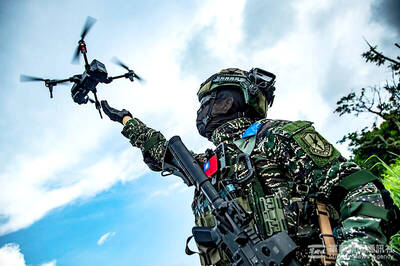
RESILIENCE: Taiwan plays a key role in semiconductors, energy, information infrastructure and advanced manufacturing, AIT Director Raymond Greene said Taiwan’s continued investment in deterrence and resilience remains vital, especially in uncrewed systems and other emerging technologies, American Institute in Taiwan (AIT) Director Raymond Greene said yesterday. Greene made the remarks at the annual National Strategic Summit on Supply Chain Resilience held by the Research Institute for Democracy, Society and Emerging Technology (DSET), a government-backed think tank. As Taiwan last year became the US’ fourth-largest trading partner and supply chain security is becoming more important, cooperation in emerging technologies continues to deepen between the two countries, he said. The US is committed to accelerating innovation, building key infrastructure, strengthening cooperation

The National Chungshan Institute of Science and Technology yesterday showcased its locally developed variants of the Vision 60 robotic patrol dog, which it plans to deploy on the nation’s outlying territories in the South China Sea. The variants were produced under the Joint Lab project — created by the institute and domestic companies — and assembled with domestically produced motors, lenses and artificial intelligence (AI) systems alongside licensed tech from the US, Missile and Rocket Systems Research Division deputy director Jen Kuo-kang (任國光) told the media event at a military base in Taipei’s Dazhi (大直) area. Taiwan has built up its strengths


 RSS
RSS