


President Chen Shui-bian (
The two made the pledge despite DPP setbacks in the city mayoral and county commissioner polls two weeks ago.
The DPP, which controlled 12 districts in 1997, won just nine city and county districts this time around. The KMT, which previously controlled eight counties, was victorious in nine districts.
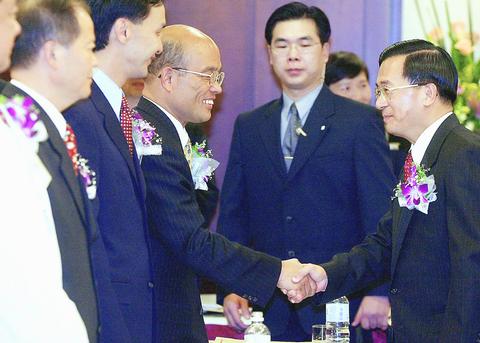
PHOTO: CHU PEI-HSIUNG, TAIPEI TIMES
Independent candidates and the People First Party (PFP) captured two districts each, while the New Party took only Kinmen County.
Addressing a meeting of 23 newly elected city mayors and county commissioners yesterday afternoon, Chen said that he will use his power to try to strengthen the relationship between the central and local governments.
"The relationship between central and local governments is like that of partners. We should all work together to benefit democracy and the economy," Chen said. "Since previous administrations failed to do a good job in this, I don't intend to let it happen again."
Chen added that, as times change, government officials should try to adjust accordingly.
"Try to listen more, see more and think more," he said.
To listen more, Chen said, is to listen to the voices of the public and people from different political parties. To see more is to see the future of Taiwan and search for a common consensus and common interests and values, according to Chen.
And to think more, he said, is to ponder how to stabilize the political situation, spur the economy and improve cross-strait relations.
Anticipating local heads would complain about their financial plight, Chang said before the closed-door meeting that the Cabinet will adopt certain measures in a bid to help local governments cope with their fiscal woes.
"In addition to trying to find more money and allocating it more effectively, we'll launch a lobbying campaign at the legislature to release NT$19.4 billion in supplementary public-works subsidies," he said.
Local governments that owe money to the central government will also be allowed to delay their payments until after the Chinese New Year holidays, Chen said.
Meanwhile, local government chiefs across party lines expressed divided views over whether they would participate in two different blocs recently proposed by the KMT and DPP.
After nine newly elected KMT city mayors and county commissioners proposed forming an opposition alliance and inviting Taipei City Mayor Ma Ying-jeou (
Kaohsiung County commissioner-elect Yang Chiu-hsing (楊秋興) of the DPP said that he would like to see the formation of the competing alliance. "By meeting on a regular basis, we can not only reinforce our fellowship but also try to help learn from each other," he said.
Taichung City mayor-elect Jason Hu (
Independent Miaoli County commissioner-elect Fu Hseuh-peng (
Taitung County commissioner-elect Hsu Ching-yuan (
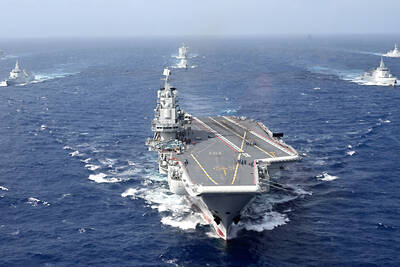
PROVOCATIVE: Chinese Deputy Ambassador to the UN Sun Lei accused Japan of sending military vessels to deliberately provoke tensions in the Taiwan Strait China denounced remarks by Japan and the EU about the South China Sea at a UN Security Council meeting on Monday, and accused Tokyo of provocative behavior in the Taiwan Strait and planning military expansion. Ayano Kunimitsu, a Japanese vice foreign minister, told the Council meeting on maritime security that Tokyo was seriously concerned about the situation in the East China and South China seas, and reiterated Japan’s opposition to any attempt to change the “status quo” by force, and obstruction of freedom of navigation and overflight. Stavros Lambrinidis, head of the EU delegation to the UN, also highlighted South China Sea
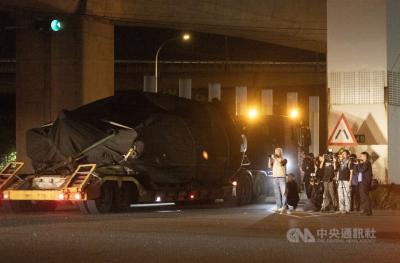
The final batch of 28 M1A2T Abrams tanks purchased from the US arrived at Taipei Port last night and were transported to the Armor Training Command in Hsinchu County’s Hukou Township (湖口), completing the military’s multi-year procurement of 108 of the tanks. Starting at 12:10am today, reporters observed more than a dozen civilian flatbed trailers departing from Taipei Port, each carrying an M1A2T tank covered with black waterproof tarps. Escorted by military vehicles, the convoy traveled via the West Coast Expressway to the Armor Training Command, with police implementing traffic control. The army operates about 1,000 tanks, including CM-11 Brave Tiger
Taiwan Semiconductor Manufacturing Co (TSMC, 台積電), the world’s largest contract chipmaker, said it expects its 2-nanometer (2nm) chip capacity to grow at a compound annual rate of 70 percent from this year to 2028. The projection comes as five fabs begin volume production of 2-nanometer chips this year — two in Hsinchu and three in Kaohsiung — TSMC senior vice president and deputy cochief operating officer Cliff Hou (侯永清) said at the company’s annual technology symposium in Silicon Valley, California, last week. Output in the first year of 2-nanometer production, which began in the fourth quarter of last year, is expected to
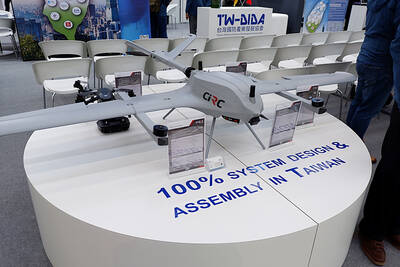
Taiwan’s drone exports surged past US$100 million in the first quarter, exceeding last year’s full-year total, with the Czech Republic emerging as the largest buyer, the Ministry of Economic Affairs said. Exports of complete drones reached US$115.85 million in the period, about 1.2 times the total recorded for all of last year, the ministry said in a report. Exports to the Czech Republic accounted for about US$100 million, far outpacing other markets. Poland, last year’s top destination, recorded about US$11.75 million in the first quarter. Taiwan’s drone exports have expanded rapidly in the past few years, with last year’s total


 RSS
RSS