


The APEC summit ended in Shanghai yesterday with a declaration on countering terrorism -- the first ever political statement in the economic forum's history.
The group also said a new round of WTO talks should be launched.
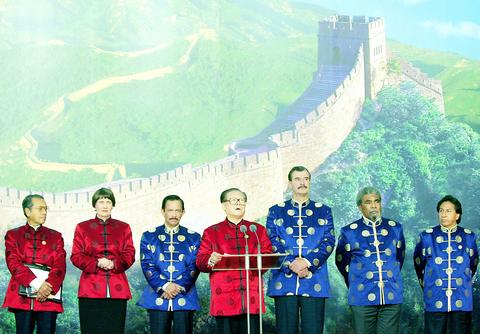
PHOTO: AP
"Leaders unequivocally condemn in the strongest terms the terrorist attacks in the United States on 11 September 2001," said Chinese President Jiang Zemin (江澤民), reading from the APEC leaders' statement on counter-terrorism yesterday.
The role of the UN in combating terrorism received a special mention in the declaration. China strongly endorsed its stance.
The statement also calls for the early signing and ratification of all basic universal anti-terrorist conventions, including the International Convention for the Suppression of the Financing of Terrorism.
The emphasis on signing and ratification of related international conventions, observers said, is to put political pressure on countries such as Japan that have yet to ratify the document.
Yukio Satoh, Japan's permanent representative to the UN, said on Oct. 2 that Japan intends to sign the financing convention by the end of this year.
The statement listed specific measures to combat terrorism -- such as appropriate financial measures to prevent the flow of funds to terrorists and enhancing the security of airports, aircraft and ports.
Pacific Rim leaders "pledge to cooperate fully to ensure that international terrorism does not disrupt economies and markets, through close communication and cooperation among economic policy and financial authorities."
In another statement dubbed the APEC Economic Leaders' Declaration, the grouping gave its support to the launch of new trade talks at the WTO ministerial meeting set for Doha, Qatar, in early November.
"We strongly support the launch of the new WTO round at the conference, recognizing that the current slowdown in the world economy has added to its urgency," the statement said, adding "a balanced, sufficiently broad-based agenda" should be the foundation for the new talks.
"Having reached such a consensus is important as APEC accounts for half of the global economy and trade," Jiang said at a press conference that marked the end of the two-day summit.
As well as "applauding" the conclusions of related negotiations on China's WTO accession, the statement also reiterated "strong support for the final approval of Taiwan's accession at the Doha meeting."
Observers said the Taiwan issue -- under APEC -- would become increasingly sticky as the forum gradually started tackling political issues.
"It's a long-term trend for APEC to gradually transform itself into tackling politics, and the development is inevitable," said Yoichi Funabashi, chief diplomatic correspondent for the Asahi Shimbun newspaper, who was in Shanghai to attend related APEC meetings.
"[The] Taiwan issue will become much more sticky as APEC becomes more and more political," Funabashi said.
Saying Taiwan's absence from the summit in Shanghai made him feel "sad," Funabashi said: "Taiwan should be more creative in participating in the forum," otherwise, "Taiwan will end up marginalizing itself."
The anti-terrorism statement made no mention of the US-led attacks on Afghanistan, which are opposed by Muslim-majority APEC members Indonesia and Malaysia.
The US downplayed the absence from the APEC statement of a mention of the Taliban or terrorist suspect Osama bin Laden.
The omissions were "not a setback," a US official said on condition of anonymity. "What we were looking for was what we got. We didn't need more from this group."
The official cited the agreements on hunting down terrorist funds and references to the UN Charter's self-defense clause as victories for the White House stand.
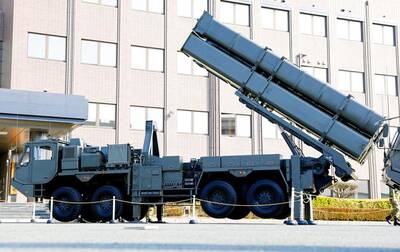
Japan has deployed long-range missiles in a southwestern region near China, the Japanese defense minister said yesterday, at a time when ties with Beijing are at their lowest in recent years. The missiles were installed in Kumamoto in the southern region of Kyushu, as Japan is attempting to shore up its military capacity as China steps up naval activity in the East China Sea. “Standoff defense capabilities enable us to counter the threat of enemy forces attempting to invade our country ... while ensuring the safety of our personnel,” Japanese Minister of Defense Shinjiro Koizumi said. “This is an extremely important initiative for
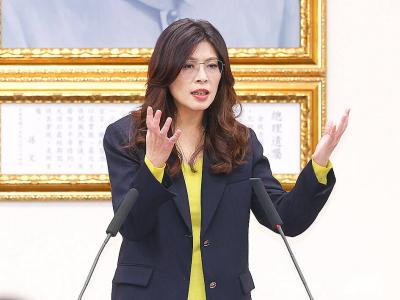
Chinese Nationalist Party (KMT) Chairwoman Cheng Li-wun (鄭麗文) today accepted an invitation from Chinese President Xi Jinping (習近平) to lead a delegation to China next month, saying she hopes to promote the peaceful development of cross-strait relations and bring stability to the Taiwan Strait. “I am grateful and happy to accept this invitation,” Cheng said in a statement from the KMT chairperson’s office. Cheng said she hopes both sides can work together to promote the peaceful development of cross-strait relations, enhance exchange and cooperation, bring stability to the Taiwan Strait and improve people’s livelihoods. At today's news conference, Cheng said any efforts to
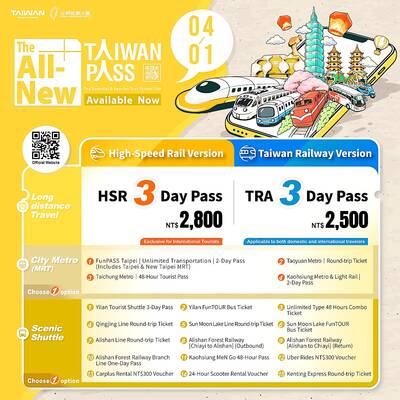
MORE POPULAR: Taiwan Pass sales increased by 59 percent during the first quarter compared with the same period last year, the Tourism Administration said The Tourism Administration yesterday said that it has streamlined the Taiwan Pass, with two versions available for purchase beginning today. The tourism agency has made the pass available to international tourists since 2024, allowing them to access the high-speed rail, Taiwan Railway Corp services, four MRT systems and four Taiwan Tourist Shuttles. Previously, five types of Taiwan Pass were available, but some tourists have said that the offerings were too complicated. The agency said only two types of Taiwan Pass would be available, starting from a three-day pass with the high-speed rail and a three-day pass with Taiwan Railway Corp. The former costs NT$2,800

The nation’s fastest supercomputer, Nano 4 (晶創26), is scheduled to be launched in the third quarter, and would be used to train large language models in finance and national defense sectors, the National Center for High-Performance Computing (NCHC) said. The supercomputer, which would operate at about 86.05 petaflops, is being tested at a new cloud computing center in the Southern Taiwan Science Park in Tainan. The exterior of the server cabinet features chip circuitry patterns overlaid with a map of Taiwan, highlighting the nation’s central position in the semiconductor industry. The center also houses Taiwania 2, Taiwania 3, Forerunner 1 and


 RSS
RSS