


President Chen Shui-bian (
Chen, wearing a cowboy hat and western-style bolo tie, grinned as he emerged from the Taste of Texas restaurant and showed off a pair of custom-made, black eel-skin boots, inlaid with his initials and containing the US and Texas flags.
The boots were a gift from Chen's host, US Representative Tom DeLay, who represents a Houston area constituency and is the majority whip in the House of Representatives.
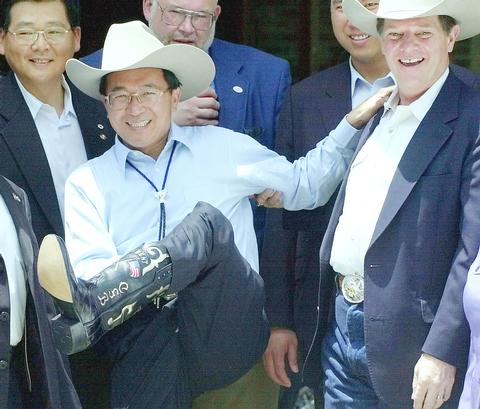
PHOTO: AP
Three other US representatives from the area -- Kevin Brady, Gene Green and Sheila Jackson Lee -- were among some 250 guests who attended the informal steak lunch meeting with Chen.
Chen avoided making any controversial remarks to reporters in Houston, saying only in Mandarin that he was having a good time and that his new boots were a comfortable fit.
Chen also waved to several hundred flag-waving supporters among Houston's Chinese and Taiwanese communities who turned out to greet him and chanted "Taiwan, Yes!"
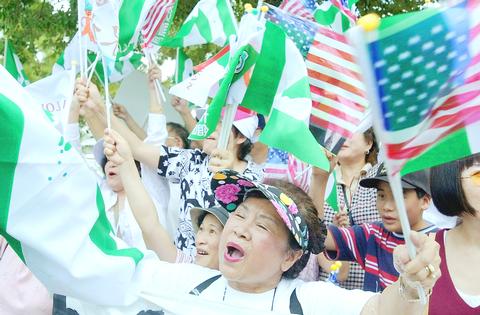
PHOTO: AP
He did not address the crowd.
A slightly smaller group of demonstrators waved Chinese flags and chanted "one China." Police kept the two groups apart and did not report any scuffles.
DeLay told the crowd that the timing of Chen's visit on the eve of the anniversary of the June 4, 1989 crackdown at Beijing's Tiananmen Square was noteworthy.
After the lunch meeting, DeLay accompanied Chen to a baseball game between the Houston Astros and the Los Angeles Dodgers at Enron Field.
Sitting behind home plate, Chen enjoyed Coke and popcorn and chatted with his host during the game.
From his seat, Chen could see supporters sitting in a block behind center field in an upper deck, holding up signs spelling out, "I [heart] Taiwan independence." Thousands of Taiwanese expatriates lifted giant banners, saying, "Welcome President Chen Shui-bian of Taiwan" to give Chen a hearty welcome.
Meanwhile, opponents also sat together in a block along the third base line, holding up their placards with their own message: "Taiwan is a part of China."
Before leaving Houston to head back home, Chen spoke at a dinner held in the Post Oak Doubletree Hotel, where he and his delegation stayed. Chen, full of emotion, said that it was the third time he had visited Houston.
His second visit was 14 years ago, when he was accompanied by his wife and kids. Chen said that in the 14 years since that visit, he had served as a legislator, Taipei mayor and now as the president of Taiwan. He stressed that he even spent time in jail in 1986.
"My hard work over these 14 years also represents the development of Taiwan's democracy," Chen said.
The US State Department gave Chen permission to stop off in the US and meet members of Congress en route to and from Latin America, drawing criticism from China, which sees the stops as a form of diplomatic recognition.
The range of activities undertaken by Chen and the meetings with members of Congress mark a departure from the practice of previous US administrations, which imposed tight restrictions on what visiting Taiwanese leaders could and could not do.
"I think the Communist Chinese need to understand that we have an administration that will no longer kowtow to the Communist Chinese," DeLay said.
The first couple and their delegation are scheduled to arrive at CKS Airport at 7:25 this morning.
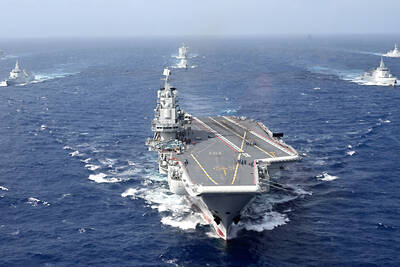
PROVOCATIVE: Chinese Deputy Ambassador to the UN Sun Lei accused Japan of sending military vessels to deliberately provoke tensions in the Taiwan Strait China denounced remarks by Japan and the EU about the South China Sea at a UN Security Council meeting on Monday, and accused Tokyo of provocative behavior in the Taiwan Strait and planning military expansion. Ayano Kunimitsu, a Japanese vice foreign minister, told the Council meeting on maritime security that Tokyo was seriously concerned about the situation in the East China and South China seas, and reiterated Japan’s opposition to any attempt to change the “status quo” by force, and obstruction of freedom of navigation and overflight. Stavros Lambrinidis, head of the EU delegation to the UN, also highlighted South China Sea
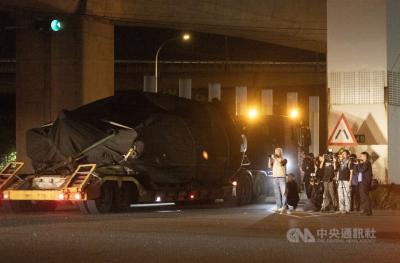
The final batch of 28 M1A2T Abrams tanks purchased from the US arrived at Taipei Port last night and were transported to the Armor Training Command in Hsinchu County’s Hukou Township (湖口), completing the military’s multi-year procurement of 108 of the tanks. Starting at 12:10am today, reporters observed more than a dozen civilian flatbed trailers departing from Taipei Port, each carrying an M1A2T tank covered with black waterproof tarps. Escorted by military vehicles, the convoy traveled via the West Coast Expressway to the Armor Training Command, with police implementing traffic control. The army operates about 1,000 tanks, including CM-11 Brave Tiger
Taiwan Semiconductor Manufacturing Co (TSMC, 台積電), the world’s largest contract chipmaker, said it expects its 2-nanometer (2nm) chip capacity to grow at a compound annual rate of 70 percent from this year to 2028. The projection comes as five fabs begin volume production of 2-nanometer chips this year — two in Hsinchu and three in Kaohsiung — TSMC senior vice president and deputy cochief operating officer Cliff Hou (侯永清) said at the company’s annual technology symposium in Silicon Valley, California, last week. Output in the first year of 2-nanometer production, which began in the fourth quarter of last year, is expected to
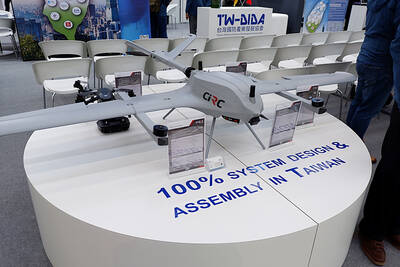
Taiwan’s drone exports surged past US$100 million in the first quarter, exceeding last year’s full-year total, with the Czech Republic emerging as the largest buyer, the Ministry of Economic Affairs said. Exports of complete drones reached US$115.85 million in the period, about 1.2 times the total recorded for all of last year, the ministry said in a report. Exports to the Czech Republic accounted for about US$100 million, far outpacing other markets. Poland, last year’s top destination, recorded about US$11.75 million in the first quarter. Taiwan’s drone exports have expanded rapidly in the past few years, with last year’s total


 RSS
RSS