


Muslim rebels yesterday claimed responsibility for the kidnapping of three Americans and 17 Filipinos from a southern Philippine resort and put one of the Americans on radio to back their claim.
"We are admitting it, we are the ones who did it," Abu Sabaya, a spokesman for the Abu Sayyaf rebels, told the DXRV radio station in a telephone call.
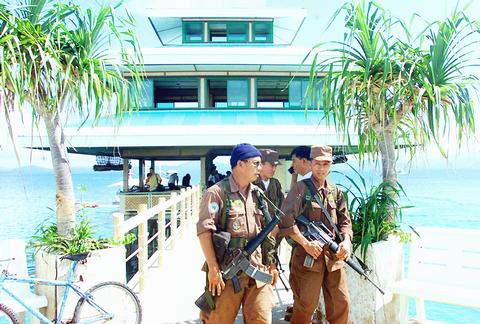
PHOTO: REUTERS
He said the 20 hostages had been divided into two groups and were on Basilan and Jolo, two neighboring islands in the south where the guerrilla group has set up jungle camps.
The Abu Sayyaf gained notoriety last year for abducting some 40 people, including several Western tourists from a Malaysian resort, and receiving ransoms of up to US$1 million for many of them.
The latest victims were kidnapped around dawn on Sunday from the Dos Palmas island resort, some 480km to the northwest across the Sulu Sea, and the group has evaded a dragnet spread by the Philippine navy and air force.
Martin Burnham, a 41-year-old missionary and one of the three Americans among the hostages, also spoke to the radio station and said: "Hi, I am Mr Martin Burnham, a US citizen. I am a missionary. I am with my wife, we are in the custody of the Abu Sayyaf under Khadafy Janjalani ... We are safe, our needs are being met. We would like to appeal to all for a reasonable and safe negotiation."
Filipino travel journalist Raul Recio also spoke on the phone, with a similar message.
Janjalani heads one of the factions of the Abu Sayyaf. His followers also held American Jeffrey Schilling for eight months before the man was freed in April when a military patrol chanced upon the rebels on Jolo and the guerrillas fled, leaving their captive behind.
Sabaya made no ransom demands on Monday, but the group had asked for US$2 million for Schilling. He also said: "Let's not compare this with Jeffrey. Jeffrey was a Muslim, that's why we had second thoughts about harming him. Now we have three Americans, let's not embarrass each other."
Government officials said there would be no change in their current policy of not paying ransom.
"No negotiations, no ransom," said National Security Adviser Roilo Golez.
The government, however, did offer a reward of 100 million pesos (US$2 million) for information leading to the capture of the kidnappers and vowed to "meet force with force."
"There will be no ransom. The only kind of negotiations will be for the unconditional release of the hostages," presidential spokesman Roberto Tiglao told reporters after President Gloria Macapagal Arroyo met senior advisers.
"We will meet force with force."
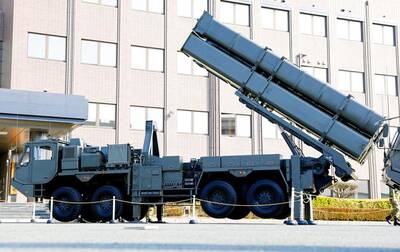
Japan has deployed long-range missiles in a southwestern region near China, the Japanese defense minister said yesterday, at a time when ties with Beijing are at their lowest in recent years. The missiles were installed in Kumamoto in the southern region of Kyushu, as Japan is attempting to shore up its military capacity as China steps up naval activity in the East China Sea. “Standoff defense capabilities enable us to counter the threat of enemy forces attempting to invade our country ... while ensuring the safety of our personnel,” Japanese Minister of Defense Shinjiro Koizumi said. “This is an extremely important initiative for

Chinese Nationalist Party (KMT) Chairwoman Cheng Li-wun (鄭麗文) today accepted an invitation from Chinese President Xi Jinping (習近平) to lead a delegation to China next month, saying she hopes to promote the peaceful development of cross-strait relations and bring stability to the Taiwan Strait. “I am grateful and happy to accept this invitation,” Cheng said in a statement from the KMT chairperson’s office. Cheng said she hopes both sides can work together to promote the peaceful development of cross-strait relations, enhance exchange and cooperation, bring stability to the Taiwan Strait and improve people’s livelihoods. At today's news conference, Cheng said any efforts to

MORE POPULAR: Taiwan Pass sales increased by 59 percent during the first quarter compared with the same period last year, the Tourism Administration said The Tourism Administration yesterday said that it has streamlined the Taiwan Pass, with two versions available for purchase beginning today. The tourism agency has made the pass available to international tourists since 2024, allowing them to access the high-speed rail, Taiwan Railway Corp services, four MRT systems and four Taiwan Tourist Shuttles. Previously, five types of Taiwan Pass were available, but some tourists have said that the offerings were too complicated. The agency said only two types of Taiwan Pass would be available, starting from a three-day pass with the high-speed rail and a three-day pass with Taiwan Railway Corp. The former costs NT$2,800

The nation’s fastest supercomputer, Nano 4 (晶創26), is scheduled to be launched in the third quarter, and would be used to train large language models in finance and national defense sectors, the National Center for High-Performance Computing (NCHC) said. The supercomputer, which would operate at about 86.05 petaflops, is being tested at a new cloud computing center in the Southern Taiwan Science Park in Tainan. The exterior of the server cabinet features chip circuitry patterns overlaid with a map of Taiwan, highlighting the nation’s central position in the semiconductor industry. The center also houses Taiwania 2, Taiwania 3, Forerunner 1 and


 RSS
RSS