


In what will be the largest US arms sale since 1992, President George W. Bush has offered Taiwan a substantial package of weapons including four Kidd-class destroyers and eight diesel submarines. But the administration in Washington has decided to "defer" the sale of AEGIS-equipped destroyers that Taiwan's navy had eagerly sought.
The sale, with an estimated value of some US$4 billion, will be by far the largest since Bush's father in 1992 decided to sell Taiwan 150 F-16 fighters.
However, the administration has rejected for now some major items on Taipei's shopping list, including high-speed anti-radiation missiles (HARM) which can knock out an enemy's radar at surface-to-air missile sites, joint direct attack munitions (JDAM) capable of attacking missile positions inside China, Apache helicopters and M1 tanks.
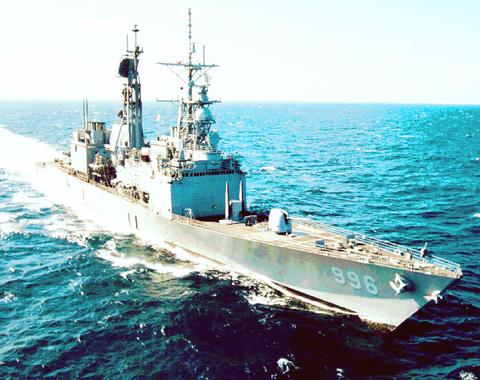
PHOTO: AFP
On Taiwan's plate are 12 P-3 Orion submarine-hunting aircraft, MH-53H minesweeping helicopters, the Paladin self-propelled artillery system, AAV7A1 amphibious assault vehicles, MK 48 torpedoes, the Avenger surface-to-air missile system, submarine-launched and surface-launched torpedoes, and aircraft survivability equipment.
While the administration apparently declined to sell the PAC-3 missile defense system, it did agree to supply a technical briefing on the Patriot anti-missile system Taiwan has been developing.
The administration apparently has also decided against moving from Arizona to Taiwan the AIM-120 air-to-air missiles President Clinton decided to sell Taiwan last year. Taiwan is to take delivery of the missiles after China acquires similar missiles from Russia.
Not ready for AEGIS
In deciding to defer the AEGIS sale, White House officials said they did not think Taiwan is capable of handling the system. Whether Taiwan gets the vessels armed with the powerful AEGIS radar and battle management systems will depend in part on China's actions, the officials said.
In any event, officials briefing reporters said that the AEGIS would still be available to Taiwan by 2010, whether or not they were sold this year.
In contrast, the Kidds, while utilizing older technology, can be available by 2003 and could provide the navy with significant training opportunities.
China immediately hit out at the arms sales. "The Chinese side expresses its concern over the reports" of the sale, foreign ministry spokeswoman Zhang Qiyue (
Earlier, Chinese Ambassador to Washington, Yang Jiechi (
"Continued US sales of advanced weapons to Taiwan threatens China's national security, violates its sovereignty, and emboldens the separatist forces on that Chinese island," he said, using rhetoric that many have come to expect from Beijing. "Such sales are bound to destabilize the situation across the Taiwan Strait and in the Asia Pacific region." Yang warned that if Washington does not handle the Taiwan situation "appropriately," Sino-US relations will "falter and even retrogress."
'Nothing for China to fear'
However, the White House tried to assuage such sentiments. "We think there is nothing in this package for China to fear," one White House official said, echoing words Bush told Chinese Vice Premier Qian Qichen (
Congressional reaction to the sale was generally favorable. Senate Foreign Relations Committee Chairman Jesse Helms said the sale shows "the United States, at long last, has an administration that is taking the critical matter of Taiwan's defense seriously."
Helms praised Bush for his "courageous" decision. "These defense systems will go a long way toward helping our friends in Taiwan resist coercion from an increasingly belligerent Communist China," he said, adding, "for my part, I am unalterably persuaded that the sale of AEGIS destroyers is also justified in light of the outrageous actions of the leaders in Beijing."
Senate Armed Services Committee Chairman John Warner said he agreed with Bush's decision. "I have consistently, steadfastly said that the president should offer four Kidd-class destroyers and defer for a year any decisions with regard to an offer of an Arleigh Burke-class destroyer," he said.
Other praise came from Craig Thomas, the chairman of the Senate foreign relations panel's East Asian and Pacific subcommittee, who had strongly opposed the AEGIS sale.
However, ultra-conservative China critic Dana Rohrbacher, a California Republican, panned the AEGIS decision. By selling the system "symbolically we would have been telling the Chinese and everyone else in Asia that we're making our own decisions and we're not intimidated," he said.
House Democratic Leader Richard Gephardt said he had "serious questions" about the failure to sell the AEGIS vessels. "China's military buildup and other provocative acts demonstrate that the US must have a comprehensive, focused and consistent policy toward that nation. Part of such a policy is clearly assisting Taiwan," he said.
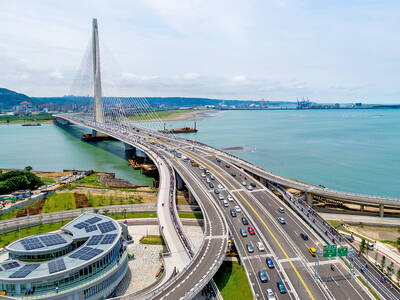
The Ministry of Transportation and Communications yesterday inaugurated the Danjiang Bridge across the Tamsui River in New Taipei City, saying that the structure would be an architectural icon and traffic artery for Taiwan. Feted as a major engineering achievement, the Danjiang Bridge is 920m long, 211m tall at the top of its pylon, and is the longest single-pylon asymmetric cable-stayed bridge in the world, the government’s Web site for the structure said. It was designed by late Iraqi-British architect Zaha Hadid. The structure, with a maximum deck of 70m, accommodates road and light rail traffic, and affords a 200m navigation channel for boats,
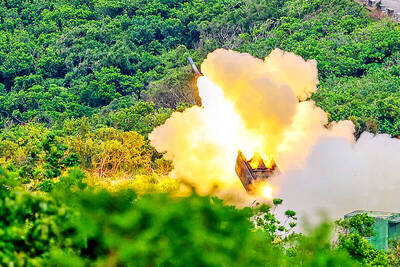
PRECISION STRIKES: The most significant reason to deploy HIMARS to outlying islands is to establish a ‘dead zone’ that the PLA would not dare enter, a source said A High Mobility Artillery Rocket System (HIMARS) would be deployed to Penghu County and Dongyin Island (東引) in Lienchiang County (Matsu) to force the Chinese military to retreat at least 100km from the coastline, a military source said yesterday. Taiwan has been procuring HIMARS and Army Tactical Missile Systems (ATACMS) from the US in batches. Once all batches have been delivered, Taiwan would possess 111 HIMARS units and 504 ATACMS, which have a range of 300km. Considering that “offense is the best defense,” the military plans to forward-deploy the systems to outlying islands such as Penghu and Dongyin so that

WHAT WAS ALL THAT FOR? Jaw Shaw-kong said that Cheng Li-wen had pushed for more drastic cuts and attacked him, just for the outcome to be nearly identical to his bill The legislature yesterday passed a supplementary budget bill to fund the purchase of separate packages of US military equipment, with the combined amount of spending capped at NT$780 billion (US$24.8 billion). The Chinese Nationalist Party (KMT) and Taiwan People’s Party (TPP) used their legislative majority to pass the bill, which runs until 2033 and has two main funding provisions. One was for NT$300 billion of arms sales already approved by the US for Taiwan on Dec. 17 last year, the other was for NT$480 billion for another arms package expected to be announced by Washington. The bill, which fell short of the NT$1.25

‘CLEAR MESSAGE’: The bill would set up an interagency ‘tiger team’ to review sanctions tools and other economic options to help deter any Chinese aggression toward Taiwan US Representative Young Kim has introduced a bill to deter Chinese aggression against Taiwan, calling for an interagency “tiger team” to preplan coordinated sanctions and economic measures in response to possible Chinese military or political action against Taiwan. “[Chinese President] Xi Jinping [習近平] has directed the People’s Liberation Army to be ready to invade Taiwan by 2027. China has a plan. America should have one too,” Kim said in a news release on Thursday last week. She introduced the “Deter PRC [People’s Republic of China] aggression against Taiwan act” to “ensure the US has a coordinated sanctions strategy ready should


 RSS
RSS