


With outrage still fresh around the world over the destruction of two giant Buddha statues in Afghanistan, a Taliban envoy says the Islamic government made its decision in a rage after a foreign delegation offered money to preserve the ancient works while a million Afghans faced starvation.
"When your children are dying in front of you, then you don't care about a piece of art," Sayed Rahmatullah Hashimi, the envoy, said in an interview on Friday.
Rahmatullah is in the US on a mission to improve ties and to try to ease the Taliban's international isolation.
One of the main focuses of his visit, he said, will be to find a way out of the impasse surrounding Osama bin Laden, who is suspected of terrorism and whose presence in Afghanistan has prompted international sanctions.
Still, Rahmatullah expressed no remorse over the demolition of the two Buddhas that were carved from a cliff in central Afghanistan 1,400 years ago and considered one of the world's artistic treasures.
An adviser to the Taliban leader, Mullah Muhammad Omar, Rahmatullah gave for the first time in New York the Taliban's version of events: How a council of religious scholars ordered the statues be destroyed in a fit of indignation.
The destruction, according to his account, was prompted last month when a visiting delegation of mostly European envoys, as well as a representative of the UN Educational, Scientific and Cultural Organization offered money to protect the giant standing Buddhas at Bamiyan, where the Taliban was engaged in fighting an opposition alliance.
Other reports, however, have said the religious leaders were debating the move for months, and ultimately decided that the statues were idolatrous and should be obliterated.
At the time the foreign delegation visited, UN relief officials were giving warning that a long drought and a harsh winter were confronting up to a million Afghans with starvation.
Rahmatullah said that when the visitors offered money to repair and maintain the statues, the Taliban's mullahs were outraged.
"The scholars told them that instead of spending money on statues, why didn't they help our children who are dying of malnutrition? They rejected that, saying, `This money is only for statues.'"
"The scholars were so angry," he continued. "They said, `If you are destroying our future with economic sanctions, you can't care about our heritage.' And so they decided that these statues must be destroyed." The Taliban's Supreme Court confirmed the edict.
"If we had wanted to destroy those statues, we could have done it three years ago," Rahmatullah said. "So why didn't we?
"In our religion, if anything is harmless, we just leave it. If money is going to statues while children are dying of malnutrition next door, then that makes it harmful, and we destroy it.
"What do you expect from a country when you just ostracize them and isolate them and send in cruise missiles and their children are dying?" he said, referring to the sanctions and American attacks against bin Laden's base in Afghanistan after the bombing of two American embassies in Africa in 1998.
"You don't recognize their government," Rahmatullah added. "It is a kind of resentment that is growing in Afghanistan."
At the same time, he said the Taliban would not destroy statues actually being worshiped and would not touch the Hindu temples still left in Afghanistan.
Rahmatullah was due to meet officials of the US State Department and the National Security Council yesterday in Washington, where he will also speak next week at the Council on Foreign Relations, the Atlantic Council of the United States and the Johns Hopkins School of Advanced International Studies.
He would not disclose details of a possible new proposal for a way out of the standoff over bin Laden, the Taliban's fourth, saying he needed a signal from Washington first.
But there are reports in Pakistan that one option might be turning bin Laden over to a special tribunal, perhaps in The Hague, for trial by a panel of Islamic judges.
The Clinton administration had rejected an Afghan trial, international monitoring of bin Laden -- whom Rahmatullah described as a nobody the Americans made into a hero -- or exile in another Muslim country.
Rahmatullah's visit and the wide hearing he is getting have provoked criticism in Congress, particularly from supporters of India, which along with Russia has begun to give military help to the Taliban's opposition. He was given an American visa because he falls below the rank of the highest officials in the Taliban government, who are barred from traveling under an embargo.
Throughout a long interview on a range of subjects, Rahmatullah maintained the fiercely independent attitude of the Taliban, who have demonstrated repeatedly to the UN that they will cooperate with the world only on their own terms.
"They want to change our policies through economic sanctions," he said of the US and other nations that pushed an embargo through the Security Council. "That does not work. For us, our ideology is first, then the economy. To try to change our ideology with economic sanctions is ridiculous."
Rahmatullah said the Taliban were in desperate need of agricultural help to supply farmers who once planted opium and to teach them to grow other crops. The UN narcotics control program has told the Taliban it has no money for seeds, and drug control officials wonder if the new ban on poppy cultivation can be sustained.
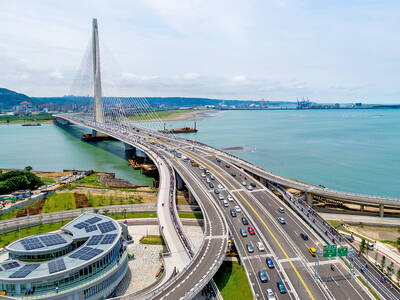
The Ministry of Transportation and Communications yesterday inaugurated the Danjiang Bridge across the Tamsui River in New Taipei City, saying that the structure would be an architectural icon and traffic artery for Taiwan. Feted as a major engineering achievement, the Danjiang Bridge is 920m long, 211m tall at the top of its pylon, and is the longest single-pylon asymmetric cable-stayed bridge in the world, the government’s Web site for the structure said. It was designed by late Iraqi-British architect Zaha Hadid. The structure, with a maximum deck of 70m, accommodates road and light rail traffic, and affords a 200m navigation channel for boats,
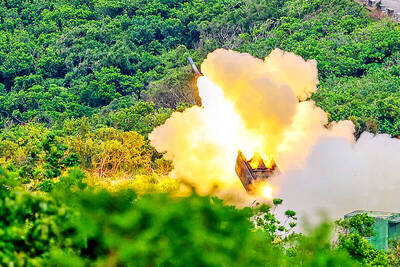
PRECISION STRIKES: The most significant reason to deploy HIMARS to outlying islands is to establish a ‘dead zone’ that the PLA would not dare enter, a source said A High Mobility Artillery Rocket System (HIMARS) would be deployed to Penghu County and Dongyin Island (東引) in Lienchiang County (Matsu) to force the Chinese military to retreat at least 100km from the coastline, a military source said yesterday. Taiwan has been procuring HIMARS and Army Tactical Missile Systems (ATACMS) from the US in batches. Once all batches have been delivered, Taiwan would possess 111 HIMARS units and 504 ATACMS, which have a range of 300km. Considering that “offense is the best defense,” the military plans to forward-deploy the systems to outlying islands such as Penghu and Dongyin so that
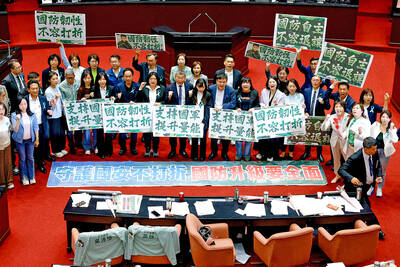
WHAT WAS ALL THAT FOR? Jaw Shaw-kong said that Cheng Li-wen had pushed for more drastic cuts and attacked him, just for the outcome to be nearly identical to his bill The legislature yesterday passed a supplementary budget bill to fund the purchase of separate packages of US military equipment, with the combined amount of spending capped at NT$780 billion (US$24.8 billion). The Chinese Nationalist Party (KMT) and Taiwan People’s Party (TPP) used their legislative majority to pass the bill, which runs until 2033 and has two main funding provisions. One was for NT$300 billion of arms sales already approved by the US for Taiwan on Dec. 17 last year, the other was for NT$480 billion for another arms package expected to be announced by Washington. The bill, which fell short of the NT$1.25

‘CLEAR MESSAGE’: The bill would set up an interagency ‘tiger team’ to review sanctions tools and other economic options to help deter any Chinese aggression toward Taiwan US Representative Young Kim has introduced a bill to deter Chinese aggression against Taiwan, calling for an interagency “tiger team” to preplan coordinated sanctions and economic measures in response to possible Chinese military or political action against Taiwan. “[Chinese President] Xi Jinping [習近平] has directed the People’s Liberation Army to be ready to invade Taiwan by 2027. China has a plan. America should have one too,” Kim said in a news release on Thursday last week. She introduced the “Deter PRC [People’s Republic of China] aggression against Taiwan act” to “ensure the US has a coordinated sanctions strategy ready should


 RSS
RSS