


The death toll from an earthquake which rocked Central America rose early yesterday to at least 138 people, but many more were missing in El Salvador, where a landslide triggered by the quake buried hundreds of homes.
Rescue workers and members of the public toiled through the night searching for survivors in the worst-hit areas of El Salvador, often in darkness where the quake Saturday had cut power lines.
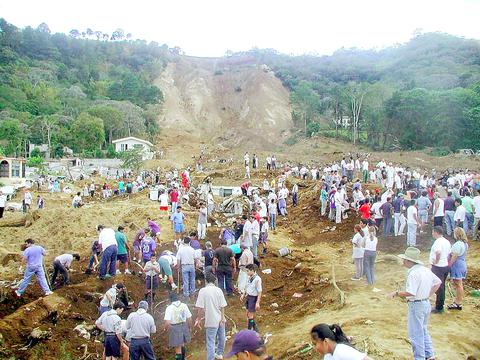
PHOTO: AFP
Officials with El Salvador's Rescue Service confirmed 136 deaths in that country alone, and said some 500 people had been injured. The death toll was expected to rise further, with 1,200 people missing in the Las Colinas neighborhood near the capital, according to Red Cross figures.
At least two people were killed in Guatemala.
The strength of the quake, which hit at 11:33am Saturday, was estimated at between 7.6 and 7.9 on the Richter scale, according to agencies based in Strasbourg, France and Alaska.
The US National Earthquake Information Center said its epicenter lay off El Salvador's Pacific Coast, about 100km southwest of the city of San Miguel.
Aftershocks continued to be felt into yesterday. The country's Geological Research Center said that by 4am a total of 475 aftershocks had been recorded.
Taiwan's first national-level rescue team left for El Salvador late yesterday to assist in post-earthquake relief work in the Central American country.
Taipei Mayor Ma Ying-jeou (
The Taiwan rescue team will take with it a large quantity of advanced equipment to facilitate its search and rescue work.
The team is part of the rescue corps under the Taipei City Fire Department. If necessary, the Taipei rescue corps' remaining 34 members and four trained rescue dogs will also take part in post-quake relief work in El Salvador later.
El Salvador is one of Taiwan's diplomatic allies. Salvadoran President Francisco Perez Flores made a state visit to Taiwan last September, and El Salvador was the first stop of Annette Lu's (
The Ministry of Foreign Affairs has donated US$200,000 to the Salvadoran government through the ROC Embassy there.
Flores said he had delegated to the National Association of Private Business (ANEP) the task of overseeing the distribution of food and other aid.
The Red Cross said late Saturday that about 1,200 people were still missing in the residential neighborhood of Las Colinas, 12km west of here, where a massive landslide triggered by the quake destroyed 330 homes.
Many of the homes were completely buried in earth from the section of wooded hillside which had collapsed onto them, and confirmed deaths at Las Colinas rose to 30 by the early hours yesterday, as relatives of the missing, alongside rescue workers, searched frantically for survivors.
In La Libertad Province, west of the capital, 38 people were confirmed dead by the National Emergency Committee on Saturday, which gave lesser numbers for other provinces.
In the low-income northern neighborhoods of the capital San Salvador, thousands of people opted to sleep in parks and squares rather than remain inside their houses, which are often built in a flimsy manner.
In the immediate aftermath of the earthquake Saturday, pregnant women and babies in incubators had been evacuated from a maternity hospital in the capital, with similar scenes at other hospitals.
"There have been serious and painful human losses and a lot of material damage," Flores said in a message to the nation broadcast Saturday, in which he detailed the government's response and appealed for calm.
Early yesterday, the first foreign team arrived -- a group of Mexican rescue workers flown in to a military base to the east of San Salvador. Later firefighters sent by Guatemala arrived by road from El Salvador's northern neighbor.
National Emergency Committee director Mauricio Ferrer said a US military task force was expected to assist with the rescue and relief operations.
The earthquake was also felt in Honduras, Nicaragua, Costa Rica and in southern Mexico. There were no immediate reports of casualties or damage from those areas.

‘NO SECURITY RISK’: The Railway Bureau reassured the public that the technicians’ activities were limited to technical guidance and did not involve sensitive systems The Railway Bureau yesterday said it had invited eight Chinese technicians to assist with an airport MRT construction project. The bureau issued the confirmation after an Internet user said Chinese nationals had entered the construction zone of Taiwan Taoyuan International Airport’s Terminal 3 project. They asked why “individuals from an enemy state” were allowed access to such a major national infrastructure project, which raised serious concerns over Taiwan’s industrial safety, sensitive systems and information security. The bureau’s Northern Region Engineering Branch Office said subcontractor Taiwan Handle Industrial Co (台灣手把工業) of the Taoyuan airport MRT’s “Contract No. CU05 Project A14 Station Civil, MEP &

The National Chungshan Institute of Science and Technology yesterday showcased its locally developed variants of the Vision 60 robotic patrol dog, which it plans to deploy on the nation’s outlying territories in the South China Sea. The variants were produced under the Joint Lab project — created by the institute and domestic companies — and assembled with domestically produced motors, lenses and artificial intelligence (AI) systems alongside licensed tech from the US, Missile and Rocket Systems Research Division deputy director Jen Kuo-kang (任國光) told the media event at a military base in Taipei’s Dazhi (大直) area. Taiwan has built up its strengths
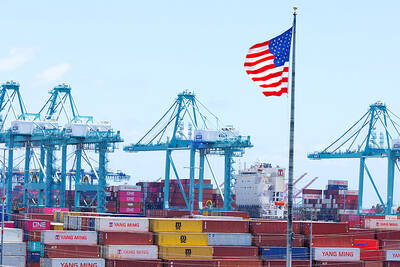
NOT IMMEDIATE: Taiwan has a chance to appeal the proposed 10 percent tariff before it starts, while other countries face a 12.5 percent tariff from the trade office Taiwan is among 60 economies determined by the US to have failed to impose or enforce a ban on the importation of goods produced with forced labor, according to a notice released on Tuesday by the Office of the US Trade Representative (USTR), which proposed imposing an additional 10 percent or more tariff on them. The USTR in a statement said that following an investigation, it had determined under Section 301 of the Trade Act of 1974 that the failure of the 60 economies to impose and effectively enforce a prohibition on the importation of goods produced with forced labor is

TIT-FOR-TAT: The US allegedly revoked the visa of a Chinese national working at Xinhua News Agency in the US in response to Beijing’s expulsion of Vivian Wang The Presidential Office yesterday condemned China for expelling a New York Times correspondent from Beijing following the newspaper’s interview with President William Lai (賴清德), saying the move highlighted Beijing’s suppression of press freedom and its threat to international news media. Taiwan has noted a series of recent incidents in which Beijing used similar tactics to “threaten and pressure international media outlets and journalists,” Presidential Office spokeswoman Karen Kuo (郭雅慧) said in a statement. “This concerns not only press freedom and freedom of expression, but also the safety of journalists, and Taiwan and relevant partners are paying close attention to the situation,” she


 RSS
RSS