


Prosecutors yesterday formally named Nantou County Commis-sioner Peng Pai-hsien (
The Nantou District Prosecutors' Office announced this development at a press conference held yesterday afternoon following raids on Peng's office and home, several county government departments and a foundation chaired by Peng.
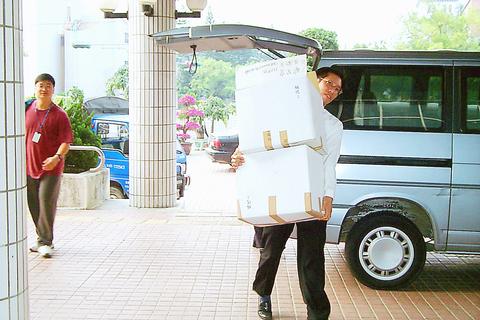
PHOTO: HSIEH CHIEH-YU, TAIPEI TIMES
Commissioner Peng, a political independent, in the evening went to the Ministry of Justice Investigation Bureau's (MJIB) Nantou office to be questioned, without appearing in public.
He had been insisting that he and officials of Nantou County Government and of the foundation were innocent and had called the prosecutors' action "political persecution."
As of press time last night he was still being questioned.
In addition to Peng, his wife, Wu Wen-wan(吳文婉), was among 16 people questioned during or after the morning raids. Others included four government officials, a foundation cashier and 10 contractors of reconstruction projects.
The prosecutors had already searched the county government offices once on Oct. 16. Since then three people have been detained by the district court, including Peng's special assistants Wu Cheng-hsun (吳政勳) and Chen Ming-chuan (陳明娟) and a construction contractor.
Nantou divisional head prosecutor Hsu Sung-kuei (徐松奎) said during the press conference that the prosecution's action yesterday was a follow-up to previous searches and interviews and was in accordance with evidence already found.
"We have found that some financial donations from the public [to the government relief funds] went to two [private] foundations chaired by Commissioner Peng," Hsu said.
He said prosecutors, investigators and police officers went yesterday morning to Peng's office and asked the commissioner to provide account books and other related materials regarding the operation of the foundations, but Peng refused.
"We therefore began the search in accordance with the law and have seized important materials," Hsu said.
Prosecutors at first asked Peng to go with them for questioning but Peng declined, saying that he had to attend the county council session.
Prosecutors therefore interviewed Peng in his office for an hour until around 9:30am and took away a computer and three cartons of materials from his office.
Hsu said they had Peng sign a subpoena promising to attend questioning in the afternoon.
At the same time,another group of prosecutors and investigators searched Peng's home and left with Peng's wife, Wu.
But Hsu stressed that Wu was not summoned as a suspect but invited to "assist the investigation."
Prosecutors suspect that there have been funds flowing between the accounts of the county government and the foundations.
Hsu said the destinations of relief funds remained mysterious and the foundations had failed to provide complete information concerning the use of the money.
But two weeks ago, when Peng's second special assistant was detained, the county government announced that the funds of the foundations and county government were separate.
According to Hsu, moreover, the prosecutors have found evidence suggesting that Peng had favored certain firms in the contracting of construction projects for the county government's new building and a temporary building.
Hsu said, in answer to reporters' questions, that some people questioned previously had said that Peng had given written orders on "slips of paper" for suspicious activities to be undertaken. But he declined to release further details.
Learning of the search of Peng's office in the morning, the county council, where a general interpellation session was underway, made a resolution to recess for two weeks.
Deputy Commissioner Lai Ying-fang (

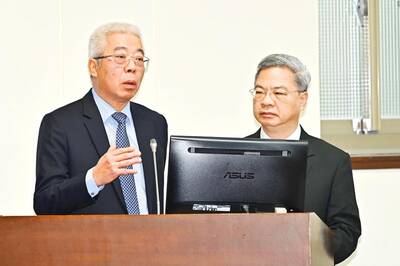
Taiwan has arranged for about 8 million barrels of crude oil, or about one-third of its monthly needs, to be shipped from the Red Sea this month to bypass the Strait of Hormuz and ease domestic supply pressures, CPC Corp, Taiwan (CPC, 台灣中油) said yesterday. The state-run oil company has worked with Middle Eastern suppliers to secure routes other than the Strait of Hormuz, through which about 20 percent of the world’s oil and liquefied natural gas typically passes, CPC chairman Fang Jeng-zen (方振仁) said at a meeting of the legislature’s Economics Committee in Taipei. Suppliers in Saudi Arabia have indicated they

South Korea has adjusted its electronic arrival card system to no longer list Taiwan as a part of China, a move that the Ministry of Foreign Affairs said would help facilitate exchanges between the two sides. South Korea previously listed “Taiwan” as “Taiwan (China)” in the drop-down menus of its online arrival card system, where people had to fill out where they came from and their next destination. The ministry had requested South Korea make a revision and said it would change South Korea’s name on Taiwan’s online immigration system from “Republic of Korea” to “Korea (South),” should the issue not be

Tainan, Taipei and New Taipei City recorded the highest fines nationwide for illegal accommodations in the first quarter of this year, with fines issued in the three cities each exceeding NT$7 million (US$220,639), Tourism Administration data showed. Among them, Taipei had the highest number of illegal short-term rental units, with 410. There were 3,280 legally registered hotels nationwide in the first quarter, down by 14 properties, or 0.43 percent, from a year earlier, likely indicating operators exiting the market, the agency said. However, the number of unregistered properties rose to 1,174, including 314 illegal hotels and 860 illegal short-term rental
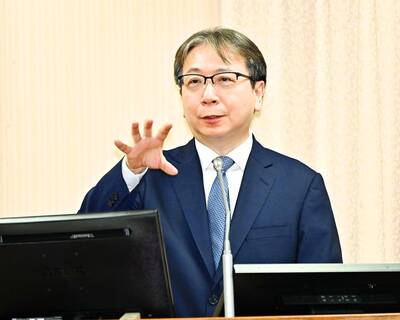
AIR ALERT: China’s reservation of airspace over the Yellow Sea and East China Sea could be an attempt to test the US’ response ahead of a Trump-Xi meeting, the NSB head said China’s attempts to infiltrate Taiwan are systematic, planned and targeted, with activity shifting from recruiting mid-level military officers to rank-and-file enlisted personnel, National Security Bureau (NSB) Director-General Tsai Ming-yen (蔡明彥) said yesterday. The Chinese Communist Party’s (CCP) integrates national security, intelligence operations and “united front” efforts into a dense network to conduct intelligence gathering and espionage in Taiwan, Tsai said at a meeting of the legislature’s Foreign Affairs and National Defense Committee. It uses specific networks to screen targets through exchange activities and recruiting local collaborators to establish intelligence-gathering organizations, he said. China is also shifting who it targets to lower-ranking military personnel,


 RSS
RSS