


Internet giant Yahoo bought the nation's most popular Web portal yesterday, saying Kimo.com would help it expand in both Taiwan and the Greater China region.
Under the acquisition agreement, Yahoo will hand over 2.25 million shares to Kimo's owner, Systex Corp (精業), in exchange for all of the firm's outstanding shares.
Kimo will become part of Yahoo Taiwan, one of Yahoo's 24 global properties.
Executives from both companies declined to comment on how much the sale would cost. But based on Yahoo's closing price of US$65 on the NASDAQ on Wednesday, the deal has an estimated worth of US$146 million.
Shares of Systex rose 6.5 percent to NT$66 yesterday in anticipation of the sale, which is still subject to final approval by Taiwan regulators.
The move signals Yahoo's desire to capture the top spot in Taiwan's Internet market, which is ranked as Asia's fourth largest and estimated to grow annually by 30 percent to 35 percent.
Yahoo officials said the deal combines Kimo's local industry expertise with Yahoo's global network.
"Not only is Taiwan's Internet market very big, its position in the Greater China market also makes it very important," said Jerry Yang (
Kimo, one of Taiwan's most visited Web sites, reported that during the third quarter this year it recorded 25 million page views per day and four million registered users.
"Kimo's seasoned management team has done a fantastic job of building a solid and successful operation that provides superior local content and services to the online audience in Taiwan," said Heather Killen, Yahoo's senior vice president of international operations.
"We really expect that these folks will be able to help us to develop our business throughout the Greater China region," Killen said.
David Lu (
James Wang, (王建中) Internet analyst for Merril Lynch, said that the acquisition is a gift for both Yahoo, which has enjoyed as much success as it would have liked in gaining market share in Taiwan, and Kimo.com, which could use Yahoo's brand name and knack for turning a buck.
Wang said that as competition intensifies, it is more than likely that further consolidation of the market, which Jerry Yang described as "mature" would follow.
"It's probably going to spark further consolidation with other foreign brands like Lycos and Sino possibly acquiring a local portal," Wang said.

The National Chungshan Institute of Science and Technology yesterday showcased its locally developed variants of the Vision 60 robotic patrol dog, which it plans to deploy on the nation’s outlying territories in the South China Sea. The variants were produced under the Joint Lab project — created by the institute and domestic companies — and assembled with domestically produced motors, lenses and artificial intelligence (AI) systems alongside licensed tech from the US, Missile and Rocket Systems Research Division deputy director Jen Kuo-kang (任國光) told the media event at a military base in Taipei’s Dazhi (大直) area. Taiwan has built up its strengths

RIGHT DIRECTION: Taiwan’s efforts to prevent forced labor include a proposal to ‘fully prohibit’ employers from withholding workers’ documents, an official said Taiwan is to establish a mechanism to restrict imports of goods linked to forced labor, the Executive Yuan said yesterday, after the US proposed imposing additional tariffs on Taiwanese goods over labor concerns. “The Ministry of Labor and the Ministry of Economic Affairs are to establish an interministerial review procedure,” Executive Yuan spokesperson Michelle Lee (李慧芝) said at a news briefing in Taipei. “The government is to use the Foreign Trade Act [貿易法] as the legal basis to restrict imports of goods produced with forced labor” and bring its supply chain governance more in line with international standards on human rights, resilience

NOT IMMEDIATE: Taiwan has a chance to appeal the proposed 10 percent tariff before it starts, while other countries face a 12.5 percent tariff from the trade office Taiwan is among 60 economies determined by the US to have failed to impose or enforce a ban on the importation of goods produced with forced labor, according to a notice released on Tuesday by the Office of the US Trade Representative (USTR), which proposed imposing an additional 10 percent or more tariff on them. The USTR in a statement said that following an investigation, it had determined under Section 301 of the Trade Act of 1974 that the failure of the 60 economies to impose and effectively enforce a prohibition on the importation of goods produced with forced labor is
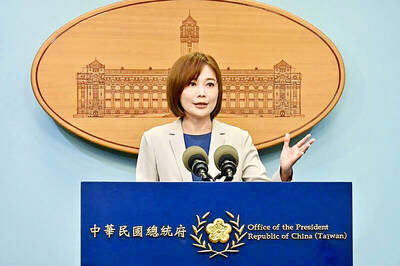
TIT-FOR-TAT: The US allegedly revoked the visa of a Chinese national working at Xinhua News Agency in the US in response to Beijing’s expulsion of Vivian Wang The Presidential Office yesterday condemned China for expelling a New York Times correspondent from Beijing following the newspaper’s interview with President William Lai (賴清德), saying the move highlighted Beijing’s suppression of press freedom and its threat to international news media. Taiwan has noted a series of recent incidents in which Beijing used similar tactics to “threaten and pressure international media outlets and journalists,” Presidential Office spokeswoman Karen Kuo (郭雅慧) said in a statement. “This concerns not only press freedom and freedom of expression, but also the safety of journalists, and Taiwan and relevant partners are paying close attention to the situation,” she


 RSS
RSS