


Responding to the Control Yuan's plan to impeach him for improperly deciding to buy Lafayette-class frigates 10 years ago, former chief of the general staff Hau Pei-tsun (
"Every decision I made while chief of the general staff was reported to then-president Lee Teng-hui (
"The decision-making process for a military purchase is not only made from the `top-down.' It also uses the `bottom-up' approach. The two methods are often used together," he said.
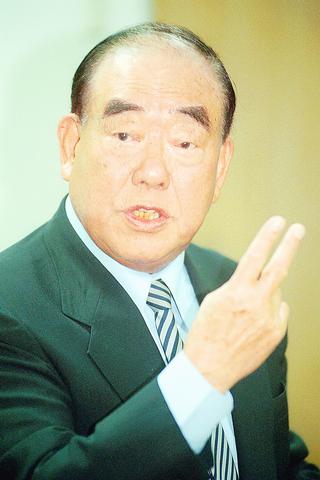
PHOTO:
"I am not fazed by the false charges made against me. I don't want to re-emphasize how much I have contributed to the country during my term as chief of the general staff. But we should not judge events of the past by current standards," he said.
Hau made the statements yesterday at a press conference he called at his Taipei office, responding to plans by the Control Yuan to impeach him and several other retired generals for neglecting their administrative responsibility regarding the Lafayette purchase.
The Control Yuan feels that the decision-making process behind the purchase was flawed.
It is the second time that Hau has defended himself against charges related to his role in the Lafayette deal. His last press conference on the issue was held early last month.
Hau was accused of arbitrarily deciding to buy six Lafayette-class frigates from France in 1989, overturning the initial plan of the navy to buy 16 warships from South Korea.
The accusation was based partially on a message, which Hau ordered his aids to send back to Taiwan in May 1989, while he was in France. The message is considered to be what motivated the navy to drop the South Korean deal in favor of the French.
Hau was also faulted for violating the "high-low mix" policy the navy had established. This policy involved combining large and smaller ships to form groups that have better ability to survive and maneuver during combat. The main vessels of the ROC fleet were to be the 3,000-tonne Yang-class in concert with the smaller 2,000-tonne South Korean ships. The Lafayette-class ships are over 3,600 tonnes.
Hau's advocacy of the Lafayette-class frigates, rather than the lighter "Weishan" ships from South Korea, went against the policy of the time.
At yesterday's press conference, Hau explained that in the message he did not order anyone to terminate plans to buy fighting ships from South Korea.
"In the message, I only told authorities concerned to put off plans to buy South Korean-made warships," Hau said.
"I did it for the sake of finding out which country could provide us with the best package. We do the same thing when we go shopping," he said.
During his last press conference on the issue, Hau had said: "Without the Lafayette deal, Taiwan would not have been able to get the Mirage 2000-5 fighter planes. Without the Mirage deal, Taiwan would not have been able to get the F-16s from the US."
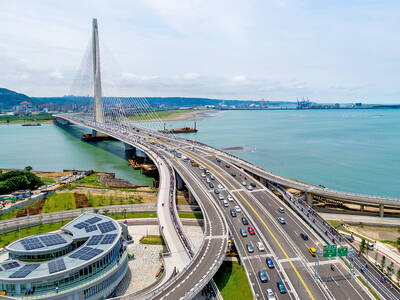
The Ministry of Transportation and Communications yesterday inaugurated the Danjiang Bridge across the Tamsui River in New Taipei City, saying that the structure would be an architectural icon and traffic artery for Taiwan. Feted as a major engineering achievement, the Danjiang Bridge is 920m long, 211m tall at the top of its pylon, and is the longest single-pylon asymmetric cable-stayed bridge in the world, the government’s Web site for the structure said. It was designed by late Iraqi-British architect Zaha Hadid. The structure, with a maximum deck of 70m, accommodates road and light rail traffic, and affords a 200m navigation channel for boats,
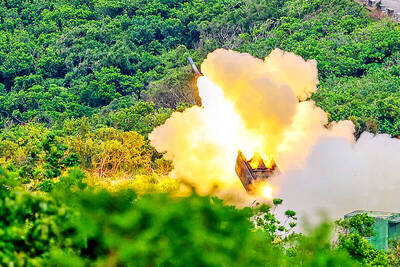
PRECISION STRIKES: The most significant reason to deploy HIMARS to outlying islands is to establish a ‘dead zone’ that the PLA would not dare enter, a source said A High Mobility Artillery Rocket System (HIMARS) would be deployed to Penghu County and Dongyin Island (東引) in Lienchiang County (Matsu) to force the Chinese military to retreat at least 100km from the coastline, a military source said yesterday. Taiwan has been procuring HIMARS and Army Tactical Missile Systems (ATACMS) from the US in batches. Once all batches have been delivered, Taiwan would possess 111 HIMARS units and 504 ATACMS, which have a range of 300km. Considering that “offense is the best defense,” the military plans to forward-deploy the systems to outlying islands such as Penghu and Dongyin so that
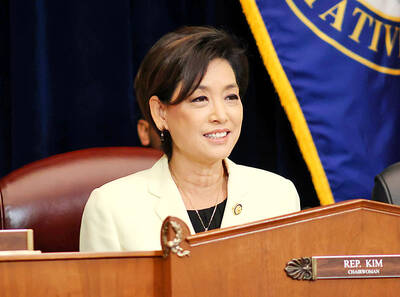
‘CLEAR MESSAGE’: The bill would set up an interagency ‘tiger team’ to review sanctions tools and other economic options to help deter any Chinese aggression toward Taiwan US Representative Young Kim has introduced a bill to deter Chinese aggression against Taiwan, calling for an interagency “tiger team” to preplan coordinated sanctions and economic measures in response to possible Chinese military or political action against Taiwan. “[Chinese President] Xi Jinping [習近平] has directed the People’s Liberation Army to be ready to invade Taiwan by 2027. China has a plan. America should have one too,” Kim said in a news release on Thursday last week. She introduced the “Deter PRC [People’s Republic of China] aggression against Taiwan act” to “ensure the US has a coordinated sanctions strategy ready should

TAIWAN ISSUE: US treasury secretary Scott Bessent said on the first day of meetings that ‘it wouldn’t be a US-China summit without the Taiwan issue coming up’ There were no surprises on the first day of the summit between US President Donald Trump and Chinese President Xi Jinping (習近平), the Mainland Affairs Council (MAC) said yesterday, as the government reiterated that cross-strait stability is crucial to the Asia-Pacific region, as well as the world. As the two presidents met for a highly anticipated summit yesterday, Chinese state media reported that Xi warned Trump that missteps regarding Taiwan could push their two countries into “conflict.” Trump arrived in China with accolades for his host, calling Xi a “great leader” and “friend,” and extending an invitation to visit the White House


 RSS
RSS