


The Presidential Office yesterday apologized to the media for keeping secret the details of Singapore's Senior Minister Lee Kuan Yew's (
"Lee requested that Taiwan arrange this trip, saying he wished to meet people in a private capacity and not as an official overseas visitor," said acting secretary-general to the president, Chen Che-nan (陳哲男). "We respected Lee's request. If this draws criticism from some quarters, I can only say sorry."
Opposition lawmakers and some local media criticized security arrangements that have forced high-ranking government officials who met with Lee to remain low-profile, saying Taiwan's new government had "degraded Taiwan's statehood."
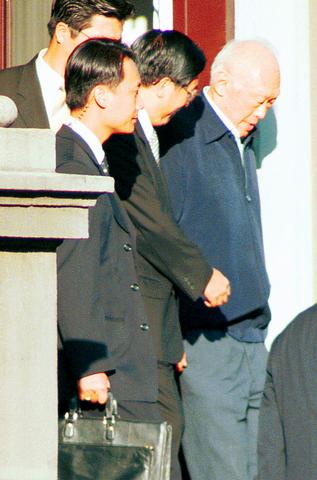
PHOTO: LU CHUN-WEI, TAIPEI TIMES
Chen commented on Lee's visit at his regular weekly press conference yesterday, saying that he was well aware of the criticisms.
These centered mostly on the secrecy surrounding meetings at Lee's hotel -- which were ultimately revealed by media to have involved officials resorting to taking back doors, service elevators, basement entrances and even emergency stairwells -- all in order to avoid the press camping outside the hotel's front door.
"Taiwan's media crowded around the front doors of the hotel in large numbers. We were only concerned with protecting a 70-year-old man from injury while there were so many TV cameras about," Chen said. "How our officials could get through the crowds of journalists was also a worry."
Before leaving Taiwan last night, Lee had a three-hour luncheon with Academia Sinica President Lee Yuan-tseh (李遠哲) and then held a second round of talks with President Chen. The details of both discussions remain secret.
During the past four days, Lee also met with KMT Chairman Lien Chan (
Responding to questions from the press, Chen Che-nan admitted that the cross-strait issue was the major topic of the secret meetings. He also said that President Chen was interested in learning about Lee's domestic achievements, especially in maintaining public security, promoting governmental effectiveness and protecting the environment.
"Beijing leaders expressed their anger about Lee's visit, which I think shows that Lee is not China's secret envoy," Chen said. "I can guarantee that it is impossible to make any secret deal between our officials and Lee."
Chen said that President Chen explained to Lee his policies for governing Taiwan and the president also expressed his views on Lee's four-day visit.
"President Chen will reveal the entire content of his talks with Lee at an appropriate time and place," Chen added.
Meanwhile, Premier Tang and Tsai Ing-wen both agreed that Lee's visit could help to improve cross-strait relations, saying that Lee still enjoyed considerable influence in Asian and global political circles.
"To let Lee understand the new government's policy will definitely help communication between the two sides of Taiwan Strait," Tsai told lawmakers.
"We have no reason to reject Lee's visit," Tang told lawmakers while accepting interpellation in the Legislative Yuan yesterday.
Lee was instrumental in pushing for a historic meeting between top negotiators from Taipei and Beijing in 1993 in Singapore, but distanced himself from Taipei during former president Lee Teng-hui's (李登輝) later tenure in office because of differences on issues such as Taiwan's future, the democratic system and so-called "Asian values."
Lee's last visit to Taiwan was six years ago in 1994.
He met Chinese leaders in June this year, urging Taiwan and China to reopen dialogue and saying that it would be dangerous for Taiwan for the current stalemate to continue.
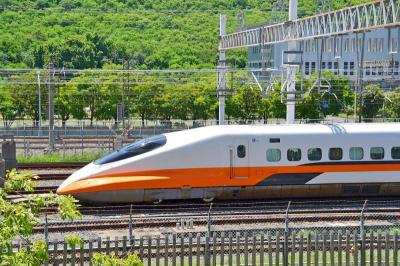
A signaling system malfunction disrupted high-speed rail (HSR) services beginning at 8am today, with trains temporarily reduced to three northbound and three southbound trains per hour as authorities conduct inspections. The malfunction occurred on a section of track in Miaoli County during pre-operation checks early this morning, forcing northbound and southbound trains to use a single track, the HSR operator said. The regular schedule has been replaced with three hourly trains offering only nonreserved seating in each direction, stopping at every station, it said, adding that business class cars would still have reserved seating. Departures from terminal stations are scheduled at the top

Taiwan is still in the process of assessing the possibility of recruiting workers from Eswatini, the Ministry of Foreign Affairs said yesterday, adding that its goal is to help Eswatini upgrade its vocational training centers. If there are plans to recruit workers from Eswatini, safeguarding national security, protecting public health and ensuring the employment rights of Taiwanese would be prerequisites, Department of West Asian and African Affairs Director-General Yen Chia-liang (顏嘉良) told a news conference. Key considerations would also include filling labor shortages in specific industries, and fostering bilateral professional and technical exchanges, he said. Yen was asked about the progress of labor

A US uncrewed surface vessel (USV) encountered multiple Chinese warships during an autonomous transit of the Taiwan Strait, US defense company Seasats said in a statement on Wednesday. Seasats announced that a Lightfish USV had completed the first autonomous transit of the Taiwan Strait. Over five days, the USV traversed the entire length of the Strait while constantly monitoring surface vessel traffic, the company said. The Lightfish encountered multiple Chinese warships, one of which was a Chinese People’s Liberation Army Navy (PLAN) Type 056 corvette, it said. The Chinese vessels were operating “well within Taiwan’s exclusive economic zone without transmitting their identity via the
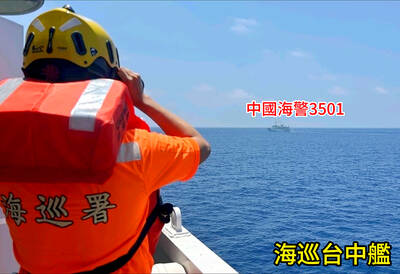
VERBOSE VESSELS: A CGA cutter and a China Coast Guard exchanged verbal barbs for more than a day in Taiwanese-controlled waters before the Chinese vessel left The Taiwanese and Chinese coast guards had a standoff near the strategically located Pratas Islands (Dongsha Islands, 東沙群島) in the north of the South China Sea, the Coast Guard Administration (CGA) said yesterday. The two sides engaged in intense radio exchanges over sovereignty claims during the 33-hour standoff. China Coast Guard vessel 3501 eventually left the restricted waters, 26.6 nautical miles (49.2km) west of the Pratas Islands, at 5pm yesterday, the CGA said. Lying approximately between southern Taiwan and Hong Kong, the Taiwan-controlled Pratas are seen by some security experts as vulnerable to Chinese attack due to their distance — more than


 RSS
RSS