


Turning her loss on Saturday around, Chen Jing (陳靜) yesterday beat Singapore's Jing Jun Hong (
The first set between Chen and Jing was a close one with Jing winning 21-18. Chen gave away eight points in the match because of unforced errors and at first appeared visibly shaken. Chen is currently ranked third in the world, while Jing is ranked 23rd.
"In the first game I missed a few good opportunities and that disrupted my strategy and rhythm. She [Jing] attacked harder than she normally would and I was standing too far away from the table to counter attack," Chen said after the match. "I made several errors and became frustrated."
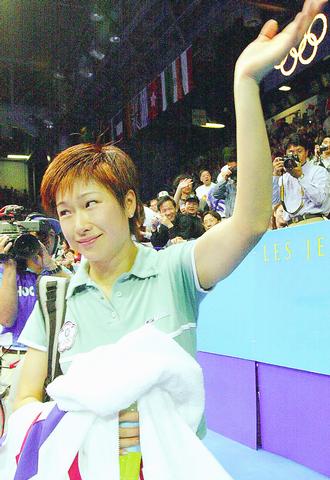
PHOTO: LIN CHENG-KUNG, TAIPEI TIMES
But after the first set, Chen started playing more aggressively, using fast play and hard smashes to put Jing off her rhythm. Chen dominated in the three sets that followed, winning 21-14, 21-15, 21-10. In the third set Chen racked up 12 points because of Jing's bobbles.
Yesterday's medal was Chen's third in Olympic competition. Chen won the gold at the 1988 Seoul Olympics, at the time competing for China. She moved to Taiwan in 1991 and competed in the 1996 Olympics, winning a silver in women's singles.
"The first time I was young and full of confidence. I knew I could win because I was representing China and I was technically the best. This time I wanted to challenge myself because these are the `Games of the new millennium.' I was confident with my technique this time. It seems that physically I'm still comparable to those playing now. But if I had won yesterday, that would have been even better," she said, when asked how she felt about winning her third Olympic medal.
Coming to Taiwan has had its challenges, Chen said yesterday, comparing the training conditions in both countries.
"I don't have as many training partners now for me to practice all the styles," Chen said.
When asked whether she would come back again in four years to try and win another Olympic medal in Athens, Chen said: "I don't know, I'll have to ask God."
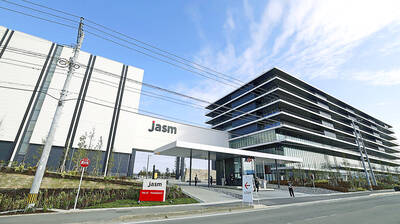
The subsidiary of Taiwan Semiconductor Manufacturing Co (TSMC, 台積電) in Kumamoto, Japan, turned a profit in the first quarter of this year, marking the first time the first fab of the unit has become profitable since mass production started at the end of 2024. According to the contract chipmaker’s financial statement released on Friday, Japan Advanced Semiconductor Manufacturing Inc (JASM), a joint venture running the fab in Kumamoto, posted NT$951 million (US$30.19 million) in profit in the January-to-March period, compared with a loss of NT$1.39 billion in the previous quarter, and a loss of NT$3.25 billion in the first quarter of
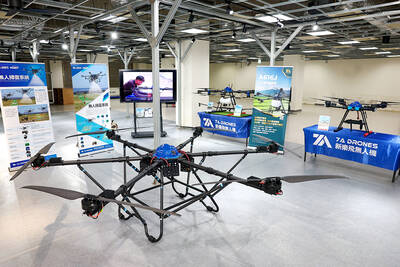
DRONE CENTRAL: Taiwan aims to become Asia’s democratic hub for drones, with most exports focused on high-quality military-grade models, an official said Taiwan’s drone industry is expected to expand significantly by 2030, producing 100,000 units per month and exporting half of them, the Ministry of Economic Affairs said yesterday. Current drone production capacity is about 15,000 units per month, but the industry can quickly scale up as demand increases, Industrial Development Administration Director-General Chiou Chyou-huey (邱求慧) told a news conference in Taipei. Taiwan’s drone output grew 2.5-fold last year to NT$12.9 billion (US$408.3 million) under a government program to develop the uncrewed vehicle sector, he said. The Executive Yuan in October last year approved plans to invest NT$44.2 billion into domestic production of uncrewed aerial
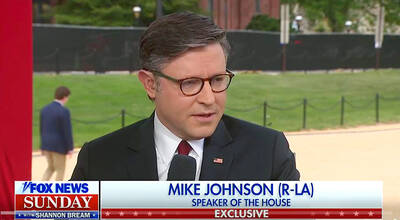
RESOLUTE BACKING: Two Republican senators are planning to introduce legislation that would impose immediate sanctions on China if it attempts to invade Taiwan US House of Representatives Speaker Mike Johnson on Sunday reaffirmed US congressional support for Taiwan, saying the US and “all freedom-loving people” have a stake in preventing China from seizing Taiwan by force. Johnson made the remarks in an interview with Fox News Sunday on US President Donald Trump’s summit with Chinese President Xi Jinping (習近平) last week. In an interview that aired on Friday on Fox News, just as Trump wrapped up a high-stakes visit to China, he said he has yet to green-light a new US$14 billion arms package to Taiwan and that it “depends on China.” “It’s a very good
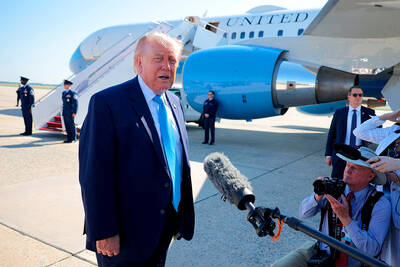
US President Donald Trump yesterday said he would speak to President William Lai (賴清德) as his administration considers whether to move ahead with a US$14 billion weapons sale to Taiwan — a potential arms deal that has drawn criticism from China. “Well, I’ll speak to him. I speak to everybody,” Trump told reporters yesterday when asked if he had any plans to call his counterpart, although he did not offer a time frame for when such a conversation could take place. Trump previously said he would speak to the person “that’s running Taiwan,” without specifying who he meant. “We have that situation very


 RSS
RSS