


A main bridge in southern Taiwan collapsed yesterday, sending drivers and passengers fleeing their cars and racing to safety as chunks of concrete dropped into the water below, but officials confirmed that no one was killed.
Officials say 22 people were injured after the collapse of two sections of the Kaoping (
No cars were found in the river after four hours of searching with divers, boats and a helicopter, a fire official from Pingtung said.
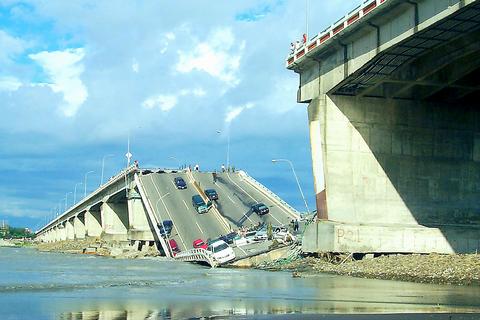
PHOTO: HUANG LIANG-CHIEH, THE LIBERTY TIMES
Witnesses described a rumbling sound as the four-lane bridge broke and concrete fell into the river. Cars crashed against the railings and more than a dozen hung precariously onto the tilting span.
The injured were taken to four local hospitals while emergency workers continued to search for more victims. At least two of the injured suffered serious bone fractures.
The bridge, which is about 1km long, is the main thoroughfare into Kaohsiung from neighboring Pingtung County. It was built in 1978 and has been renovated several times.
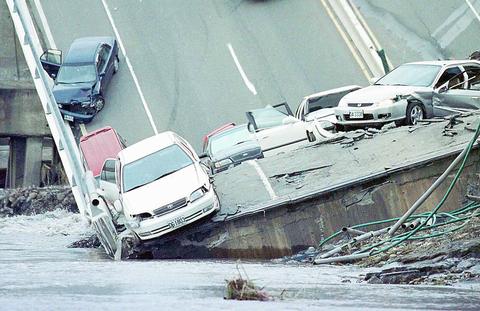
PHOTO: LIN CHENG-KUNG, THE LIBERTY TIMES
About 100m of the bridge collapsed, and one end completely snapped off.
Rescuers have brought in boats and a helicopter to search the rushing river for anyone who may have fallen into the water.
Premier Tang Fei (
He also apologized to the victims and the rest of Taiwan for the incident.
The military has also sent 450 troops to the scene, including divers from the marine combat forces.
The cause of the accident is under investigation, and President Chen Shui-bian (
Illegal gravel quarrying upstream is also suspected to have contributed to the collapse. The bridge was weakened further by raging waters brought by Typhoon Bilis last week.
Given the length of the bridge, it would be difficult to build a temporary bridge nearby, according to officials from the Ministry of Transportation and Communications. The officials met yesterday to find ways to handle traffic before the bridge is repaired.

LEVERAGE: China did not ‘need to fire a shot’ to deny Taiwan airspace over Africa when it owns ‘half the continent’s debt,’ a US official said, calling it economic warfare The EU has raised concerns about overflight rights following the delay of President William Lai’s (賴清德) planned state visit to the Kingdom of Eswatini after three African nations denied overflight clearance for his charter at the last minute. Taiwanese allies Paraguay and Saint Kitts and Nevis, as well as several US lawmakers and the Inter-Parliamentary Alliance on China (IPAC) condemned China for allegedly pressuring the countries. Lai was scheduled to fly directly to Taiwan’s only African ally from yesterday to Sunday to celebrate the 40th anniversary of King Mswati III’s accession and his 58th birthday, but Seychelles, Mauritius and Madagascar suddenly revoked
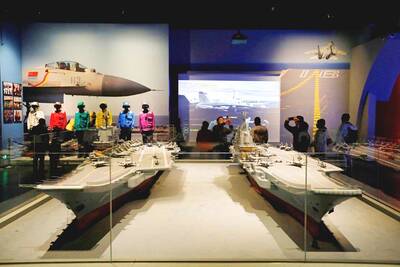
China on Wednesday teased in a video an aircraft carrier that could be its fourth, and the first using nuclear power, while making an allusion to Taiwan and vowing to further build up its islands, as it looks to boost maritime power, secure resources and bolster territorial claims. The video, issued on the eve of the 77th founding anniversary of the Chinese People’s Liberation Army Navy, featured fictional officers with names that are homophones of three commissioned aircraft carriers, the Liaoning (遼寧), Shandong (山東) and Fujian (福建). Titled Into the Deep, it showed a 19-year-old named “Hejian” (何劍) joining the group, sparking
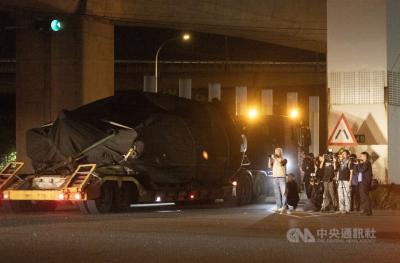
The final batch of 28 M1A2T Abrams tanks purchased from the US arrived at Taipei Port last night and were transported to the Armor Training Command in Hsinchu County’s Hukou Township (湖口), completing the military’s multi-year procurement of 108 of the tanks. Starting at 12:10am today, reporters observed more than a dozen civilian flatbed trailers departing from Taipei Port, each carrying an M1A2T tank covered with black waterproof tarps. Escorted by military vehicles, the convoy traveled via the West Coast Expressway to the Armor Training Command, with police implementing traffic control. The army operates about 1,000 tanks, including CM-11 Brave Tiger
BIG YEAR: The company said it would also release its A12 chip the same year to keep a ‘reliable stream of new silicon technologies’ flowing to its customers Taiwan Semiconductor Manufacturing Co (TSMC, 台積電) yesterday said its newest A13 chip is to enter volume production in 2029 as the chipmaker seeks to hold onto its tech leadership and demand for next-generation chips used in artificial intelligence (AI), high-performance-computing (HPC) and mobile applications. TSMC, the world’s biggest contract chipmaker, also unveiled its A12 chip at its annual technology symposium in Santa Clara, California. The A12 chip, which features TSMC’s super-power-rail technology to provide backside power delivery for AI and HPC applications, is also to enter volume production in 2029, a year after the scheduled release of the A14 chip. The technology moves


 RSS
RSS