


The Cabinet, which had been led by Premier Vincent Siew
"It is time to pack up the past and hand over the heavy burden to the new Cabinet," Siew told outgoing Cabinet members at their 141st and final meeting.
In his speech, Siew thanked his colleagues for their "sacrifices, contributions and distinguished achievements."
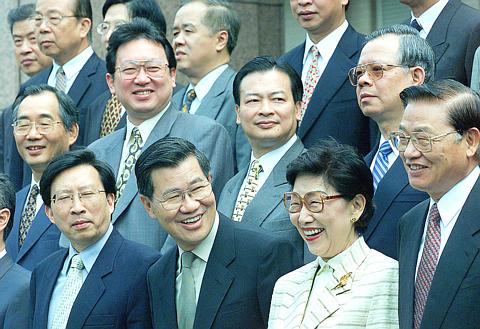
PHOTO: REUTERS
He paid particular tribute to the late Central Bank president, Sheu Yuan-dung (許遠東), who died in a plane crash near CKS airport in 1998, and the late Minister of Education Lin Ching-chiang (林清江), who died of a brain tumor last December.
Siew also said that the peaceful transfer of power was unprecedented in Taiwan's history.
"Although there were no guidelines to follow, and there were some misunderstandings during the process, in general everything has gone smoothly," Siew said.
The incoming administration had complained more than once during the interim period that Siew's Cabinet did not cooperate in the handover of governmental affairs.
The weekly Cabinet meeting -- which usually lasts for up to two hours -- concluded after just 40 minutes yesterday. And rather than discuss administrative matters, the group passed around a collective resignation document and, each in turn, used their chop to stamp the paper.
Premier-designate Tang Fei (唐飛) -- also the outgoing Minister of National Defense -- did not attend the meeting as he is still recovering from surgery he underwent last month. However, he was represented by his deputy, who stamped the resignation document.
Siew told the group that their proudest achievement had been Taiwan's weathering of the Asian financial crisis.
He also expressed regret at how the Cabinet was treated for its handling of 921 earthquake reconstruction work.
The government has been widely criticized for inefficiency in dealing with post-quake reconstruction work and in taking care of those made homeless by the quake.
On Tuesday the Control Yuan passed a motion censuring the Executive Yuan, indicating that there had been many failures in its post-quake reconstruction work.
Siew had dubbed his administration an "action Cabinet" (
One analyst said that Siew's Cabinet had suffered from both inherent problems and, in some cases, bad luck.
"Things have not gone very smoothly from the beginning -- encountering, for example, both the financial crisis and the earthquake," said Chiu Hei-yuan (瞿海源), an Academia Sinica sociologist.
"The challenges of post-quake reconstruction were inherently difficult and [the country] had no such experience [to draw from]. The government had a lot of problems with coordination and communication among different units," Chiu said.
Chiu also said the Cabinet lineup had not been ideal from the start -- some ministerial posts were simply given to the wrong people. This was a factor which determined the Cabinet's fate.
Chiu said its performance had, to a large extent, caused the KMT's defeat in the election.
"However, [Siew's Cabinet] has made some positive contributions toward the nation's prosperity, and that should not be overlooked." Chiu said.

Japan has deployed long-range missiles in a southwestern region near China, the Japanese defense minister said yesterday, at a time when ties with Beijing are at their lowest in recent years. The missiles were installed in Kumamoto in the southern region of Kyushu, as Japan is attempting to shore up its military capacity as China steps up naval activity in the East China Sea. “Standoff defense capabilities enable us to counter the threat of enemy forces attempting to invade our country ... while ensuring the safety of our personnel,” Japanese Minister of Defense Shinjiro Koizumi said. “This is an extremely important initiative for
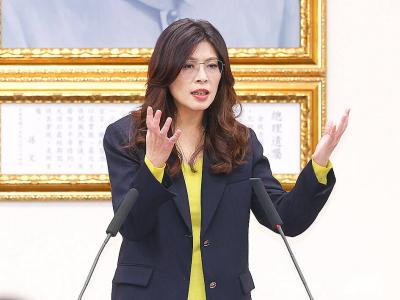
Chinese Nationalist Party (KMT) Chairwoman Cheng Li-wun (鄭麗文) today accepted an invitation from Chinese President Xi Jinping (習近平) to lead a delegation to China next month, saying she hopes to promote the peaceful development of cross-strait relations and bring stability to the Taiwan Strait. “I am grateful and happy to accept this invitation,” Cheng said in a statement from the KMT chairperson’s office. Cheng said she hopes both sides can work together to promote the peaceful development of cross-strait relations, enhance exchange and cooperation, bring stability to the Taiwan Strait and improve people’s livelihoods. At today's news conference, Cheng said any efforts to

MORE POPULAR: Taiwan Pass sales increased by 59 percent during the first quarter compared with the same period last year, the Tourism Administration said The Tourism Administration yesterday said that it has streamlined the Taiwan Pass, with two versions available for purchase beginning today. The tourism agency has made the pass available to international tourists since 2024, allowing them to access the high-speed rail, Taiwan Railway Corp services, four MRT systems and four Taiwan Tourist Shuttles. Previously, five types of Taiwan Pass were available, but some tourists have said that the offerings were too complicated. The agency said only two types of Taiwan Pass would be available, starting from a three-day pass with the high-speed rail and a three-day pass with Taiwan Railway Corp. The former costs NT$2,800

The nation’s fastest supercomputer, Nano 4 (晶創26), is scheduled to be launched in the third quarter, and would be used to train large language models in finance and national defense sectors, the National Center for High-Performance Computing (NCHC) said. The supercomputer, which would operate at about 86.05 petaflops, is being tested at a new cloud computing center in the Southern Taiwan Science Park in Tainan. The exterior of the server cabinet features chip circuitry patterns overlaid with a map of Taiwan, highlighting the nation’s central position in the semiconductor industry. The center also houses Taiwania 2, Taiwania 3, Forerunner 1 and


 RSS
RSS