


One turbulent day in the legislature more than a decade ago, a little-known firebrand legislator from the fledgling opposition party locked horns with the most powerful man in the country, the defense minister-turned-premier, Hau Pei-tsun (
That legislator, who sent Taiwan's fairly compliant legislature charging down a path of open confrontation with the Executive Yuan by throwing a bunch of papers at Hau in disgust during an interpellation session, was elected president on March 18 this year: Chen Shui-bian (
In a meeting rich with irony yesterday, Chen met with Hau, an icon of the old mainlander elite, to apologize for his behavior all those years ago. And in a moment steeped in symbolism, he was warmly welcomed.
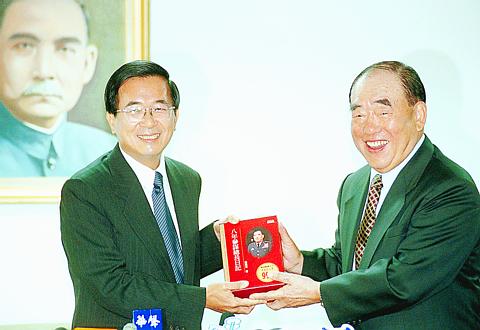
PHOTO: LEE HUNG-MING, LIBERTY TIMES
The two men agreed that peace -- both at home and abroad -- was an overriding concern for Taiwan.
Chen and Hau could not possibly be more different -- or more representative of the divergent views in Taiwan society.
Hau, a career soldier who was fiercely loyal to Taiwan's paramount post-war leader, Chiang Kai-shek (
Chen was one of Hau's chief -- and harshest -- critics.
When Chen was first elected to the legislature in 1989, Hau was initially appointed defense minister, while Chen was a thorn in his side on the defense committee.
On one occasion, Chen became so angry with Hau's reluctance to give him straight answers that he overturned a desk separating them. The incident was instrumental in raising Chen's national profile, and made changes to interpellation rules possible.
Then, when Lee appointed Hau premier in 1990, the opposition movement voiced stern objections to the appointment of a general as the nation's chief executive. Chen was among those who launched a direct and concerted campaign against Hau due to his military background, which finally forced him to give up his general's rank.
Ten years later, Chen is the most powerful man in the country, while Hau has retired from politics.
But in an inescapable twist of irony, Chen has just recently nominated Minister of National Defense Tang Fei (唐飛) as his premier.
If there was an opportunity to grind the ax, however, Hau was not going to take it yesterday, calling Chen's decision "full of highly political wisdom."
The meeting won praise from many quarters, not the least significant of whom was Hau Lung-bin (
Chen, for his part, indicated he would seek to protect and improve soldiers' rights and raise their level of professionalism. As a leader of both the state and the military, Chen said he would put state interests above his own ideology.
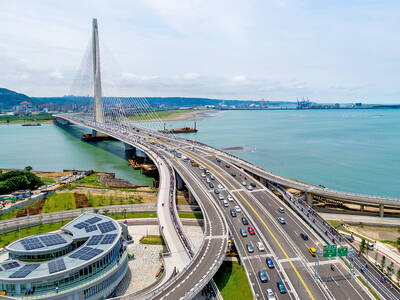
The Ministry of Transportation and Communications yesterday inaugurated the Danjiang Bridge across the Tamsui River in New Taipei City, saying that the structure would be an architectural icon and traffic artery for Taiwan. Feted as a major engineering achievement, the Danjiang Bridge is 920m long, 211m tall at the top of its pylon, and is the longest single-pylon asymmetric cable-stayed bridge in the world, the government’s Web site for the structure said. It was designed by late Iraqi-British architect Zaha Hadid. The structure, with a maximum deck of 70m, accommodates road and light rail traffic, and affords a 200m navigation channel for boats,
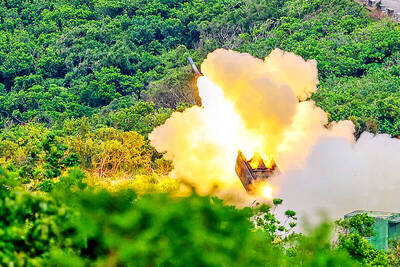
PRECISION STRIKES: The most significant reason to deploy HIMARS to outlying islands is to establish a ‘dead zone’ that the PLA would not dare enter, a source said A High Mobility Artillery Rocket System (HIMARS) would be deployed to Penghu County and Dongyin Island (東引) in Lienchiang County (Matsu) to force the Chinese military to retreat at least 100km from the coastline, a military source said yesterday. Taiwan has been procuring HIMARS and Army Tactical Missile Systems (ATACMS) from the US in batches. Once all batches have been delivered, Taiwan would possess 111 HIMARS units and 504 ATACMS, which have a range of 300km. Considering that “offense is the best defense,” the military plans to forward-deploy the systems to outlying islands such as Penghu and Dongyin so that
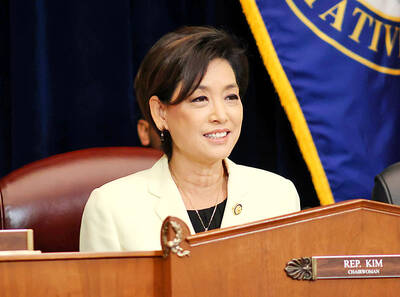
‘CLEAR MESSAGE’: The bill would set up an interagency ‘tiger team’ to review sanctions tools and other economic options to help deter any Chinese aggression toward Taiwan US Representative Young Kim has introduced a bill to deter Chinese aggression against Taiwan, calling for an interagency “tiger team” to preplan coordinated sanctions and economic measures in response to possible Chinese military or political action against Taiwan. “[Chinese President] Xi Jinping [習近平] has directed the People’s Liberation Army to be ready to invade Taiwan by 2027. China has a plan. America should have one too,” Kim said in a news release on Thursday last week. She introduced the “Deter PRC [People’s Republic of China] aggression against Taiwan act” to “ensure the US has a coordinated sanctions strategy ready should

TAIWAN ISSUE: US treasury secretary Scott Bessent said on the first day of meetings that ‘it wouldn’t be a US-China summit without the Taiwan issue coming up’ There were no surprises on the first day of the summit between US President Donald Trump and Chinese President Xi Jinping (習近平), the Mainland Affairs Council (MAC) said yesterday, as the government reiterated that cross-strait stability is crucial to the Asia-Pacific region, as well as the world. As the two presidents met for a highly anticipated summit yesterday, Chinese state media reported that Xi warned Trump that missteps regarding Taiwan could push their two countries into “conflict.” Trump arrived in China with accolades for his host, calling Xi a “great leader” and “friend,” and extending an invitation to visit the White House


 RSS
RSS