


Just hours before the year 2000 dawned in the western Pacific last night, US and Russian military experts sat down to stave off the biggest millennium bug nightmare of them all -- an accidental nuclear attack.
In Australia, revellers were already getting into full New Year's Eve swing but elsewhere, security fears, religious intolerance and plain incompetence threatened to take the fizz out of festivities.
The Center for Year 2000 Strategic Stability began operations on the grounds of Peterson Air Force Base in Colorado Springs, manned by military personnel from the United States and Russia.
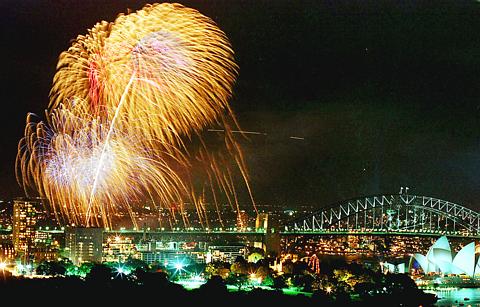
PHOTO: REUTERS
They will monitor nuclear missile launch warning systems to avoid any catastrophic accident prompted by a Y2K bug.
The millennium bug stems from mainly older computer systems which were programmed to read only the last two digits of a year. If the glitch is left uncorrected, systems could misread 2000 as 1900, causing systems to malfunction or even crash.
Sydney Harbour resembled a tent city with revellers camping out along the foreshore, braving rain and strong winds, to secure the best vantage point for the celebrations.
Hundreds of boats have anchored, jostling for a view of the Sydney Harbour Bridge and Opera House, two of several firing platforms for more than 20 tonnes of fireworks.
Australia, believed to be one of the best prepared nations for the Y2K bug, said it still expected some disruption but believed it would avoid major failures.
Some Y2K-related problems would take weeks to emerge but the millennium bug should cause little disruption to the economy or major infrastructure, said Ian Campbell, parliamentary secretary to Australia's communications minister.
"I think the only thing you can guarantee is that there will be some problems," Campbell told Australian Broadcasting Corporation radio.
The New Year was due to start in the tiny island states of Tonga and parts of Kiribati 14 hours ahead of midnight Greenwich Mean Time. The new millennium begins in 2001, but most of the world has latched on to the round figure 2000 to start celebrating.
In some of the world's big cities, those festivities have been stalled. Seattle cancelled its main party after an Algerian carrying suspected bomb-making material was arrested in Washington state two weeks ago.
The Federal Bureau of Investigation stepped up an investigation into a suspected plot to plant bombs at US millennium celebration sites.
New York expects two million people at its Times Square millennium bash. President Bill Clinton's staff said his party plans were "going full steam ahead." His schedule includes three public speeches and two White House parties.
Police marksmen prepared to take up rooftop positions to protect Britain's showpiece celebrations from possible guerrilla attack, particularly the Millennium Dome in London's Docklands where Queen Elizabeth and Prime Minister Tony Blair were to see in the new century.
The party risked falling flat because most of the guests had not received tickets and it was too late to send out the rest.
Plans for the first passengers to ride on New Year's Eve on another London millennium attraction, a giant Ferris wheel on the south bank of the Thames, had to be scrapped because it had not passed all safety checks.
In the Holy Land, the very prospect of celebrations ensured that the religious arguments that have marked the last two millennia would continue into the third.
New Year's Eve falls squarely into the Jewish Sabbath, when no music can be played or electricity used.
In Jerusalem, Wadee' Abu Nasser, director of the Roman Catholic Holy Land millennium celebrations, accused rabbis of infringing on Christian rights by pressuring hotels to scrap all festivities on New Year's Eve.
There have been problems of a different kind elsewhere, with reports of lackluster sales for millennium parties all over the world due to high prices.
Cape Town remained determined to stage a big party amid high security after police seized bomb-making equipment and arrested the leader of a Muslim vigilante group suspected of a role in recent bombings in the city.

Japan has deployed long-range missiles in a southwestern region near China, the Japanese defense minister said yesterday, at a time when ties with Beijing are at their lowest in recent years. The missiles were installed in Kumamoto in the southern region of Kyushu, as Japan is attempting to shore up its military capacity as China steps up naval activity in the East China Sea. “Standoff defense capabilities enable us to counter the threat of enemy forces attempting to invade our country ... while ensuring the safety of our personnel,” Japanese Minister of Defense Shinjiro Koizumi said. “This is an extremely important initiative for
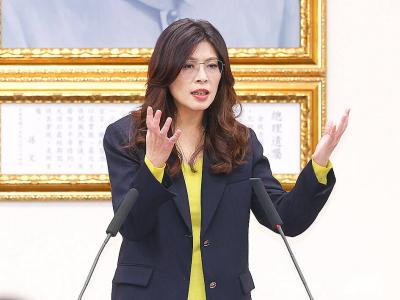
Chinese Nationalist Party (KMT) Chairwoman Cheng Li-wun (鄭麗文) today accepted an invitation from Chinese President Xi Jinping (習近平) to lead a delegation to China next month, saying she hopes to promote the peaceful development of cross-strait relations and bring stability to the Taiwan Strait. “I am grateful and happy to accept this invitation,” Cheng said in a statement from the KMT chairperson’s office. Cheng said she hopes both sides can work together to promote the peaceful development of cross-strait relations, enhance exchange and cooperation, bring stability to the Taiwan Strait and improve people’s livelihoods. At today's news conference, Cheng said any efforts to

MORE POPULAR: Taiwan Pass sales increased by 59 percent during the first quarter compared with the same period last year, the Tourism Administration said The Tourism Administration yesterday said that it has streamlined the Taiwan Pass, with two versions available for purchase beginning today. The tourism agency has made the pass available to international tourists since 2024, allowing them to access the high-speed rail, Taiwan Railway Corp services, four MRT systems and four Taiwan Tourist Shuttles. Previously, five types of Taiwan Pass were available, but some tourists have said that the offerings were too complicated. The agency said only two types of Taiwan Pass would be available, starting from a three-day pass with the high-speed rail and a three-day pass with Taiwan Railway Corp. The former costs NT$2,800

The nation’s fastest supercomputer, Nano 4 (晶創26), is scheduled to be launched in the third quarter, and would be used to train large language models in finance and national defense sectors, the National Center for High-Performance Computing (NCHC) said. The supercomputer, which would operate at about 86.05 petaflops, is being tested at a new cloud computing center in the Southern Taiwan Science Park in Tainan. The exterior of the server cabinet features chip circuitry patterns overlaid with a map of Taiwan, highlighting the nation’s central position in the semiconductor industry. The center also houses Taiwania 2, Taiwania 3, Forerunner 1 and


 RSS
RSS