


Macau was in a buoyant mood yesterday, notwithstanding a seemingly endless line of ceremonies on its first day of Chinese rule.
Tens of thousands of Macau's residents were on the streets at midnight on Sunday celebrating the handover, a clear reflection of the fact that the change of sovereignty has by and large been welcomed here, without the suspicion and the protests that marred the handover of Hong Kong two and a half years ago.
At the handover ceremony itself, Chinese President Jiang Zemin (
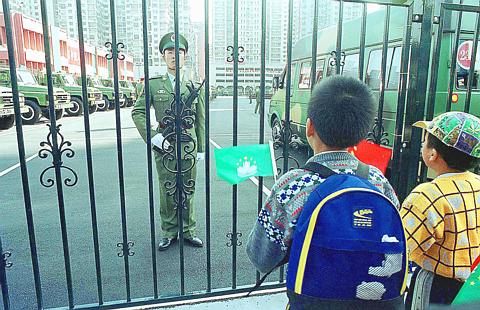
PHOTO: CHEN CHENG-CHANG, TAIPEI TIMES
"The implementation of `one country, two systems' in Hong Kong and Macau has played and will continue to play an important, exemplary role for our eventual settlement of the Taiwan question," Jiang said.
Following Jiang's speech was an inauguration ceremony and swearing-in of the Macau Special Administrative Region (SAR) government at a ceremony presided over by Jiang, Premier Zhu Rongji (
At the head of the SAR's new government is Edmund Ho, whose family owns the Tai Fung Bank, one of Macau's largest, and has long been prominent in Chinese community affairs. Ho's father, Ho Yin, was leader of the Chinese Chamber of Commerce in Macau for 20 years starting in the 1960s and was an important intermediary between China and the Portuguese authorities before the establishment of diplomatic relations in 1979.
Ho himself swore in the officials of the new administration, which has been criticized for the overall lack of experience of its members.
For most people in Macau, however, the highlight of the day -- even eclipsing a spectacular parade held throughout the afternoon arranged by the official handover committee -- was the entry of the People's Liberation Army garrison into the SAR from barracks in the neighboring Chinese city of Zhuhai.
A convoy of 40 vehicles brought some 700 PLA troops, most of whom were from crack army units. A small naval contingent will be based in Macau but, unlike its Hong Kong counterpart, it will not be equipped with guided-missile vessels.
Due to a lack of military facilities inherited from the Portuguese -- Lisbon had not stationed troops in the enclave ever since the revolution of 1974 -- the garrison will be billeted in an empty residential apartment block on reclaimed land near the waterfront, one of many empty buildings left as a result of the bursting of a property bubble in the last 12 months.
A crowd of 150,000 assembled in Zhuhai, which borders Macau, to see off the PLA troops, including not only locals but people from many other parts of China. One group of retired cadres had even spent 26 days bicycling from Shanghai to see what they considered to be a historic occasion.
The PLA troops drove across the border to a reception ceremony in which Chinese community leaders presented them with a souvenir banner and plaque praising what it called "a powerful and civilized army."
Always anxious to distance itself from the specter of the Tiananmen incident in June 1989, when PLA troops killed thousands of unarmed pro-democracy demonstrators, the PLA has been at pains to stress the cultural level of the troops. Most of them have tertiary education, according to the PLA, while three of them have master's degrees.
It is not, however, as cultural ambassadors that residents welcomed them yesterday with cheering, flag waving, fire crackers and lion dances. Rather, it is the idea that the PLA might bring an end to the gang violence that has afflicted Macau in the last two years.
Major General Liu Yuejun, the new commander of the PLA garrison in Macau, told Chinese state-run TV in November that his troops were ready to assist in maintaining social order in Macau, while Edmund Ho has also raised the prospect of using the PLA against the triads, threatening to "use whatever resources are permitted under the law, not only the police."
In the wake of negative economic growth of 6.8 percent last year as a result of gang violence scaring away tourists, few people are overly worried about the civil liberty questions involved in soldiers doing police tasks. The real police force is seen as either too corrupt or simply too scared to deal with the triads -- many of whose members are ex-PLA members themselves. Thank heavens, therefore, for the army, is the overwhelming sentiment.
But exactly when and how the PLA might be used has not been specified. Under the Basic Law the administration is allowed to ask for assistance from the military if it feels that social order is endangered.
But the kind of endangering of social order the Basic Law seems to have had in mind was riot control. How the PLA might raise the quality of policing outside of riot-control situations is a question that few in Macau seem to have asked.

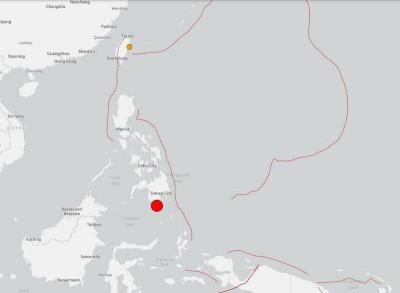
A magnitude 7.8 earthquake struck off the southern coast of Mindanao in the Philippines at 7:38am today, prompting the US Tsunami Warning System to issue an alert for neighboring countries, including Taiwan. The system issued a purple alert indicating a "tsunami threat." The potential threat zone includes Taiwan, the Philippines, Papua New Guinea, Yap and Palau. Philippine authorities were assessing the damage from the quake, with the office of civil defense seeking to verifying initial reports that 15 people had been killed and 129 injured in the region, mostly from falling debris. Arlene Hollero, disaster chief of Maasim town in the Philippines' Sarangani Province,
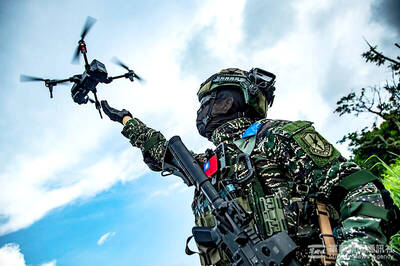
RESILIENCE: Taiwan plays a key role in semiconductors, energy, information infrastructure and advanced manufacturing, AIT Director Raymond Greene said Taiwan’s continued investment in deterrence and resilience remains vital, especially in uncrewed systems and other emerging technologies, American Institute in Taiwan (AIT) Director Raymond Greene said yesterday. Greene made the remarks at the annual National Strategic Summit on Supply Chain Resilience held by the Research Institute for Democracy, Society and Emerging Technology (DSET), a government-backed think tank. As Taiwan last year became the US’ fourth-largest trading partner and supply chain security is becoming more important, cooperation in emerging technologies continues to deepen between the two countries, he said. The US is committed to accelerating innovation, building key infrastructure, strengthening cooperation

The National Chungshan Institute of Science and Technology yesterday showcased its locally developed variants of the Vision 60 robotic patrol dog, which it plans to deploy on the nation’s outlying territories in the South China Sea. The variants were produced under the Joint Lab project — created by the institute and domestic companies — and assembled with domestically produced motors, lenses and artificial intelligence (AI) systems alongside licensed tech from the US, Missile and Rocket Systems Research Division deputy director Jen Kuo-kang (任國光) told the media event at a military base in Taipei’s Dazhi (大直) area. Taiwan has built up its strengths
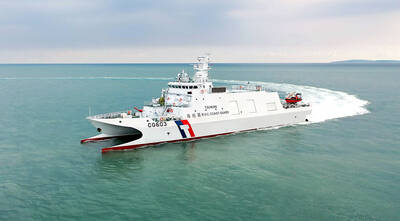
‘GRAY ZONE’ PRESSURE: Beijing’s activities are intended to create the deceitful impression that China has jurisdiction over the area around Taiwan, the CGA said Taiwan’s rights over its territorial waters and exclusive economic zone must not be violated by any country, the Mainland Affairs Council said yesterday, adding that it will not accept any unprovoked actions. The council issued the remarks in response to the China Coast Guard conducting maritime enforcement drills near eastern Taiwan and claiming to fully exercise China’s maritime administrative law enforcement authority. The Coast Guard Administration (CGA) has been closely monitoring the situation and is taking concrete steps to defend the nation’s sovereignty and secure its waters, the council said. China has no sovereign rights over the waters off eastern


 RSS
RSS