


Vilified as seditionists 20 years ago, the leaders of the Kaohsiung Incident are now the heroes of Taiwan's struggle for democracy after 20 years of what historians call "the quiet revolution."
The origins of this change lie in the founding of Formosa magazine in August 1979. The magazine was more than a political publication. By establishing local chapters throughout the island it became a political party in all but name. Its editorial board was a roll call of the leading opposition tang wai ("outside the party,"
The magazine had planned a rally in Kaohsiung on Dec. 10, 1979 to observe International Human Rights Day. The government reneged on an agreement to allow the Rotary Club Park to be used for a rally, so Formosa supporters attempted to march to another venue.
The march tuned into a riot when the marchers were attacked by riot police lobbing tear gas. To this day the police claim they were attacked first by the marchers, while some of the marchers claim that KMT agent provocateurs in their ranks instigated the violence, giving the police the excuse to attack.
The government, which was quick to condemn the violence as a conspiracy to overturn the government, arrested what it believed to be eight leading organizers, and put them on trial by court martial on charges of sedition.
The Kaohsiung Eight, as they became known, were sentenced to lengthy jail terms for their overt anti-government statements.
"These people tried to cover up their illegal acts by talking about human rights, democracy, and freedom. They used public rallies, speeches, and demonstrations to convey radical opinion that is detrimental to the government's image and national unity. And the end of their plans is to overturn the government," reads the indictment against the Kaohsiung Eight.
A political prisoner for over 25 years, DPP lawmaker Shih Ming-teh (
"Look at what Chiang Ching-kuo and Lee Teng-hui have done in pushing for political reform. Everything they were and are doing was what we were pressing the government to do 20 years ago," Shih said.
At his trial in 1980, Shih told the court that the purpose of starting Formosa magazine was to push for democratic reform, which included rescinding martial law, lifting the ban on the formation of political parties, lifting restrictions on the size and establishment of newspapers, and replacing the majority of legislators and national assemblymen who had been elected in China in 1948 with representatives elected from Taiwan.
In fact, all four reforms were carried out subsequently in the late 1980s and early 1990s.
In the wake of "localization" of the political climate, considerable efforts were undertaken then to begin emphasizing a Taiwanese identity independent of China, and to reconstruct the history of Taiwan from a Taiwanese perspective.
This prompted a plethora of discussion on the nature of Taiwanese identity in culture, language, and history.
The Kaohsiung incident "was definitely a decisive event through which Taiwanese people were awakened overnight, regaining their strength and courage to defy the authoritarian regime," Shih said.
In analyzing Taiwan's 54 years under KMT rule, scholars have found similarities between the Kaohsiung Incident and another historical event on Feb. 28, 1947 -- the "2-28 Massacre" -- both of which left relations between Taiwanese and mainland Chinese in disarray, and led to recovery of Taiwan's own identity.
Prior to February 28, 1947, feelings between Taiwanese and mainland Chinese on Taiwan had become inflamed due to the iron-handed rule by then-military governor Chen Yi (
Within days the island was engulfed by anti-mainland Chinese rioting which eventually was suppressed with great savagery by soldiers despatched from China with the deaths of up to 40,000 Taiwanese.
Huang Fu-san (黃富三), an historian at National Taiwan University, points out that both incidents have marked historical moments of recovery of Taiwanese consciousness against the then-privileged status of mainland Chinese.
Huang said, however, that the two events have prompted diverse societal responses. After the 228 Incident, Taiwan became a "silent society," where freedom of expression -- especially by Taiwanese -- was strictly controlled by the government. In contrast, the Kaohsiung Incident, instead of discouraging, actually encouraged more Taiwanese to come forward to assert themselves. A "silent revolution," Huang said, took place following the Incident.
"Dissidents were put in jail and society appeared to be peaceful after the incident. But it was just an illusion, underneath which unrest was going on quietly, ready to break out anywhere on the island," Huang said.
As this "revolution" continued among Taiwanese communities in the early 1980s, a number of social movements began to take shape, for environmental protection, as well as the rights of laborers, women and farmers. And it was the common end of the various movements to think of things from Taiwan's perspective and fight for the rights of Taiwanese people.
The Kaohsiung Incident is thought to have had a significant impact on the public perception of the opposition movement, and that of the KMT regime. Taiwanese, who sympathized with the jailed opposition leaders, became disappointed with the KMT, and gradually became alienated from the party.
But as well as alienating large numbers of Taiwanese from the KMT regime, another important legacy of the Incident on domestic politics was to make the issue of Taiwan's international status central to its domestic politics.
Chang Yen-hsien (
"It's an inherent dilemma with which Taiwan has been confronted for long. The opposition leaders were daring enough to talk about the issue openly in a climate where only reunification was politically correct," Chang said. "The impact of their statements on Taiwan independence has lasted to this day. And sooner or later Taiwan people have to make their decision."
After their release from jail, the Kaohsiung Eight became instant celebrities, and continued to play an important part in Taiwan's democratic development. Nearly half of the defense team, meanwhile, pursued political careers after the trial, becoming the backbone of the DPP's leadership.
Twenty years ago, the courage of the Kaohsiung Eight and their defenders helped precipitate Taiwan's democratization. Even today many Taiwanese treat these people as folk heros. But as the political environment changed in the two decades, the credit for pushing for Taiwan's democratization has not necessarily gone to those who campaigned for so long and suffered so much to bring it about.
"The spotlight was stolen by [the KMT's] Lee Teng-hui, who has also been pushing for political reform from a Taiwanese perspective," said political analyst Julian Kuo (

A signaling system malfunction disrupted high-speed rail (HSR) services beginning at 8am today, with trains temporarily reduced to three northbound and three southbound trains per hour as authorities conduct inspections. The malfunction occurred on a section of track in Miaoli County during pre-operation checks early this morning, forcing northbound and southbound trains to use a single track, the HSR operator said. The regular schedule has been replaced with three hourly trains offering only nonreserved seating in each direction, stopping at every station, it said, adding that business class cars would still have reserved seating. Departures from terminal stations are scheduled at the top
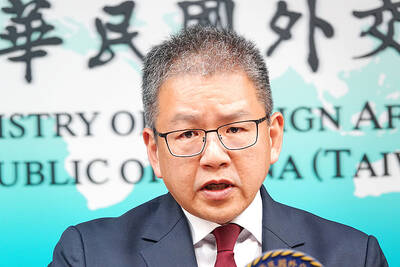
Taiwan is still in the process of assessing the possibility of recruiting workers from Eswatini, the Ministry of Foreign Affairs said yesterday, adding that its goal is to help Eswatini upgrade its vocational training centers. If there are plans to recruit workers from Eswatini, safeguarding national security, protecting public health and ensuring the employment rights of Taiwanese would be prerequisites, Department of West Asian and African Affairs Director-General Yen Chia-liang (顏嘉良) told a news conference. Key considerations would also include filling labor shortages in specific industries, and fostering bilateral professional and technical exchanges, he said. Yen was asked about the progress of labor

VERBOSE VESSELS: A CGA cutter and a China Coast Guard exchanged verbal barbs for more than a day in Taiwanese-controlled waters before the Chinese vessel left The Taiwanese and Chinese coast guards had a standoff near the strategically located Pratas Islands (Dongsha Islands, 東沙群島) in the north of the South China Sea, the Coast Guard Administration (CGA) said yesterday. The two sides engaged in intense radio exchanges over sovereignty claims during the 33-hour standoff. China Coast Guard vessel 3501 eventually left the restricted waters, 26.6 nautical miles (49.2km) west of the Pratas Islands, at 5pm yesterday, the CGA said. Lying approximately between southern Taiwan and Hong Kong, the Taiwan-controlled Pratas are seen by some security experts as vulnerable to Chinese attack due to their distance — more than

A US uncrewed surface vessel (USV) encountered multiple Chinese warships during an autonomous transit of the Taiwan Strait, US defense company Seasats said in a statement on Wednesday. Seasats announced that a Lightfish USV had completed the first autonomous transit of the Taiwan Strait. Over five days, the USV traversed the entire length of the Strait while constantly monitoring surface vessel traffic, the company said. The Lightfish encountered multiple Chinese warships, one of which was a Chinese People’s Liberation Army Navy (PLAN) Type 056 corvette, it said. The Chinese vessels were operating “well within Taiwan’s exclusive economic zone without transmitting their identity via the


 RSS
RSS