


Nearly 20 years ago, DPP presidential candidate Chen Shui-bian (
Dressed in their legal gowns yesterday, Chen appeared at a press conference with his former colleagues, most of whom went on to pursue active political careers and some of whom became household names.
The purpose of the press conference was to show support for Chen, but the focus inevitably turned to his rival, independent candidate James Soong (
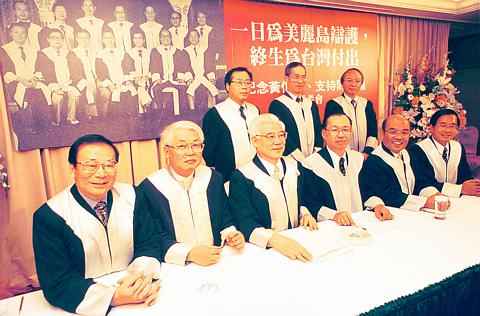
PHOTO: CHEN CHENG-CHANG, TAIPEI TIMES
Their reunion stirred memories of that fateful day, Dec. 10, 1979 -- International Human Rights Day.
It all began with an anti-government parade organized by the Formosa magazine, a front for a broad alliance of tang wai (outside the party) activists. Although it had been carefully planned so as to be peaceful, the parade degenerated into violence when a confrontation occured with police. It is now widely believed that the KMT had sent in agent provocateurs to mingle with the crowd and create conflict.
When a group of opposition leaders, who came to be known as the Kaohsiung Eight, were tried for their role in organizing the rally, few lawyers dared to take the politically charged case.
Chen, then 29 and a highly successful maritime lawyer, was among the few who would.
He was the youngest of the group but, as his peers were quick to point out at yesterday's commemoration a week ahead of the Incident's anniversary, he went on to become the most successful.
"He may have been the youngest, but all of us were very impressed with his talent and determination," said Chen Chi-sen (
"Some say he is too young to be president, which we think is unfair. Just take a look at how he's managed his past positions -- as a city councilor, a legislator, and as a mayor -- and you will know he can be trusted to be a competent president," Chen said.
As history shows, the lawyers' efforts were in vain. The Kaohsiung Eight, who included Chen's likely running mate, Taoyuan County Commissioner Annette Lu (
But in the longer term, perhaps their case was really won in the court of public opinion. All eight became instant celebrities and, after their release from jail, continued to play an important part in Taiwan's democratic development.
Nearly half of the defense team, meanwhile, pursued political careers after the trial, becoming the backbone of the DPP's leadership.
Besides Chen, for whom the trial was a political baptism of fire, Kaohsiung Mayor Frank Hsieh (
Their reunion yesterday provided a forum for not only happy memories to be shared, but also to express their natural dislike of Chen's rival for the presidency.
The group singled out Soong particularly for his current "hypocrisy" in speaking with members of the press about the lack of respect for free speech within the KMT, as he had been serving as head of the Government Information Office at the time of the Kaohsiung Incident.
"Soong was an assassin of Taiwan's thriving democracy," DPP legislator Chang Chun-hsiung (
Kuo Chi-jen (
Kuo said it was ironic that Chen and Soong, who had been standing on opposite sides of the democratic fence during the Kaohsiung Eight's trial, are now going head-to-head again, two decades later.
Chen, the defense lawyer for DPP patriarch Huang Hsin-chieh, who died two days ago, repeatedly expressed his deep remorse yesterday, saying he would not have achieved anything if not for the inspiration given him by Huang.

‘NO SECURITY RISK’: The Railway Bureau reassured the public that the technicians’ activities were limited to technical guidance and did not involve sensitive systems The Railway Bureau yesterday said it had invited eight Chinese technicians to assist with an airport MRT construction project. The bureau issued the confirmation after an Internet user said Chinese nationals had entered the construction zone of Taiwan Taoyuan International Airport’s Terminal 3 project. They asked why “individuals from an enemy state” were allowed access to such a major national infrastructure project, which raised serious concerns over Taiwan’s industrial safety, sensitive systems and information security. The bureau’s Northern Region Engineering Branch Office said subcontractor Taiwan Handle Industrial Co (台灣手把工業) of the Taoyuan airport MRT’s “Contract No. CU05 Project A14 Station Civil, MEP &

A US uncrewed surface vessel (USV) encountered multiple Chinese warships during an autonomous transit of the Taiwan Strait, US defense company Seasats said in a statement on Wednesday. Seasats announced that a Lightfish USV had completed the first autonomous transit of the Taiwan Strait. Over five days, the USV traversed the entire length of the Strait while constantly monitoring surface vessel traffic, the company said. The Lightfish encountered multiple Chinese warships, one of which was a Chinese People’s Liberation Army Navy (PLAN) Type 056 corvette, it said. The Chinese vessels were operating “well within Taiwan’s exclusive economic zone without transmitting their identity via the
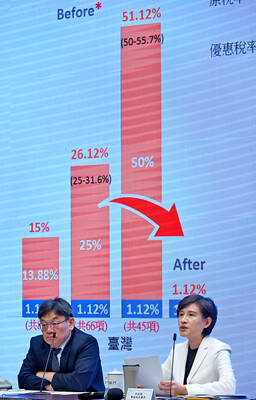
GREATER REACH? Auto parts and wood products would face tariffs of up to 15%, matching those targeting the EU, Japan and South Korea, Vice Premier said The US has announced that preferential tariff treatment for Taiwan’s non-semiconductor Section 232 goods would take effect retroactively from May 1, the Executive Yuan said yesterday. The US government yesterday posted a notice on the Federal Register’s public inspection Web site previewing tariff concessions for Taiwan under a memorandum of understanding (MOU) on Taiwan-US investment after two months of negotiations. The MOU signed on Jan. 15 stipulated three major preferential tariff arrangements: a 15 percent “reciprocal” tariff rate for Taiwan without stacking most-favored nation (MFN) rates; preferential Section 232 treatment for semiconductors and related products; and preferential Section 232 treatment for non-semiconductor

TIT-FOR-TAT: The US allegedly revoked the visa of a Chinese national working at Xinhua News Agency in the US in response to Beijing’s expulsion of Vivian Wang The Presidential Office yesterday condemned China for expelling a New York Times correspondent from Beijing following the newspaper’s interview with President William Lai (賴清德), saying the move highlighted Beijing’s suppression of press freedom and its threat to international news media. Taiwan has noted a series of recent incidents in which Beijing used similar tactics to “threaten and pressure international media outlets and journalists,” Presidential Office spokeswoman Karen Kuo (郭雅慧) said in a statement. “This concerns not only press freedom and freedom of expression, but also the safety of journalists, and Taiwan and relevant partners are paying close attention to the situation,” she


 RSS
RSS