


US Republican Party front-runner George W. Bush has again expressed support for Taiwan in the strongest terms -- this time, saying if elected, the United States would defend the "free people" of Taiwan if China resorted to bullying.
But such comments -- while welcome in Taiwan -- came as little surprise, cross-strait analysts said.
"There are really no surprises," said Julian Kuo (
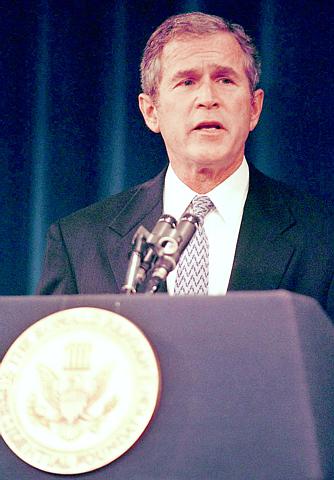
PHOTO: AFP
Bush's remarks -- made during a speech yesterday -- placed particular emphasis on shifting the approach of the current US-China relationship away from a "strategic partnership" and toward what he called a "competitive relationship."
"China is a competitor, not a strategic partner. We must deal with China without ill will, but without illusions," Bush said during his first major policy speech. "This means keeping our pledge to deter aggression against the Republic of Korea and strengthening security ties with Japan. This means expanding theater missile defenses among our allies."
Bush, however, did not specify Taiwan when he mentioned the Theatre Missile Defense (TMD) system, a defense umbrella Beijing adamantly opposes, especially if it were to include Taiwan.
"I don't know how far Bush would go -- would he support the development of TMD for Taiwan?" Kuo asked.
Joseph Wu (吳釗燮), a professor at National Chengchi University's Institute of International Relations, agreed.
"His statement is not that clear, but it is clear that he is willing to come to Taiwan's assistance," Wu said.
During his speech Bush said: "We do not deny there is one China. But we deny the right of Beijing to impose their rule on a free people. As I've said before, we will help Taiwan defend itself."
Analysts also said it was unclear whether Bush implied that would include any moves by China to force unification on Taiwan in the future in the form of the expanded "one country, two systems" formula the island has been offered.
What was clear, Wu said, was that US-China policy is tough to change, no matter what one's stance may be.
Echoing comments made by Bush, Wu said that previously US President Bill Clinton had called the Chinese leadership the "butchers of Beijing," only later to support a "strategic partnership with China".
But he said Clinton was not the only one doing so.
Ronald Reagan, during his campaigning in the 1980 election campaign, had threatened to cut ties with China -- only to later sign the third US-PRC Joint Communique in 1982, Wu said.
The Communique calls on both sides to work to eventually halt weapons sales to Taiwan.
Such a phenomenon can not only be labelled empty promises but more importantly shows the consistent control the State Department has had on the US-China relationship, Wu said.
"You can't be overly optimistic," Wu said. "Even though some candidates want to reorient US-China relations, the State Department has been involved for a long time."
Wu said, however, that a shift in tone, even if only that, was welcome for Taiwan.
"If the tone is more favorable, if the US State Department is not calling Taiwan a troublemaker, that is progress," Wu said.
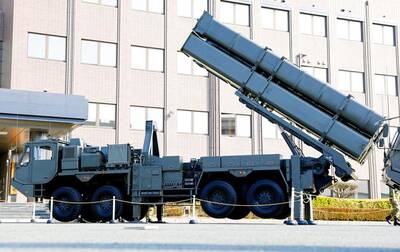
Japan has deployed long-range missiles in a southwestern region near China, the Japanese defense minister said yesterday, at a time when ties with Beijing are at their lowest in recent years. The missiles were installed in Kumamoto in the southern region of Kyushu, as Japan is attempting to shore up its military capacity as China steps up naval activity in the East China Sea. “Standoff defense capabilities enable us to counter the threat of enemy forces attempting to invade our country ... while ensuring the safety of our personnel,” Japanese Minister of Defense Shinjiro Koizumi said. “This is an extremely important initiative for
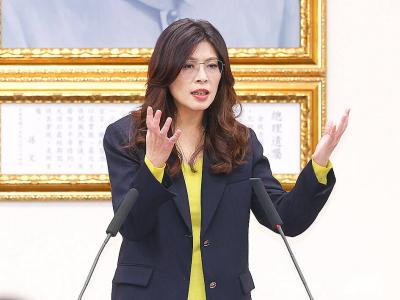
Chinese Nationalist Party (KMT) Chairwoman Cheng Li-wun (鄭麗文) today accepted an invitation from Chinese President Xi Jinping (習近平) to lead a delegation to China next month, saying she hopes to promote the peaceful development of cross-strait relations and bring stability to the Taiwan Strait. “I am grateful and happy to accept this invitation,” Cheng said in a statement from the KMT chairperson’s office. Cheng said she hopes both sides can work together to promote the peaceful development of cross-strait relations, enhance exchange and cooperation, bring stability to the Taiwan Strait and improve people’s livelihoods. At today's news conference, Cheng said any efforts to
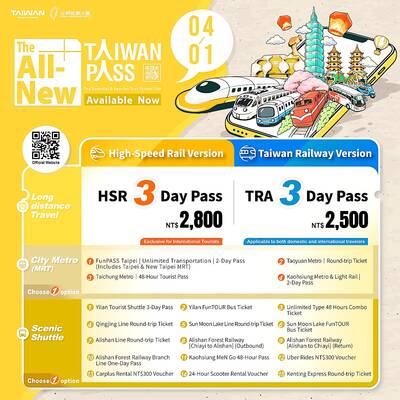
MORE POPULAR: Taiwan Pass sales increased by 59 percent during the first quarter compared with the same period last year, the Tourism Administration said The Tourism Administration yesterday said that it has streamlined the Taiwan Pass, with two versions available for purchase beginning today. The tourism agency has made the pass available to international tourists since 2024, allowing them to access the high-speed rail, Taiwan Railway Corp services, four MRT systems and four Taiwan Tourist Shuttles. Previously, five types of Taiwan Pass were available, but some tourists have said that the offerings were too complicated. The agency said only two types of Taiwan Pass would be available, starting from a three-day pass with the high-speed rail and a three-day pass with Taiwan Railway Corp. The former costs NT$2,800

The nation’s fastest supercomputer, Nano 4 (晶創26), is scheduled to be launched in the third quarter, and would be used to train large language models in finance and national defense sectors, the National Center for High-Performance Computing (NCHC) said. The supercomputer, which would operate at about 86.05 petaflops, is being tested at a new cloud computing center in the Southern Taiwan Science Park in Tainan. The exterior of the server cabinet features chip circuitry patterns overlaid with a map of Taiwan, highlighting the nation’s central position in the semiconductor industry. The center also houses Taiwania 2, Taiwania 3, Forerunner 1 and


 RSS
RSS