


Indonesian President Abdurrah-man Wahid has stunned his ministers in Jakarta by announcing he is in favor of holding a referendum in restive Aceh province on Jakarta's rule there, and that he was willing to accept the outcome.
"If we can hold a referendum in East Timor, why not in Aceh," he said during a state visit to Manila yesterday. "The consequences of a referendum, whatever the outcome, we will accept."
Wahid said, however, that he was confident Aceh would choose to remain in Indonesia.
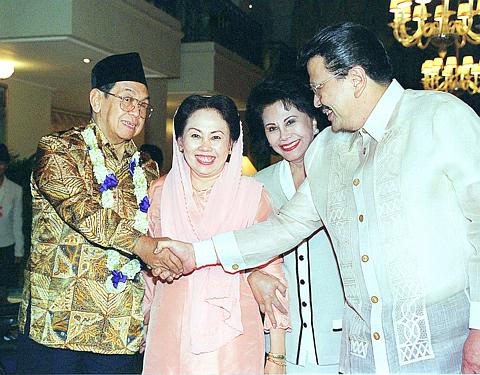
PHOTO: REUTERS
He said he was willing to offer Aceh total autonomy and 75 percent of all revenues generated in the resource-rich province.
Wahid said he was willing to visit the province along with Vice-President Megawati Sukarnoputri to meet leaders there.
At least half a million people came out on the streets of Banda Aceh, the provincial capital, on Monday to demand a referendum on independence. It was the biggest separatist protest in Indonesian history.
Aceh, on the northernmost tip of Indonesia, has a long history of opposition to Jakarta's rule starting in the Dutch colonial era.
The separatist movement has been fanned by the August referendum in East Timor, which voted for independence from Indonesia.
On hearing the news, Aceh separatists said they were poised for independence from Jakarta and expected to see a disintegration of the world's largest archipelago.
"We are supporting the struggle of our children who demand a referendum for an independent Aceh. We will defend our country, Aceh," Tengku Abdullah Syafii, commander of the Free Aceh Movement, said in Pidi, about 150km east of Banda Aceh.
"We are sure Indonesia will break up soon ... that will be the victory of the Aceh people. The struggle of the Aceh people has reached a joyful point ... in order to achieve immediate independence," he said.
The central government is facing demands for independence from Jakarta's rule from several areas of the vast archipelago of 17,000 islands. These include the Maluku islands, Irian Jaya and Aceh.
Wahid's handling of the Aceh issue has caused concern in Jakarta among military and political leaders, who believe Indonesia cannot afford another East Timor.
Parliamentarian Aisyah Amini regretted Wahid's decision to publicly support a referendum in Aceh.
"Don't let the East Timor precedent be repeated," he said yesterday. "For that reason, the president should consult with the People's Consultative Assembly (MPR). The term of referendum should be discussed, whether it will only involve the Acehnese people or involve the whole of Indonesia. A referendum is not simple, so don't hurry. Moreover it's not the president's authority to decide."
Amini was referring to the decision made earlier this year by former president B.J. Habibie, who granted East Timor a referendum without consulting the MPR, the country's highest law-making body.
Interior minister Suryadi Sudirdja said the threat of disintegration in Aceh, Maluku and Irian Jaya reflects the accumulation of disappointment in the country. He was referring to waves of violent unrest and low-level rebellion in the country's two easternmost provinces.
"We should find a just and democratic solution for the problem," Sudirdja said.
The military has been equally scathing of Wahid's handling of the issue, in particular his order last week to remove non-essential troops in Aceh.
Colonel Syarifuddin Tippe, one of two military commanders in the province, cautioned that withdrawing troops could make Aceh more dangerous and hand the initiative to separatist rebels.

LEVERAGE: China did not ‘need to fire a shot’ to deny Taiwan airspace over Africa when it owns ‘half the continent’s debt,’ a US official said, calling it economic warfare The EU has raised concerns about overflight rights following the delay of President William Lai’s (賴清德) planned state visit to the Kingdom of Eswatini after three African nations denied overflight clearance for his charter at the last minute. Taiwanese allies Paraguay and Saint Kitts and Nevis, as well as several US lawmakers and the Inter-Parliamentary Alliance on China (IPAC) condemned China for allegedly pressuring the countries. Lai was scheduled to fly directly to Taiwan’s only African ally from yesterday to Sunday to celebrate the 40th anniversary of King Mswati III’s accession and his 58th birthday, but Seychelles, Mauritius and Madagascar suddenly revoked
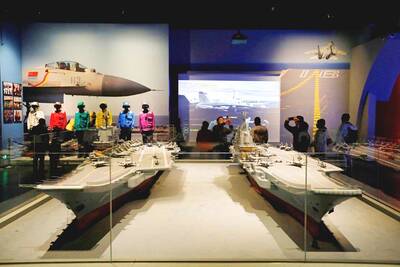
China on Wednesday teased in a video an aircraft carrier that could be its fourth, and the first using nuclear power, while making an allusion to Taiwan and vowing to further build up its islands, as it looks to boost maritime power, secure resources and bolster territorial claims. The video, issued on the eve of the 77th founding anniversary of the Chinese People’s Liberation Army Navy, featured fictional officers with names that are homophones of three commissioned aircraft carriers, the Liaoning (遼寧), Shandong (山東) and Fujian (福建). Titled Into the Deep, it showed a 19-year-old named “Hejian” (何劍) joining the group, sparking

BIG YEAR: The company said it would also release its A12 chip the same year to keep a ‘reliable stream of new silicon technologies’ flowing to its customers Taiwan Semiconductor Manufacturing Co (TSMC, 台積電) yesterday said its newest A13 chip is to enter volume production in 2029 as the chipmaker seeks to hold onto its tech leadership and demand for next-generation chips used in artificial intelligence (AI), high-performance-computing (HPC) and mobile applications. TSMC, the world’s biggest contract chipmaker, also unveiled its A12 chip at its annual technology symposium in Santa Clara, California. The A12 chip, which features TSMC’s super-power-rail technology to provide backside power delivery for AI and HPC applications, is also to enter volume production in 2029, a year after the scheduled release of the A14 chip. The technology moves
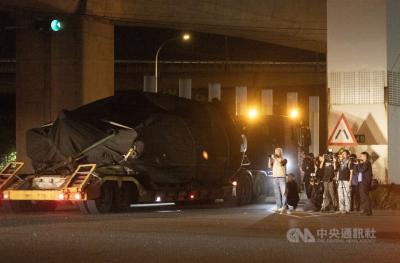
The final batch of 28 M1A2T Abrams tanks purchased from the US arrived at Taipei Port last night and were transported to the Armor Training Command in Hsinchu County’s Hukou Township (湖口), completing the military’s multi-year procurement of 108 of the tanks. Starting at 12:10am today, reporters observed more than a dozen civilian flatbed trailers departing from Taipei Port, each carrying an M1A2T tank covered with black waterproof tarps. Escorted by military vehicles, the convoy traveled via the West Coast Expressway to the Armor Training Command, with police implementing traffic control. The army operates about 1,000 tanks, including CM-11 Brave Tiger


 RSS
RSS