


Officials said yesterday that losses caused by the 921 earthquake had risen to NT$448.8 billion (US$14.1 billion).
That figure represented a significant upward revision from an Oct. 12 assessment by Taiwan's Directorate General of Budget, Accounting and Statistics (DGBAS,
Physical damage, including toppled buildings, bridges, roads and other relevant facilities, amounted to NT$341.2 billion, the directorate said in a statement.
In light of the losses, both physical and financial, senior economic officials are urging people to put mourning behind them and start spending to help contain further economic damage.
"While we feel for disaster victims and should refrain from wasting money, we should not be bound to suppress our consumption unnecessarily," Chiang Ping-kun (|?
"Suppressing consumption will not necessarily save resources for reconstruction after the quake, but will certainly cut demand and hurt economic recovery," he said.
"Private consumption, which has dropped by NT$26 billion after the quake, contributes as much as 62 percent to gross domestic product [GDP]," Chiang said.
"Important government activities should be held as scheduled and normal private sector consumption should stay on course," he said.
Chiang's views were echoed by Vice President Lien Chan (
Official forecasts for economic growth in 1999 were cut to 5.6 to 5.5 percent two days after the Sept. 21 quake, from 5.7 percent. Yesterday the DGBAS further slashed the figure to 5.4 percent, while the CEPD revised it down to 5.3 percent.
The CEPD had originally targeted a 6.1 percent economic growth rate for next year.
To revive the economy, Chiang also said the private sector should be encouraged to participate in the reconstruction, and steady power supplies should be ensured.
Wei Duan (-3旖?, Director-General of Budget, Accounting and Statistics, said yesterday physical damage, including buildings, roads and other infrastructures, was now estimated at NT$341.2 billion.
That translated into 3.7 percent of GDP, much higher than the two percent of GDP lost to Japan in the 1995 Kobe earthquake.
The 921 quake in Taiwan killed 2,474 people, injured 11,000 people, made around 310,000 people homeless and destroyed about 88,000 homes, Wei said.
In a separate assessment, the CEPD said the quake also cost NT$107.6 billion in lost revenues from the manufacturing sector.
The quake cut government revenues, including taxes and profits by state firms, by NT$40.4 billion, the council said.
The council estimated that it would need NT$77.3 billion to rebuild infrastructure, including railways, roads and dams.
The government has so far dispensed a total of NT$11.7 billion in compensation and rent subsidies for victims whose houses were destroyed and family members killed during the September quake.
However, Minister of Economic Affairs Wang Chih-kang (
Taiwan's overall foreign trade for 1999 would not be seriously damaged and Taiwan is expected to end the year with an estimated trade surplus of more than US$10 billion, Wang said.
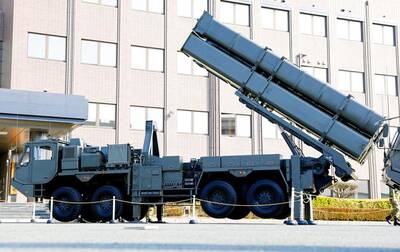
Japan has deployed long-range missiles in a southwestern region near China, the Japanese defense minister said yesterday, at a time when ties with Beijing are at their lowest in recent years. The missiles were installed in Kumamoto in the southern region of Kyushu, as Japan is attempting to shore up its military capacity as China steps up naval activity in the East China Sea. “Standoff defense capabilities enable us to counter the threat of enemy forces attempting to invade our country ... while ensuring the safety of our personnel,” Japanese Minister of Defense Shinjiro Koizumi said. “This is an extremely important initiative for

Chinese Nationalist Party (KMT) Chairwoman Cheng Li-wun (鄭麗文) today accepted an invitation from Chinese President Xi Jinping (習近平) to lead a delegation to China next month, saying she hopes to promote the peaceful development of cross-strait relations and bring stability to the Taiwan Strait. “I am grateful and happy to accept this invitation,” Cheng said in a statement from the KMT chairperson’s office. Cheng said she hopes both sides can work together to promote the peaceful development of cross-strait relations, enhance exchange and cooperation, bring stability to the Taiwan Strait and improve people’s livelihoods. At today's news conference, Cheng said any efforts to

MORE POPULAR: Taiwan Pass sales increased by 59 percent during the first quarter compared with the same period last year, the Tourism Administration said The Tourism Administration yesterday said that it has streamlined the Taiwan Pass, with two versions available for purchase beginning today. The tourism agency has made the pass available to international tourists since 2024, allowing them to access the high-speed rail, Taiwan Railway Corp services, four MRT systems and four Taiwan Tourist Shuttles. Previously, five types of Taiwan Pass were available, but some tourists have said that the offerings were too complicated. The agency said only two types of Taiwan Pass would be available, starting from a three-day pass with the high-speed rail and a three-day pass with Taiwan Railway Corp. The former costs NT$2,800

The nation’s fastest supercomputer, Nano 4 (晶創26), is scheduled to be launched in the third quarter, and would be used to train large language models in finance and national defense sectors, the National Center for High-Performance Computing (NCHC) said. The supercomputer, which would operate at about 86.05 petaflops, is being tested at a new cloud computing center in the Southern Taiwan Science Park in Tainan. The exterior of the server cabinet features chip circuitry patterns overlaid with a map of Taiwan, highlighting the nation’s central position in the semiconductor industry. The center also houses Taiwania 2, Taiwania 3, Forerunner 1 and


 RSS
RSS