

For nearly 130 hours, Liu Luan (
Rescuers must have certainly thought that what they were seeing was a manifestation of divine intervention, as Sun Chi-kuang (
Sun's father, Sun Cheng (
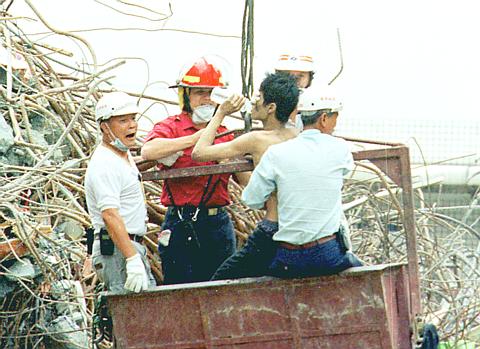
PHOTO: YEH JEN-HAO, LIBERTY TIMES
Even Deputy Mayor Ou Chin-der (
"I was stunned for a while when I saw him. Then he shouted out that his brother was still inside. Then I asked him who he was," Ou said. "He told me he was Sun Chi-kuang, a survivor."
Sun looked in fairly good health as he flashed a smile to rescuers and his approaching relatives, before being lifted down off the rubble by a crane.
About 20 minutes later, his elder brother, Sun Chi-fong (
Mayor Ma Ying-jeou (
"He told me that he and his brother survived by eating rotten apples from a refrigerator buried with them, and by drinking mineral water and rain -- actually, it was the water we sprayed on the site through fire hoses -- as well as their own urine," Ma said.
Su Tsun-jeng (蘇忠仁), a doctor at the Armed Forces Sungshan Hospital where the brothers were sent, said that aside from smoke inhalation, dehydration and low body temperatures and blood pressure, the two were in a stable condition.
The rescue raised hopes among other relatives standing at the site that their loved ones could still be saved, and reinvigorated rescuers continued to fight against the clock, even with the specter looming of frightening aftershocks, which rocked the site yesterday.
The deputy mayor, who had been responsible for saving the lives of at least two people on the operation's first day, said the Sun brothers' survival had raised the morale of the rescue team. "We were greatly encouraged. We've always had hope. But as we saw bodies lifted from the rubble hour by hour, it was disheartening," he said.
"Now that we have seen these two men emerge from the rubble in sound health, our fatigue accumulated over the past 100 hours is gone," he said.
Ou said he had asked the younger brother to help identify his precise position in the wreckage and whether he had heard any sounds from other possible survivors still trapped in the darkness. "He said he heard the voice of an old woman, as well as the sound of how she opened a bottle of mineral water coming from a certain direction, about one or two days ago," he said.
Although doubts were obviously raised about Sun's orientation, especially in the dark, the rescue team threw its weight into pushing through the ruins in the direction Sun had pointed, in the hope of finding other survivors.
News of the recovery even prompted the Japanese team to return to the site at around 2:30pm.
But as waiting relatives moved out of an indoor resting area to sit directly opposite the wreckage, craning their necks to look for any more signs of life, they were to be disappointed as four more bodies were pulled from the ruins.
As of 10pm yesterday, the death toll at the site had reached 51, with about 50 believed to be still trapped, city officials said.
With night falling, however, no one was about to give up and rescue teams continued their toil. Anxious relatives continued to pray, hoping against the odds that the next miracle would be theirs.
Sun's mother, who later returned to the site to encourage her counterparts, brought them a message of strength: "I simply want to tell those who are still waiting that we've got to have hope."
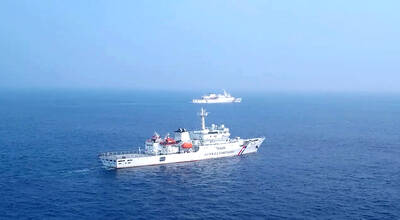
PATROL PARTNERS: The ‘Chiayi’ and the ‘Penghu’ departed for a two-day joint patrol of Palau’s exclusive economic zone, the CGA’s second diplomatic visit to the country The Coast Guard Administration (CGA) set a record for its southernmost deployment of a coast guard vessel as the vessels Chiayi and the Penghu reached Palau’s Pulo Anna Island on Saturday in a cooperative exercise between the two countries. The island, about 217 nautical miles (401km) southwest of Koror in the Palauan state of Sonsorol and 1,220 nautical miles from Taiwan’s southernmost point, Oluanpi (鵝鑾鼻), is the furthest south a CGA vessel has sailed. The two vessels are in Palau for the coast guard’s second diplomatic visit to the country. They docked at Malakal Harbor on Tuesday last week. The coast guard
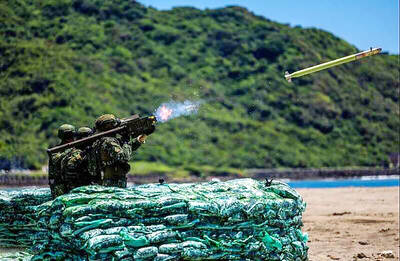
BATCH 1: The military has plans to assign the weapons to the army to defend Taiwan proper, as well as outlying islands and the navy for the Marine Corps, the official said Taiwan is to receive 500 Stinger missiles and 178 launchers from the US by the end of the year, the first batch under a planned two-stage acquisition totaling 2,621 missiles and 763 launchers, a defense official said yesterday on condition of anonymity. The portable missiles would play a vital role in the nation’s air defense capabilities, the source said. The army plans to deploy 2,235 missiles and 657 launchers to defend Taiwan proper and outlying islands, they said, citing military documents. The navy is allotted 295 missiles and 85 launchers to arm the Marine Corps and some surface vessels that lack air defense

The European Parliament on Wednesday adopted a recommendation on EU-China political relations that rejected China’s efforts to restrict Taiwan’s participation in international organizations and exchanges. The recommendation, addressed to the European Council, the European Commission and EU High Representative for Foreign Affairs and Security Policy Kaja Kallas, includes several references to EU-Taiwan relations and expresses support for closer ties, saying they would bring positive benefits and have strategic importance. Describing Taiwan as a valuable partner in trade and technology, the European Parliament said it “rejects China’s attempts to coerce international organizations, third countries and other actors into restricting Taiwan’s international participation and
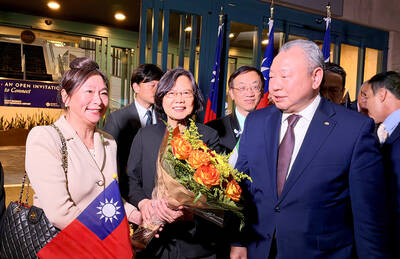
Former president Tsai Ing-wen (蔡英文) on Monday arrived in San Francisco, receiving a warm welcome from hundreds of overseas Taiwanese as she launched a week-long visit. Accompanied by Representative to the US Alexander Yui (俞大?), and head of Taiwan’s San Francisco office Wu Chih-hsiang (伍志翔), Tsai arrived at her hotel, waving, smiling and giving high-fives to Taiwanese compatriots amid cheers of “Taiwan’s democracy involves you and me” to welcome her to the San Francisco Bay Area. It is Tsai’s first visit to the US since she left office in May 2024 after serving two four-year terms as president. Tsai is today to deliver


 RSS
RSS