

In an eight-hour long clash that lasted until 4:30am yesterday, hundreds of Thai and Filipino laborers fought with rocks, pipes and gasoline bombs at the Formosa Plastic Group's Sixth Naptha Cracker site in Mailiao, Yunlin County, injuring over 20 people. Four Filipino workers were hospitalized with severe head injuries and dozens of others suffered minor injuries in the brawl, police said. Two remain hospitalized late last night.
It was the worst clash of its kind in Taiwan, but the third such incident at the Formosa Plastics complex since construction began there in 1993.
The fight erupted around 9.30pm Sunday, following disputes over the use of telephones, police said. But there was already some tension between the two groups, following a smaller-scale fistfight earlier in the evening. Three Thai workers were reportedly beaten up by their Filipino counterparts after mistakenly getting on a bus carrying Filipinos, as workers from both groups were returning from health checkups in Taichung.
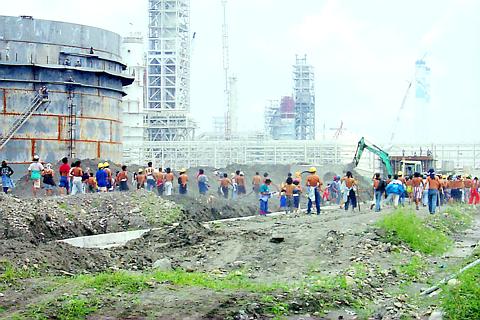
PHOTO: LIN KUO-HSIEN, LIBERTY TIMES
The Formosa complex -- the largest employer of foreign laborers in Taiwan -- has over 12,000 foreign workers at the site. Some 7,000 are from the Philippines and about 5,000 are from Thailand.
Around 200 to 300 workers were reportedly directly involved in the massive fight. Television reports said Thai workers began attacking Filipino dormitories with pipes and rocks. Home-made firebombs were then thrown by both sides, sparking several small blazes that were quickly put out, Chinese-language newspapers reported.
Undermanned local police were unable to halt the violence. After reinforcements arrived from other substations, a police crackdown began around 1:30am. But it took another three hours to bring a halt to the running battles -- and separate the feuding groups.
But tempers remained high throughout the day. Groups of Thais fought with police later in the morning, as they tried to break through police lines separating the groups. Formosa Plastics then relocated a large number of the Filipino workers, after threats were made to gather all the Filipinos for an attack on the Thais. Some 2,000 Filipinos were sent to nearby temples to spend the night, pending more permanent arrangements for their housing.
Additional police reinforcements were brought in throughout the day to guard against further clashes. Some 500 police were still at the site as of press time last night.
However, as of 11:30pm, the chief of the Yulin county police station said, "It's okay now."
High-ranking officials from the Manila Economic and Cultural Office (MECO) as well as the Thailand Trade and Economic Office in Taipei flew to Yunlin yesterday evening to try to help ease the situation. "We don't know who started the fight yet. But we'll try to ensure their (the workers) safety first, and then to find out the causes of the fight," Eliot S. Cojuangco, MECO's labor representative, told the Taipei Times.
A reconciliation meeting has been scheduled for this morning at 10am, with Philippine and Thai officials on hand to supervise representatives from the two groups of workers.
Meanwhile, just who is responsible for overseeing the Filipino and Thai workers at the Mailiao site is the subject of debate.
Su Hsiu-yi (蘇秀義), deputy director of CLA's vocational training administration said, "The council will investigate to see whether Formosa Plastics and Samsung Engineering and Construction Company (one of 44 subcontractors at the site) have enforced their management over foreign workers there. If Formosa is found responsible for insufficient management, we won't rule out the possibility of cutting its labor import quota."
Lin Chin-tzu (林慶賜), deputy manager of the Management Department at the Formosa complex, admitted that there is room for improvement. "There is only one interpreter for every 200 foreign laborers," Lin said. "Because of language barriers, we don't understand what they are trying to tell us."
Formosa officials in Taipei, however, said the contract between the two companies states that Samsung is responsible for managing foreign laborers working for it, while Formosa is in charge of the workers' entrance and exit control only.
But the CLA's Su disagrees. "Despite the fact that these workers are hired by Samsung, it's Formosa that had applied to us to import these laborers. Formosa should supervise its subcontractors," he said.
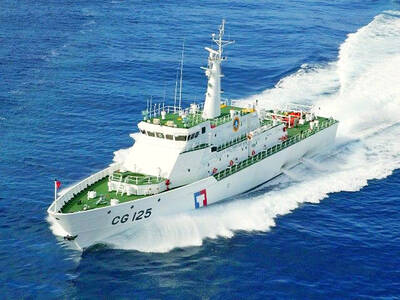
GEOPOLITICAL SIGNIFICANCE: The CGA’s nonmilitary role makes it a tool to avert diplomatic issues, an official said, while confirming the donation of a ship to Manila Coast Guard Administration (CGA) ships are scheduled to sail to the Philippines bearing the words “Taiwan Coast Guard” in a high-profile visit in October next year, the first such visit by a Taiwanese maritime law enforcement vessel to the Southeast Asian nation, the agency said yesterday. The CGA also confirmed that it had donated one of its decommissioned patrol vessels to the Philippines in a rare transfer of a retired ship to a nondiplomatic ally. The Republic of China (ROC) Navy last made such a visit in 1974, shortly before the Philippines switched diplomatic recognition to the People’s Republic of China in
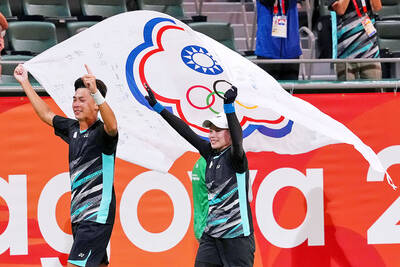
SOFT TENNIS: Yu Kai-wen and Huang Shih-yuan narrowly defeated their Japanese rivals to capture Taiwan’s first gold at the Asian Games in Nagoya Yu Kai-wen (余凱文) and Huang Shih-yuan (黃詩媛) won Taiwan’s first gold of this year’s Asian Games, defeating a Japanese duo in a nail-biter in the soft tennis mixed doubles final in Nagoya, Japan, while Johnny Sun (孫家閎) won silver in wushu and Shih Cheng-chung (石政中) won bronze in men’s kumite. Yu and Huang narrowly defeated Japan’s Toshiki Uematsu and Rena Temma 5-4 (2-4, 5-3, 4-2, 1-4, 1-4, 4-0, 1-4, 4-1, 7-5) to give Taiwan its first gold in soft tennis mixed doubles at an Asian Games since 2018. Sun secured Taiwan’s first wushu medal at this year’s game, with a combined score
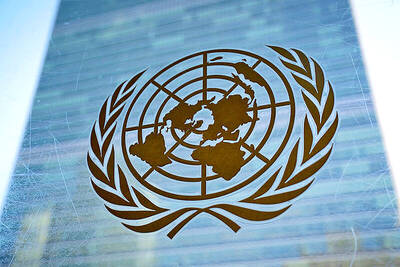
CALL FOR CHANGE: They urged the UN to facilitate Taiwan’s involvement in the body, recognize its peace efforts and to work with members in preventing military conflict Representatives to the UN from five of Taiwan’s diplomatic allies sent a joint letter to UN Secretary-General Antonio Guterres on Friday, calling for the country’s inclusion in the body. Allies in the letter sent ahead of the 81st session of the UN General Assembly General Debate made three demands in support of Taiwan: inclusion, recognition and camaraderie. They implored the UN to seek an appropriate way to facilitate Taiwan’s meaningful involvement in the world governing body, saying that UN Resolution 2758, which accepted the People’s Republic of China (PRC) as a member of the UN, does not exclude Taiwan. Beijing claims that the
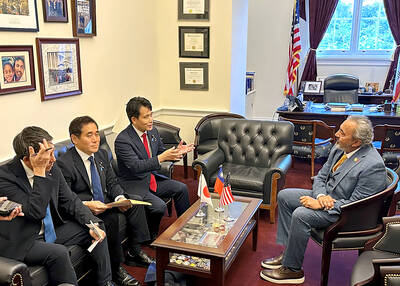
WASHINGTON MEETING: Japan’s Hirofumi Takinami said participants rejected the idea that the US should limit its defensive perimeter to the Second Island Chain US and Japanese lawmakers agree that the US must defend the First Island Chain, including Taiwan, and should not fall back to the Second Island Chain, while “a Taiwan contingency is a Japan contingency and therefore a US-Japan alliance contingency,” media reported after a meeting between officials of the two nations in Washington on Tuesday. A delegation of Japanese lawmakers from the Liberal Democratic Party met with US Senator Thom Tillis, co-chair of the Senate Taiwan Caucus, and US Representative Ami Bera, co-chair of the US Congressional Taiwan caucus, to discuss issues concerning East Asia and the Taiwan Strait. The Japanese and


 RSS
RSS