

You would never have guessed that a comic book featuring a giant snake would make you feel warm and safe.
And yet, the art of Huang Wen-yu (黃文妤) speaks to the heart through imagery suffused with monsters and dark shadows.
And that is because Huang is not only a cartoonist and illustrator, she is also an art therapist.
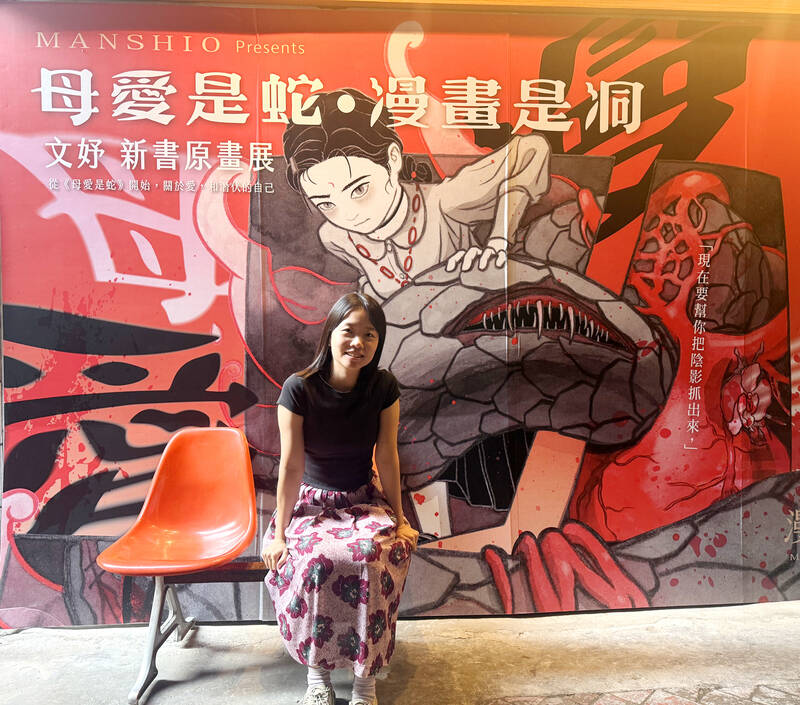
Photo: Julien Oeuillet
Under the title “Motherly Love is a Snake,” the show exhibits works from Huang’s books, and is the inaugural exhibition of the newly opened Manshio cafe in Kaohsiung.
“During art creation,” she tells the Taipei Times, “artists have inner changes, their mindset changes while they draw.”
Huang’s art is inspired by her work as an art therapist, which enables her to use images to express trauma and mental health recovery.
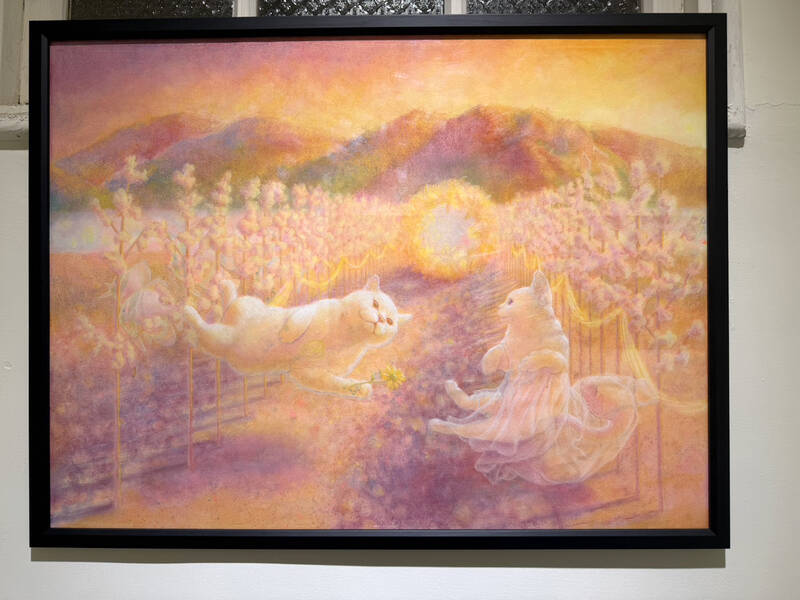
Photo: Julien Oeuillet
Her first book tells the story of a cat with a dinosaur tail, illustrated in large paintings where the cute animal is confronted by monsters and dangerous landscapes.
“The tail symbolizes our inner fears and our suppressed desires,” she says, “this dinosaur will pop out and devour and eat everything.”
The juxtaposition of such an innocent and fragile animal, in realistic drawings, with such dark scenery, allows viewers to connect with the emotional journey towards recovery.
“Every page represents different stages. First it’s in the sea and all is unclear, then there is more awareness of the inner desires which are represented by monsters, I acknowledge and accept them. Then all is sunny and clear. Every page is a different state of mind.”
FLEDGLING DISCIPLINE
Huang says that Taiwanese have little understanding of art therapy, so demand remains low.
“It’s only acknowledged academically and there is no national licence. There are now two academic associations for art therapy, but just above 200 registered art therapists, which is not a lot,” she says.
Huang works with both children and the elderly, and says that art therapy is often the first time in their lives that old people get to express a personal taste, “things as simple as what their favorite color is.”
There is an element of inter-generational tension in Huang’s work.
Further stories focus on a woman using a sort of magic gun to get ghostly shadows out of people.
“In this work,” she says, “I try to get to know how culture affects women, mother-and-daughter relationships.”
Snake imagery also appears in her personal experience working in an institution for children that functions in a similar way to an orphanage.
“The children’s parents can’t take care of them because of domestic violence or drug addiction or incarceration,” she says. “Many of these children have trauma or emotional regulation issues, so I do art therapy for them.”
One little boy who suffered from abuse made a snake out of clay that he used to express anger, pretending to bite her and then putting it to sleep in a box. “This is how he learned to manage his feelings.”
The transmutation of such a frightening image as a snake or spectral shadows or monstrous dinosaurs into a touching and human story invites the audience to see them in a positive light, and thus accept their emotions in a healthy manner.
Huang says she has grown sensitive to the cultural aspect of art therapy.
“Art in Taiwan comes a lot from colonial history,” she says, “Taiwan’s modern art developed during Japanese colonization, when Japan introduced Western oil painting. Art therapy is also a Western idea. Our professors all come from abroad to bring this concept here. I think if we want people to enjoy art therapy more we have to find our art, that relates to our daily life and experience.”
There was a time, a few decades ago, when the men who owned the world’s biggest pornography businesses were happy to be famous. They paraded a lifestyle they hoped looked glamorous, appearing in public dressed in silk pajamas or with a woman in swimwear on each arm. Porn moguls like Hustler’s Larry Flynt or Playboy’s Hugh Hefner were household names. “Say what you want about these old perverts, who once set the tone of our sexual culture, but at least you knew who they were and what they were selling,” Patricia Nilsson writes in her new book, Guilty Pleasure: The Pornification

Speculation started to fly last month that Chinese Nationalist Party (KMT) candidates running in the November elections wanted to keep their distance from party Chair Cheng Li-wun (鄭麗文). That some in the KMT were concerned that Cheng’s firm ideological adherence to the “one China principle” is no secret. There had already been pushback from within the party on issues ranging from the budget to defense, as well as over some of her more hardline comments. The timing made sense, however. The KMT party congress unity love fest wrapped up at the end of July. Through the primaries and up to

In 1904 the Japanese introduced caning to Taiwan. As a punishment, caning was applied by the Japanese to Taiwanese and Chinese subjects, never to the Japanese themselves (it had been outlawed in Japan in 1882). An imperial and colonial act, caning thus functioned to define and display social class boundaries. So it is with the new legislation permitting caning proposed by Chinese Nationalist Party (KMT) legislators last week. According to the KMT proposal, individuals committing major fraud, aggravated sexual assault, driving under the influence of drugs and child abuse may be subject to caning. These are high-profile offenses that generate great
OCT. 5 to OCT. 11 Many worshippers of Taoist deity Lord Su (蘇府王爺) had never witnessed his “north-south grand inspection tour” of central Taiwan. The historic procession last took place in 1969, and before that, in 1893. Lukang’s Fengtian Temple (奉天宮) in Changhua County last Sunday completed Lord Su’s sixth grand inspection tour ever, taking its three main statues to settlements from Miaoli to Yunlin over 10 days. According to news reports, this year’s event also included a boat patrol that set out from Taichung, bringing luck and safety to fishers and offshore wind farm workers. Why did it


 RSS