

Speculation started to fly last month that Chinese Nationalist Party (KMT) candidates running in the November elections wanted to keep their distance from party Chair Cheng Li-wun (鄭麗文).
That some in the KMT were concerned that Cheng’s firm ideological adherence to the “one China principle” is no secret. There had already been pushback from within the party on issues ranging from the budget to defense, as well as over some of her more hardline comments.
The timing made sense, however. The KMT party congress unity love fest wrapped up at the end of July. Through the primaries and up to that point, it was necessary to regularly appear with the party chair. Not so starting in August.
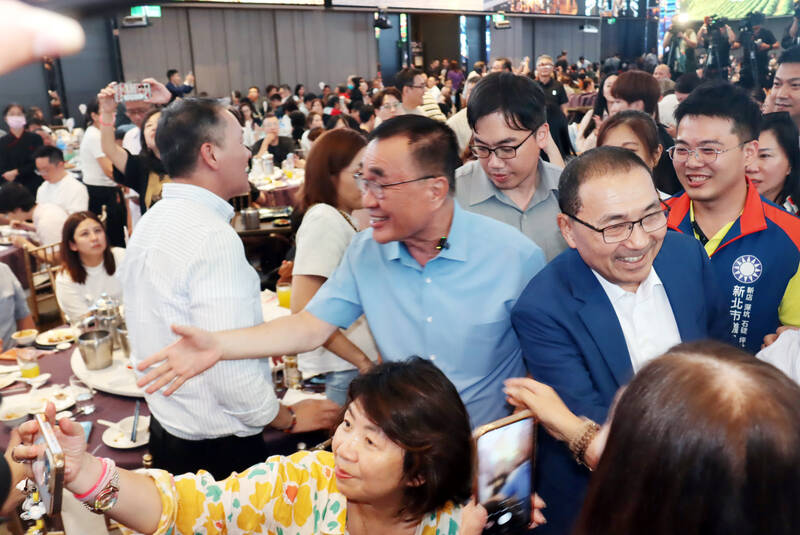
Photo: Weng Yu-huang, Taipei Times
In other democracies, candidates sometimes distance themselves from the party leader — especially in tough districts. In Taiwan, typically the party chair plays a role regardless, though how closely the candidates embrace them varies.
In 2018, however, there was a very public split between KMT candidates who preferred to appear with a trio of popular candidates and cut out the party chair from rallies and events, and a small handful of candidates that stayed loyal to the party chair.
Will Cheng face a similar marginalization? It is too early to say and the signs are mixed, but it will become glaringly obvious one way or the other in late October and into November as the rallies get into high gear.
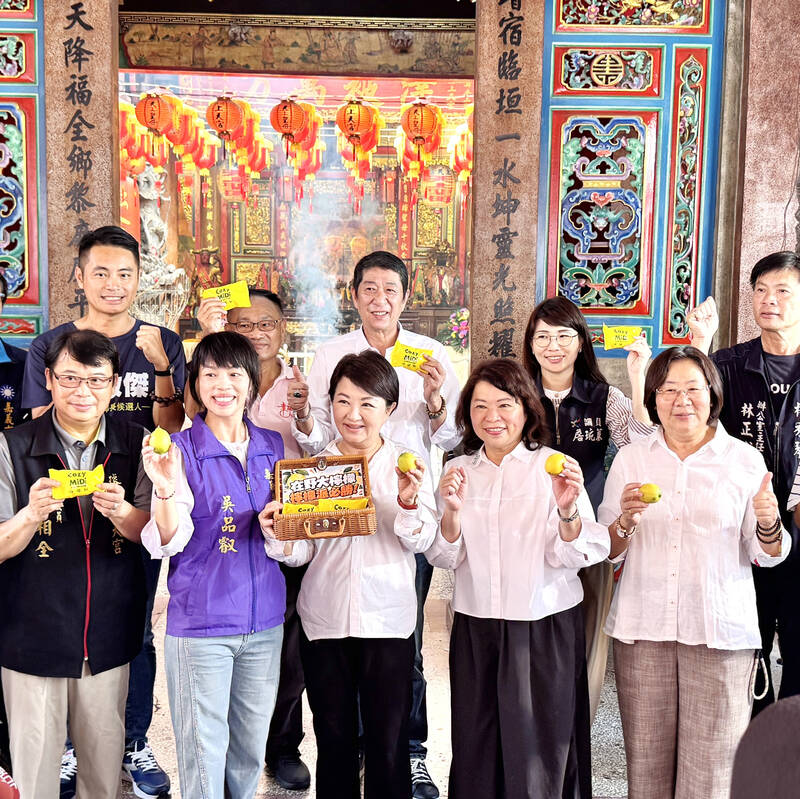
Photo: Tsai Tsung-hsun, Taipei Times
Consider this from a candidate’s perspective. The June Formosa poll found that only 26.7 percent had confidence in Cheng, versus 56 percent who did not. Since then, a lot has happened that could have pushed those numbers both up or down, but it suggests that in competitive districts she could turn off independents.
Among KMT supporters, 69.2 percent trusted her, and among Taiwan People’s Party (TPP) supporters it was 49.1 percent. However, those picking “very confident” were only 12.4 and 9.5, respectively. That suggests she would not be a big draw for the base, either. Relations between the KMT and the TPP have soured in some parts of the country, so those TPP numbers could now be lower.
Of course, constituencies vary, and in some, Cheng is a positive, but broadly speaking, she is not a major asset. However, having the party chair as an ally comes with other benefits, and some candidates personally support her ideological stances.
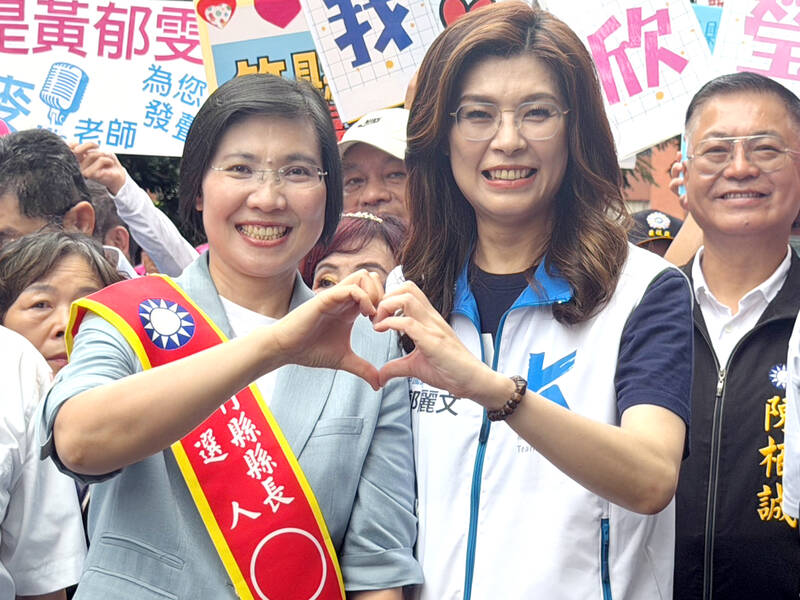
Photo: Liao Hsueh-ju, Taipei Times
To research this, I set a start date of Aug. 1. I examined news stories about interactions between the candidates and Cheng, image searches of their public interactions, the Facebook photos posted by each candidate to see who they wanted to be associated with, and searched for campaign advertising. I examined all 19 KMT candidates for mayor and county commissioner, plus three KMT-backed independent and TPP candidates.
Some important broad patterns appeared. Most candidates in this cycle are not playing down their party affiliation, are proudly pan-blue and love being photographed with major party figures. Especially popular KMT figures to be photographed with include Taichung Mayor Lu Shiow-yen (盧秀燕), New Taipei Mayor Hou You-yi (侯友宜), Taipei Mayor Chiang Wan-an (蔣萬安) and New Taipei mayoral candidate Hammer Lee (李四川). Being pictured with TPP founder Ko Wen-je (柯文哲) is a popular choice in areas where KMT candidates hope to appeal to TPP supporters.
COUNTY COMMISSIONER RACES
At least three candidates are very keen to associate themselves with Cheng. Kinmen candidate Jennifer Chen (陳玉珍) and Cheng have a visibly warm relationship, and Cheng referred to Chen as a “cute little sister,” which is a far cry from Chen’s normal nickname, the “Kinmen tank.” The two are ideologically tight-knit.
In Changhua Wei Ping-cheng (魏平政) is widely disliked by the local KMT, and his two remaining major allies just got put in jail. He is desperately clinging to Cheng for dear life.
In Hsinchu County, Hsu Hsin-ying (徐欣瑩) also needs Cheng’s support in the wake of an ugly primary that split local KMT support. Then, relations with the TPP acrimoniously broke down over the Jhubei City mayoral race, with Hsu at the center of the controversy. Yilan’s James Wu (吳宗憲) faces the problem that the outgoing KMT administration was plagued by scandal and the DPP is looking strong this cycle.
Hsu Shu-hua (許淑華) in Nantou and Chung Tung-chin (鍾東錦) in Miaoli have also been welcoming of Cheng. Both are incumbents in deep-blue counties, so they do not need Cheng’s help, but they appear to appreciate it regardless.
KMT-backed former TPP-turned-independent Ann Kao (高虹安) in Hsinchu City and TPP Chiayi City candidate Chang Chi-kai (張啟楷) are playing a different game. They are welcoming of Cheng, but carefully balance her with appearances by Ko Wen-je and TPP Chair Huang Kuo-chang (黃國昌).
Four candidates appear with Cheng in public, but do not emphasize it on social media.
In Pingtung, Su Ching-chuan (蘇清泉) lost in a tight race in 2022, and may hope Cheng will juice up voter turnout. In Taitung, Wu Hsiu-hua (吳秀華) is facing a DPP candidate that some think might actually have a chance in this deep-blue county, so she may be thinking along similar lines. Chiayi County KMT-backed independent Wu Pin-jui (吳品叡) will also need KMT voter turnout.
Though in a stronger position, Yunlin’s Chang Chia-chun (張嘉郡) may have similar considerations, but as a member of the powerful Yunlin Chang clan faction, she may have other motivations beyond electability in the direction of political influence.
The candidates for Lienchiang County (Matsu), Penghu and Hualien do not appear to have met with Cheng, but it is unclear if there is any political meaning, or they are simply too remote.
THE ‘BIG SIX’
Things got interesting examining the mayoral candidates for the “big six” special municipalities. Only three have met with Cheng publicly since July, but not one posted pictures on Facebook about it.
Tainan’s Hsieh Lung-chieh (謝龍介) met with her in August and again on Sept. 30 when Cheng moved the KMT’s central standing committee meeting to Tainan. On July 25 he was asked point blank if he would appear on campaign billboards with Cheng, and he replied he would not rule it out. However, so far it has not happened. Tainan is deep green, so that is not surprising.
In Taoyuan, Simon Chang (張善政) appeared with Cheng at an event on Sept. 2. Of the “big six” candidates, he has the least to lose by appearing with Cheng. He is far ahead in polling, and Taoyuan leans KMT.
On Sept. 12, Cheng and New Taipei candidate Hammer Lee (李四川) appeared at an event, but curiously two other attendees — Lu Shiow-yen and Hou You-yi — left before Cheng arrived. This could simply be scheduling conflicts, but regardless, it shows they did not prioritize being around Cheng.
A similar situation also took place the same day. Both Taipei candidate Chiang Wan-an (蔣萬安) and Cheng attended the same event, but not at the same time, so they did not appear together.
On Sept. 25, Kaohsiung’s Ko Chih-en (柯志恩) was sharing with the press plans to campaign with Ko Wen-je, but when asked whether she would invite Cheng to campaign with her, she simply said that everyone respects each other’s schedules and the pace of their respective campaigns. That enthusiasm gap is telling; she clearly calculates that Ko helps her gain supporters, but Cheng, not so much.
That Taichung’s Johnny Chiang (江啟臣) has not met with Cheng should surprise no one; the two are as far apart ideologically within the KMT framework as is possible. As if sending a message, he just announced that the exact same trio that cut out the party chair in 2018 — Han Kuo-yu (韓國瑜), Lu Shiow-yen and Hou You-yi will be attending his campaign headquarters opening on Oct. 4.
Donovan’s Deep Dives is a regular column by Courtney Donovan Smith (石東文) who writes in-depth analysis on everything about Taiwan’s political scene and geopolitics. Donovan is also the central Taiwan correspondent at ICRT FM100 Radio News, co-publisher of Compass Magazine, co-founder Taiwan Report (report.tw) and former chair of the Taichung American Chamber of Commerce. Follow him on X: @donovan_smith.
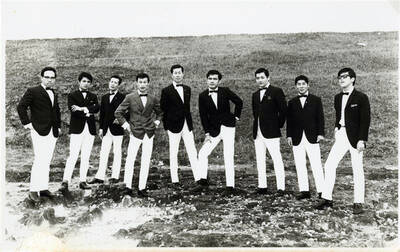
Sept. 28 to Oct. 4 Opening in 1971, Singapore’s Wisma Theatre (海燕歌劇院) was entirely modeled after Taiwanese live variety shows, combining singing, dancing and drama. Even its performers were recruited from Taiwan. The formula was an instant hit, selling out on the third night with the crowd fighting outside for tickets. Among its key figures was 31-year-old Chi Li-nan (紀利男), an acclaimed saxophonist and band leader who had entered Taiwan’s live entertainment scene at age 19 with zero musical training. Chi wasn’t even supposed to be there. He had accompanied his girlfriend, pop singer Shang Kuan Ping (上官萍), to negotiations with Wisma’s agent.

In 1951, the Central Propaganda Department of the Chinese Nationalist Party’s (KMT) Central Reform Committee launched an English-language magazine, which, for the next 75 years, would serve as a mouthpiece for Taiwan’s government. Initially titled the Free China Review, and later rechristened as the Taiwan Review, the magazine published its final issue in March. Former editor Richard Vuylsteke has described the magazine as Taiwan’s “landmark foreign language publication going abroad.” The magazine was not universally respected. Some international scholars, including a few contacted for this article, dismissed it as a “propaganda rag.” But others, including Shelley Rigger, a top US researcher at
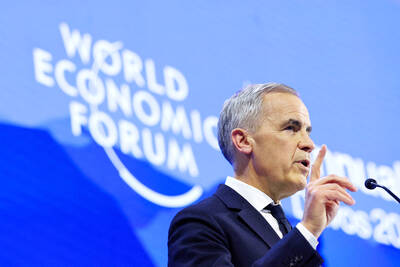
Mark Carney built a global profile this year by standing up to US President Donald Trump. If some prediction-market traders and prominent admirers are right, the Canadian prime minister could end the year with the Nobel Peace Prize and Time magazine’s Person of the Year. Carney briefly became the favorite Monday for the 2026 Nobel Peace Prize on Kalshi, a US-based prediction market, when traders on the exchange put his chances at 14 percent. His odds later fell, illustrating the highly speculative nature of the wagering. There is no public evidence Carney is on the Nobel Committee’s secret shortlist for the prize

Off the coast of Taichung lies the well known Gaomei Wetlands (高美濕地), a popular nature preserve. On weekends, especially in the evenings, the site’s walkways are crowded with sunset watchers, its mudflats filled with people wading and taking pictures of the local wildlife. Birds, amphibious fish, crabs and other organisms flourish. A few hundred meters to the south Berth number 8 of the Port of Taichung juts inland, surrounded by chemical plants, cement factories, chemical storage sites, warehouses and wind turbines. This infrastructure, critical to the running of a major industrial economy, will be targeted in wartime. Though they do not


 RSS
RSS