

Television loves a gangster story — and apparently so does the Duchess of Sussex. This week, Netflix’s The Gentlemen — Guy Ritchie’s latest addition to the gangster canon, which stars Theo James as a distractingly handsome aristocrat who becomes embroiled in the world of organized crime — returns for its second season. And last month, the show hit the headlines after rumors that Meghan was reportedly in early talks to join its third season when she and Prince Harry made their highly unexpected return to the UK.
At first, Meghan’s potential role seemed like a random pivot for the former Suits star, who now seems far more at home holding a jar of her Montecito-made jam than brandishing a gun. But really, these casting rumors are indicative of a wider shift in the traditionally machismo-fueled gangster genre, where it’s now more common to see women stealing the spotlight — and calling the shots.
When The Gentlemen premiered in 2024, it marked a departure from Ritchie’s previous work. Alongside James and Vinnie Jones, the show stars Kaya Scodelario, who is best known for portraying Effie in Skins, the seminal British teen drama. Scodelario plays Susie Glass, a sharp, impeccably dressed, ruthless head of an underground cannabis empire, who introduces Eddie (James) to her world following the death of his father. She isn’t the first female character in Ritchie’s crime shows, but she is the first woman who has parity with her male peers. She’s the polar opposite of a “damsel in distress” — in fact, wherever she leads, Eddie follows.
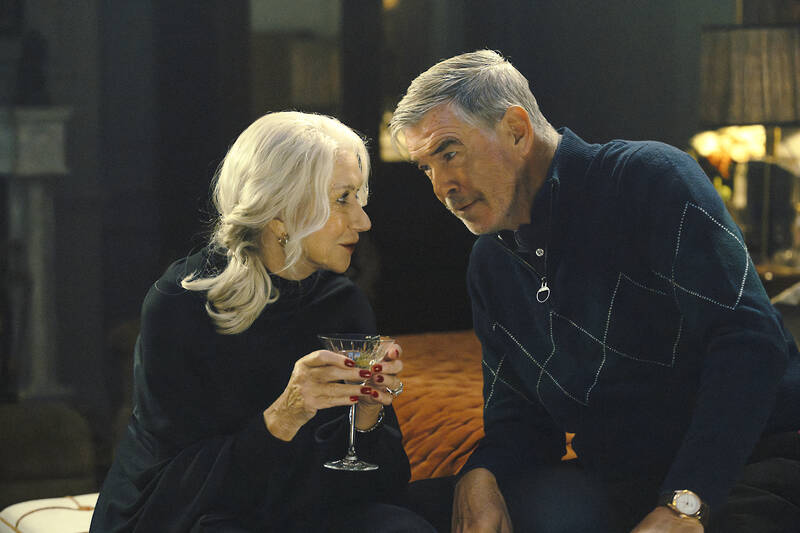
Photo: AP
“What I liked about her was that this isn’t a story about her learning how to be a criminal … She’s already at the top of the ladder,” said Scodelario when I interviewed her in 2024.
She told me that people initially assumed Susie would be “the girlfriend or the wife or the sidekick,” when really the opposite was the case.
Susie is part of a new wave of female characters in gangster shows who are intrinsic to the genre increasing its depth and scope. As a society, there’s a tacit acceptance that men will be involved in all kinds of criminal activity and violence, but female gangsters force us to take a much closer look at the characters’ motivations. These women create space for scenes that sometimes feel even more shocking and subversive, precisely because of their proximity to femininity.
On Netflix’s assassin series Black Doves, the professional killers are handled by the grudge-holding Lenny Lines (Kathryn Hunter), whose tiny stature only makes her more scary. The show’s most powerful organized crime boss is Alex Clark, played by Tracey Ullman, who runs a massive criminal enterprise that has connections reaching into the highest level of the British government.
Similarly, in the Paramount+ series MobLand, which also returns for its second season this month, the most hair-raising character isn’t crime boss Conrad Harrigan (Pierce Brosnan) or even his rough-around-the-edges “fixer,” Harry Da Souza (Tom Hardy). No, it’s Maeve Harrigan (Helen Mirren) — the mob family’s Irish matriarch, who is as bloodthirsty as she is protective.
Traditionally, women in gangster shows have tended to be either shallowly written objects of male desire, or cunning matriarchs like Maeve, who command respect and use family ties to control people. The latter category often operate quietly behind the scenes, holding the real financial or political power while the men in their families are front and centre. Think Polly Gray (Helen McCrory), the treasurer of the Shelby family in Peaky Blinders, or Youn Yuh-jung’s portrayal of a deliciously evil and corrupt country club owner in season two of Netflix’s Beef.
This year, we’re starting to see the archetype gradually evolve. In HBO’s Euphoria, drug queenpin Laurie, played by a chillingly deadpan Martha Kelly, is very much not a matriarch or a sexualized figure. (With the exception of doting on her beloved pet parrot, Paladin). And rather than fade into the background, she didn’t hesitate to go up against fellow drug lord Alamo Brown in a murderous turf war. In fact, right up until the grisly finale, there is nobody above Laurie, and her destiny is entirely in her own hands.
And in The Gentlemen, Scodelario’s character is the classic millennial girlboss — a fitting role for an actor who had her breakthrough on a show that defined 2000s youth culture. Susie loves red lipstick and an Instagram-ready outfit, making her simultaneously an object of desire and aspiration. She’s a gangster who doesn’t look like a gangster, but at the same time, her visual femininity isn’t her defining characteristic — it’s her ability to strategize and get things done.
In a show where the men are often held back by their status and the firmly set roles that they occupy — father, heir, fixer — Susie is a hyper-capable shapeshifter who can cut their egos down to size. In the heart-pumping season two premiere alone, we see her tweed-clad at grouse shooting, suited up at an art auction (to spend a cool £16 million on a Botticelli painting), covertly hatching plans in a steamy lakeside sauna (of all places), pursuing masked thieves on bikes in a classic high-speed chase, negotiating with a (terrifying) Italian mafia boss, and continuing her flirtationship (or is it?) with Eddie.
Really, it’s not surprising that The Gentlemen supposedly piqued Meghan’s interest, because its second season is a high-budget, twist-heavy affair. The series now boasts a prestige production value that feels more aligned with Netflix past mega-hits including The Crown and House of Cards. And crucially, it’s also a show where women take up more space than ever in the Guy Ritchie cinematic universe. In Susie’s world, aristocrats might be the original organized criminals, they are by no means the best — as long as she’s around.
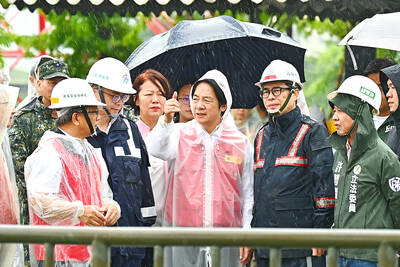
The flooding in Kaohsiung after the recent torrential rains has become an issue for mayoral candidates of both major parties. Chinese Nationalist Party (KMT) Kaohsiung mayoral candidate Ko Chih-en (柯志恩) brought in hydraulic-engineering professor Lee Hong-yuan (李鴻源), who called for comprehensive flood control measures on the Dianbao Creek (典寶溪), according to local media. Ko attacked the Democratic Progressive Party (DPP) for being behind on flood control measures, but as the city administration observed, there are many weaknesses in how the government can mitigate extreme rainfall. Nor is the river entirely under the management of the city. The low-lying Dianbao River
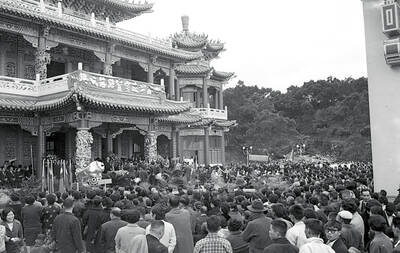
Aug. 31 to Sept. 6 More than 3 million people visited Taipei’s Zhinan Temple (指南宮) in 1973, making it Taiwan’s second-most visited scenic area that year. Built in 1891, the temple had been a tourist destination since the Japanese colonial period, when visitors had to initially take a ferry across the Jingmei River before climbing a winding trail up Houshan (猴山). Its popularity was reflected in popular media. The 1932 tune New Song of the Black Cat and Black Dog (新烏貓烏狗歌) depicted two lovers who prayed at the temple for their marriage. The man

Taiwan Power Co (Taipower, 台電) chairman Tseng Wen-sheng (曾文生) uses a sports metaphor to describe the density of electricity demand. A household is a ping-pong ball, ordinary industry a baseball and a science park a bowling ball. A data center is a shot put. Taiwan is preparing for the shot puts. Four new combined-cycle units at Hsinta (興達) and Taichung (台中), with combined capacity of about 5.2GW, are scheduled to begin supplying or testing on the grid by the end of this year. The Energy Administration’s (能源署) plan adds about 25.98GW of gas-fired capacity between this year and 2035, predominantly fueled
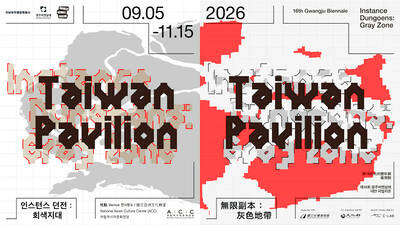
The name “Taiwan” is to appear at South Korea’s Gwangju Biennale when it opens on Saturday, after months of objections from Taiwanese artists and government agencies over an attempted name change. China Pavilion personnel halted installation and left the venue on Friday, after China’s Ambassador to South Korea Dai Bing (戴兵) objected to the restoration of the “Taiwan Pavilion” name. As of Monday, the Chinese side was reportedly preparing to withdraw, although its formal withdrawal had not been completed. The pavilion dispute began on June 10, when the ministry and participating artists said organizers had changed “Taiwan Pavilion” to “NTMoFA Pavilion,” referring


 RSS
RSS