

The name “Taiwan” is to appear at South Korea’s Gwangju Biennale when it opens on Saturday, after months of objections from Taiwanese artists and government agencies over an attempted name change.
China Pavilion personnel halted installation and left the venue on Friday, after China’s Ambassador to South Korea Dai Bing (戴兵) objected to the restoration of the “Taiwan Pavilion” name. As of Monday, the Chinese side was reportedly preparing to withdraw, although its formal withdrawal had not been completed.
The pavilion dispute began on June 10, when the ministry and participating artists said organizers had changed “Taiwan Pavilion” to “NTMoFA Pavilion,” referring to the National Taiwan Museum of Fine Arts.
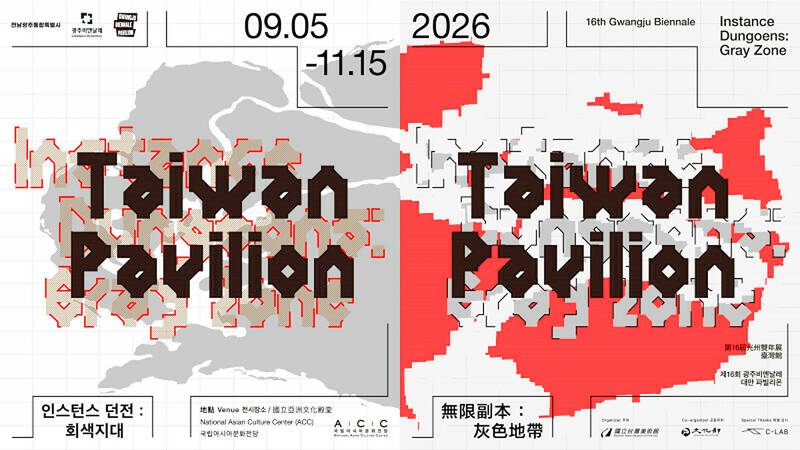
Photo courtesy of the Ministry of Culture
The government demanded that the original name be restored. The disagreement attracted wider attention in Taiwanese and South Korean media after it became public on Aug. 15.
Taiwanese artist Su Hui-yu (蘇匯宇), who is participating in the biennale, told the Taipei Times he believed Chinese pressure was behind the change.
“Everyone knows,” Su said, adding that he had never encountered such an extreme case in an art setting.
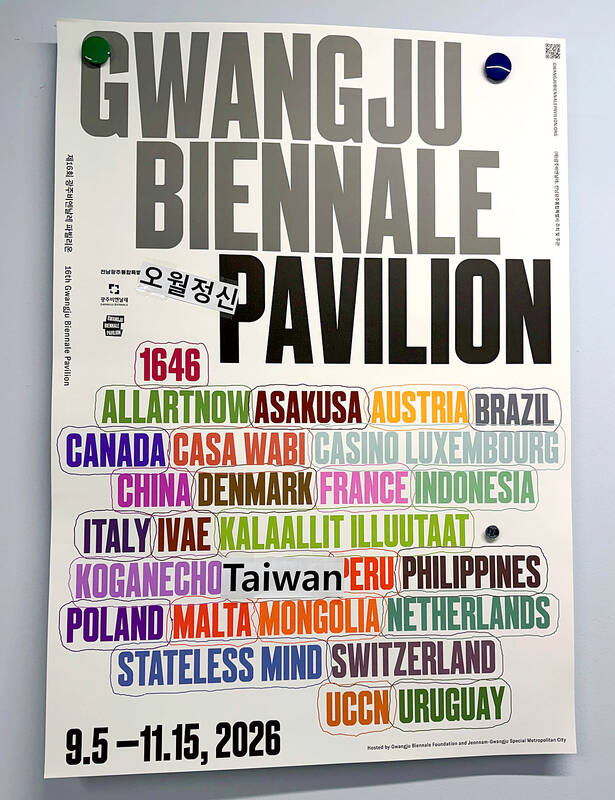
Photo: CNA
The Gwangju Biennale Foundation did not clearly explain why “Taiwan” was dropped. It said in its press release on Aug. 19 that NTMoFA had joined as an institutional participant and was therefore identified by its institutional name, rejecting allegations of “political censorship.”
The Ministry of Culture disputed this, saying it applied as the “Taiwan Pavilion” in January but the foundation suddenly proposed NTMoFA in June. Asked by a local broadcaster, Gwangju MBC, whether considerations involving China influenced the decision, the foundation said it “could not answer.”
Gwangju Biennale CEO Yoon Beom-mo told another local broadcaster, KBC, that “working-level staff” changed the name, adding that the foundation later had to consider “international and diplomatic issues” after Taiwan protested.
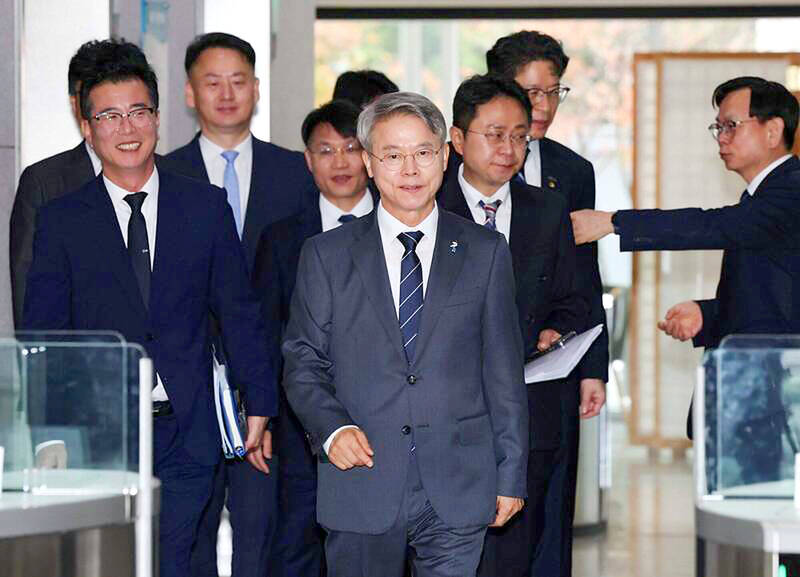
Photo: Euronews
After continued objections, an official at the foundation told the Taipei Times on Aug. 26 that the foundation had agreed to use “Taiwan” at the venue.
Gwangju Mayor Min Hyung-bae, who also chairs the foundation, criticized its handling of the dispute during the livestreamed city government meeting — seen by the Taipei Times — on Aug. 26, asking: “Why should politics intervene in art?”
He called the controversy “very shameful for Gwangju.”
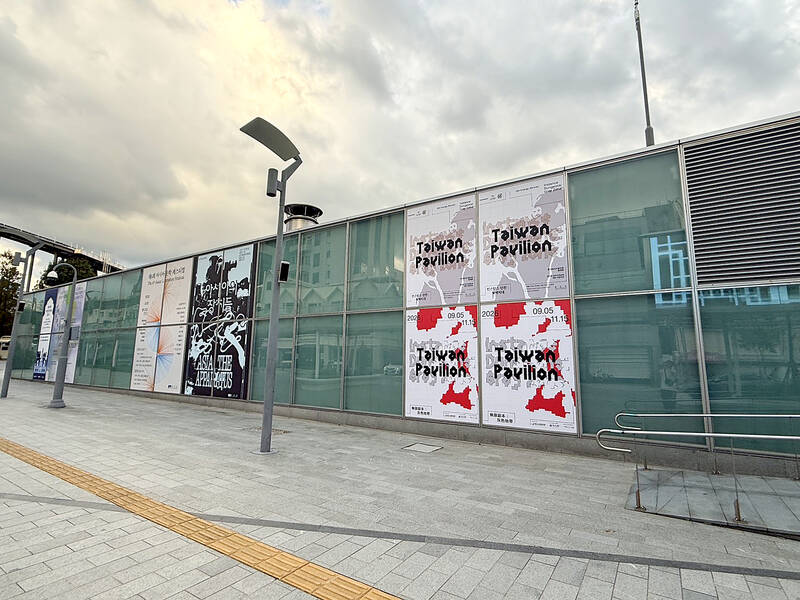
Photo courtesy of the Ministry of Culture
Dai met Min the following day and expressed regret over the decision, South Korean media reported.
CHINA’S INTERVENTION
First held in 1995 and held every two years, the Gwangju Biennale this year features 27 pavilions representing 16 countries and 11 institutions. Taiwan used the name “Taiwan” at previous editions with no comparable dispute reported.
Questions remain over why the foundation resisted the name for months. Min’s criticism indicates that the decision did not originate with the foundation’s chairman.
The Seoul Shinmun reported that the foundation’s staffing problems and disrupted continuity might also have contributed, with mostly short-term employees and “only two contract workers handling 27 countries and institutions.”
Hankook Ilbo also reported suspicions that organizers resisted Taiwan’s objections because of Chinese pressure, while Taiwan’s venue — the National Asian Culture Center — also faced criticism for delaying installation.
PRESSURE ON INTERNATIONAL STAGE
The issue extends beyond Taiwan-South Korea relations. Beijing has long pressured international companies and cultural institutions over how they refer to Taiwan.
Gwangju is also closely associated with South Korea’s democracy movement and progressive politics, which made an apparent restriction on Taiwan’s name particularly jarring to Taiwanese artists and their supporters.
And with the Nov. 28 local elections three months away, another international dispute over Taiwan’s name could again become a domestic political issue.
Ahead of Taiwan’s 2018 local elections, the Dominican Republic, Burkina Faso and El Salvador severed diplomatic ties, reducing its allies from 20 to 17 within four months and fueling criticism of the Tsai Ing-wen (蔡英文) administration amid the “Han wave” led by Han Kuo-yu (韓國瑜).
Attention now turns to whether China completes its withdrawal and the “Taiwan Pavilion” name remains throughout the biennale, which runs through Nov. 15.
The city government on Sunday apologized for its inadequate handling of the dispute. It said the pavilion name was a matter of artistic expression and did not represent recognition of Taiwan as a state, while affirming that its respect for South Korea’s “one China” policy remained unchanged. Broadcaster KBS reported that Min had visited the Chinese Embassy shortly before the apology.
As of Monday, the foundation confirmed to the Taipei Times that “Taiwan Pavilion” would remain in use, while the Chinese side was still withdrawing from the biennale.
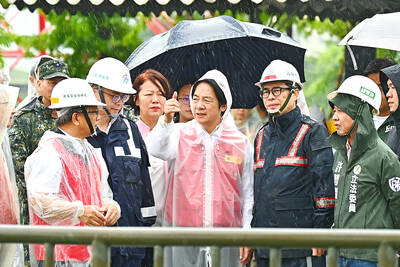
The flooding in Kaohsiung after the recent torrential rains has become an issue for mayoral candidates of both major parties. Chinese Nationalist Party (KMT) Kaohsiung mayoral candidate Ko Chih-en (柯志恩) brought in hydraulic-engineering professor Lee Hong-yuan (李鴻源), who called for comprehensive flood control measures on the Dianbao Creek (典寶溪), according to local media. Ko attacked the Democratic Progressive Party (DPP) for being behind on flood control measures, but as the city administration observed, there are many weaknesses in how the government can mitigate extreme rainfall. Nor is the river entirely under the management of the city. The low-lying Dianbao River
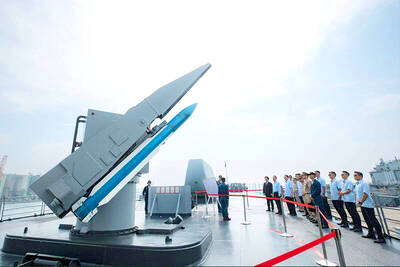
Bloomberg reported earlier this week that the People’s Republic of China (PRC) “has developed hypersonic glide vehicles that can launch air-to-air weapons, an advancement meant to threaten high-value targets such as command-and-control aircraft thousands of miles away.” Military Watch magazine reported in 2024 on one of the designs: “the vehicle is designed with payload options that include electronic warfare and reconnaissance suites, as well as bombs and both supersonic and subsonic drones that detach from the vehicle during flight,” while noting that the PRC is a world leader in such technologies. The threat from the PRC is not only increasing,

Taiwan Power Co (Taipower, 台電) chairman Tseng Wen-sheng (曾文生) uses a sports metaphor to describe the density of electricity demand. A household is a ping-pong ball, ordinary industry a baseball and a science park a bowling ball. A data center is a shot put. Taiwan is preparing for the shot puts. Four new combined-cycle units at Hsinta (興達) and Taichung (台中), with combined capacity of about 5.2GW, are scheduled to begin supplying or testing on the grid by the end of this year. The Energy Administration’s (能源署) plan adds about 25.98GW of gas-fired capacity between this year and 2035, predominantly fueled
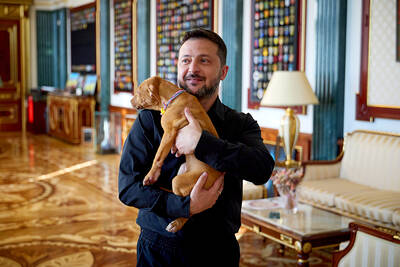
Wait. President Volodymyr Zelenskyy, Ukraine’s war chief, holding a puppy? Yes, and it’s no accident. In a collision of dog lovers, sports and ongoing war with Russia, the Ukrainian president was seen on video Tuesday as never before — cuddling and cooing over a floppy, 3-month-old American pit bull terrier, handed to him by US former boxer Terence Crawford. The cute and fluffy scene in Zelenskyy’s office in Kyiv was the latest volley in a deadly serious battle of visuals that runs in parallel to Ukraine’s fight against Russia’s brutal four-year invasion. Crawford, a longtime supporter of Ukraine and a devotee of the


 RSS
RSS