

During the Martial Law era, newspapers and magazines were strictly controlled by the government. But from 1985 to 1990 — a period that straddled the lifting of martial law in 1987 — a free monthly expat magazine emerged as one of the first published and edited by foreigners. It was also perhaps the first to express a uniquely local expatriate voice.
Taiwan Grapevine’s articles were irreverent, politically incorrect and plagued by typos. Neither editors nor writers were named in the magazine, and those bylines that appeared were obvious pseudonyms like Archibald Hellbender.
Yet the magazine achieved nationwide distribution. And while its circulation is not known, similar publications that followed on its heels printed 15,000 to 20,000 issues per month.
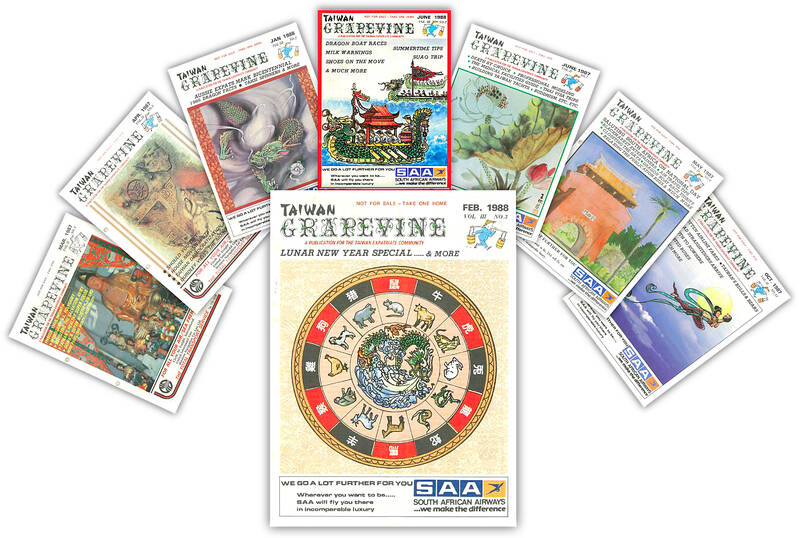
In concept, Taiwan Grapevine plied the route of American ad-driven community magazines. In voice, it took inspiration from alternative US newspapers like Village Voice and the bawdy, gonzo reportage found in the likes of the Bangkok Post’s legendary bar column, “Night Owl.”
One article from Jan 1989, which loosely described a visit to Taipei Adventist Hospital, opened as follows:
“I had been nursing a bad liver for some time. I had found that I couldn’t take the grind of trade reports, market surveys, public relations consultations and so forth without drinking heavily. I was desperately casting about for something to do. I probably should have known better than to enter a den of Christians, but I randomly decided to check out the Seventh-Day Adventist Hospital’s five-day quit-smoking clinic. There might be an article there, I thought.”
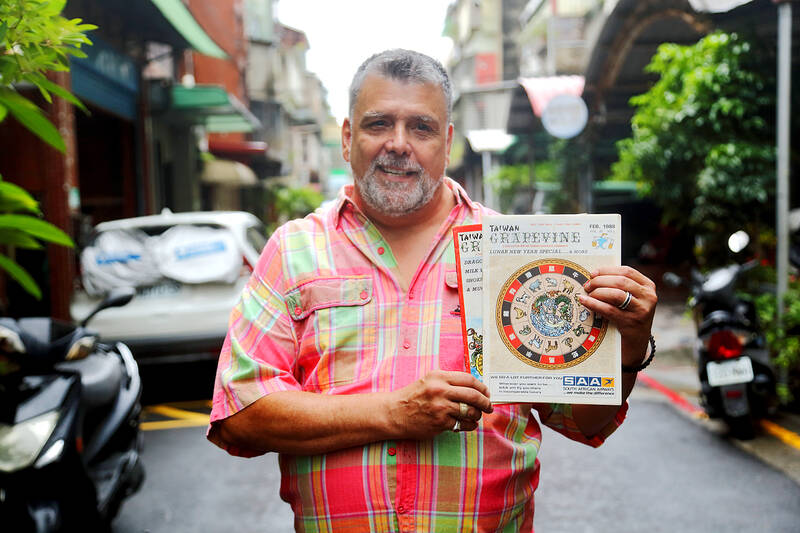
Photo: David Frazier
Mainly, however, Taiwan Grapevine was a vehicle for community news. Dubbing itself “a publication for the Taiwan expatriate community,” it reported on changing flight routes, holidays and festivals and the goings-on of international clubs and associations, including a number of veterans’ organizations that no longer exist. Advertising came from major expat watering holes of the day.
“There was really no other place to get information at that time in English,” said Trace Gomez, a 66-year-old American who served as Taiwan Grapevine’s final managing editor.
Describing the magazine as a “time capsule,” Gomez pointed to articles on having to apply to the phone company to hook up a modem or answering machine, the launch of Wellcome supermarkets, and the explosion of pubs and discos that accelerated during the 1980s.
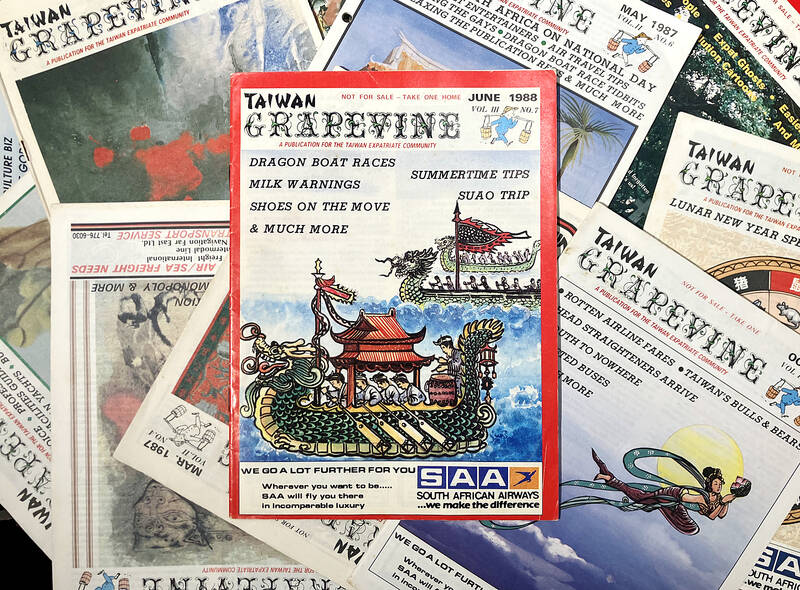
Photo: David Frazier
“This was martial law-era news for foreigners,” he said.
GOING DIGITAL
Only around 50 issues of Taiwan Grapevine were ever published, and until recently the magazine was almost completely forgotten. I first learned of its existence around three years ago from Gomez, who showed me a large but deteriorating stack he’d kept stored in his basement.
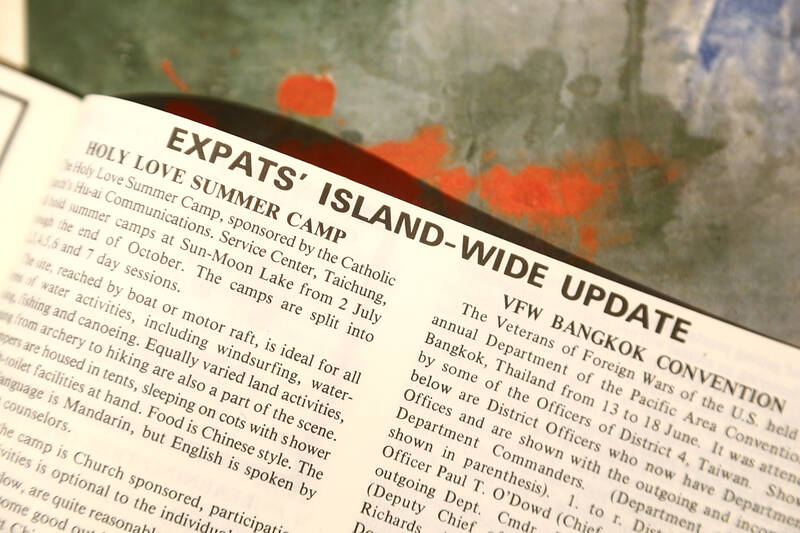
Photo: David Frazier
Since then I’ve asked numerous Taiwan old-timers about it, but only a few had vague recollections.
Gomez, who built his career in manufacturing, says he inherited the magazine in late 1989 from its final editor and publisher Dennis Keagan, who died mysteriously in Thailand three years later.
Gomez had arrived in Taipei in 1987 and initially helped the magazine’s editors with layout and graphics. After taking charge, he went on to publish its final few issues before folding the publication around March 1990.
“When [Keagan] left, it fell in my lap totally,” said Gomez. “But I didn’t want to do it because I was already working full time.”
Now four decades later, Gomez — in part at my urging — has digitized the 13 issues of the magazine he can still locate and uploaded them to archive.org for all to access. He says he will continue to search for more issues and add them if possible.
‘GREATEST PUBLICATION’
The magazine was hardly Taiwan’s only English-language publication of its day. Daily newspapers of the time included the China Post and the China News. In 1970, AmCham Taipei also launched a newsletter, Taiwan Business Topics, which by the 1980s had become a magazine.
Taiwan Grapevine’s main competitor was another expatriate-run monthly, This Month in Taiwan. Founded in 1974 by an ex-military man, E. Kirk Henderson, that publication had a strong commercial focus and placed little value on original writing. According to Earl Wieman, an editor working in Taipei since the early 1970s, Henderson referred to everything except his advertisements as “non-revenue paper.”
Taiwan Grapevine set itself apart from this field with its irreverent voice and strong doses of irony. From its letters section, one can see that readers both loved and hated it.
One reader slammed an entire issue as “blatantly insulting to black people, women, and gays.” Another declared the bar column to be “gutter talk.”
But others praised the magazine. “Taiwan Grapevine is the greatest publication to ever hit the Taiwan expatriate community,” declared one reader.
Another opined, “A month without Grapevine is like a month without ketchup. Your efforts are deeply appreciated by those of us who are here by choice, who love Taiwan and its people and who dread the prospect of returning to the quagmire of reality that awaits us on the other side of the Pacific.”
‘GETTING ACQUAINTED’
One of Taiwan Grapevine’s more fascinating columns, “Getting Acquainted,” offered short biographies of long-term expats. These linked the roots of Taiwan’s foreign community to the end of World War II and — in the case of British tea merchant Frank Berger, who’d first arrived during the Japanese colonial era — even earlier.
One of these columns profiled one of ICRT’s first news readers, David G. White. A UK native, White had been present at D-Day in a spotter submarine and also fought for the British army in Burma. He first arrived in Taiwan in 1949 working for Civil Air Transport, a commercial airline that was acquired covertly by the CIA in 1950.
White eventually got into radio in 1955 when he took a job with the BBC in England. He then hopscotched the globe before returning to Taipei and ICRT in 1980 — the radio station’s second year of operation.
A column on American Ed Little offered just as much intrigue, though from a later generation. Little came to Asia as part of a US Marines Corps combat unit and fought in Vietnam from 1968 to 1969. During that tour, he “had the first seed of Buddhist dharma planted in his soul by a Bangkok prostitute.”
It was Buddhism that brought Little to Taiwan in the mid-1970s — to live as a monk at Kaohsiung’s Fo Guang Shan (佛光山寺) monastery. But he only lasted six months, complaining that there was “too much ‘Pureland’ chanting and not enough meditation.” He eventually walked out of the monastery in his orange robes, bought pants and a t-shirt in a Kaohsiung department store and started looking for work as an English teacher.
As Taiwan moved toward liberalization, the magazine also commented on the December 1986 election. An April 1987 column signed “Cyril H.B. Dilling” treated the democratic transition with a mixture of gravitas and barstool irony.
“We live in remarkable times… and are seeing elements of fundamental history played out before our very eyes,” wrote the magazine’s anonymous political columnist. Then, with eyes on the future, the column predicted that Taiwan “will find out that it is as impossible to be a little bit democratic as a little bit pregnant.” Finally, it welcomed Taiwan “on board the often leaky, sometimes badly ballasted Ship of Democracy.”
MYSTERY FOUNDER
It is perhaps impossible to know who wrote most of these articles. Even the identity of Taiwan Grapevine’s founder remains something of a mystery.
As government regulations made it difficult for foreigners to own media businesses, Gomez says the magazine operated under the aegis of publishing companies run by Taiwanese proxies.
As a result, the name of the magazine’s founder does not appear in business registration records, and he further concealed his identity by omitting a masthead. One guest editor noted that the founder, in addition to serving as managing editor, was “also the chief writer, sales executive, delivery boy and all around handyman,” but did not mention his name.
Gomez and former advertisers contacted for this article can only remember that Taiwan Grapevine’s founder was an American man named “Dave.”
Gomez remembers that “Dave” left Taiwan for Thailand around March 1989. At that time the magazine passed to Keagan, who he says wrote the bar column under the pseudonym Durdley Drinkright, before Keagan in turn gave the magazine to Gomez later that same year.
After the magazine folded in early 1990, Taiwan’s publishing landscape continued to liberalize. Later that decade, other publishing ventures sprang up that were ad-fueled and expat-targeted, including Taichung Compass, which began in 1994 and has been published continuously ever since.
According to Taichung Compass co-publisher, Courtney Donovan Smith, who is also a Taipei Times columnist, even into the late 1990s, “publishing magazines was still very much in a grey zone.”
Smith said that in those early years, his magazine was repeatedly targeted by citizen complaints, and the publishers were once called in by the police for questioning. But the magazine was cleared in every instance.
Later on, local governments “gave us positive attention because we were doing a better job than their own tourism bureaus at promoting what to do and where to go. Taichung mayor Jason Hu (胡志強) said as much, both to us personally and publicly in city council,” Smith said.
Taiwan Grapevine perhaps produced too little too early to leave such a lasting impression. But an archive can now be found online at: archive.org/details/taiwangrapevine/
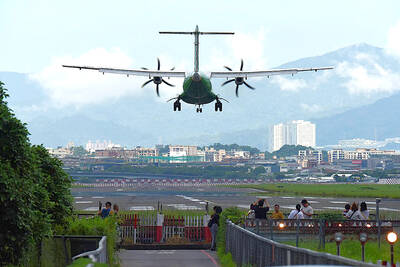
An interesting essay in the spring issue this year of International Security by Kerby Davis and Eugene Gholz explores the possibilities and outcomes of simulated missile attacks by the People’s Republic of China (PRC) on Taiwan’s ports to carry out a blockade. “Substantively,” they conclude in Blockade by Fire: China’s Potential to Blockade Taiwan Using Missile Attacks on Ports, “our article raises serious concern about Taiwan’s vulnerability to Chinese military coercion. Even if Taiwan and the United States take steps to better prepare for a Chinese blockade, they face a greater threat from China than analysts previously believed.” The authors
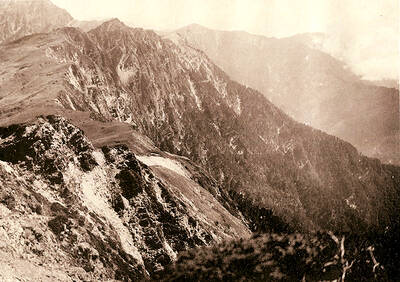
Aug. 24 to Aug. 30 Three pairs of chopsticks, stuck upright in the ground like incense, have become one of the most curious details in the story of three university graduates who disappeared on Qilai Mountain (奇萊) in 1972. The case remains unsolved today. Despite an extensive two-month search, the three men’s bodies were never found. The incident came just a year after five National Tsing Hua University students died on the mountain on July 25, 1971, after being unexpectedly caught in a typhoon, prompting serious concerns about hiking safety. Tunghai University graduate Chiu Kao (邱高) and Fu Jen Catholic

The Taiwan People’s Party (TPP) is facing some difficulties, and there are some tensions in their alliance with the Chinese Nationalist Party (KMT). However, though these problems are real, the local press is blowing them out of proportion and hyping too much out of context. Take, for example, a poll released by Z.media on Wednesday of 1,070 adults with a sampling error of ±3 percentage points. It showed support for the TPP dropping to 6.3 percent, an all-time low on their historical chart and 4.2 percent lower than their May poll and 11 percent from a year earlier. This led
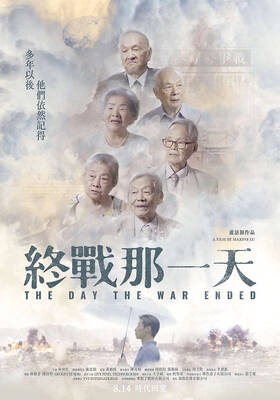
They were born Taiwanese, educated as Japanese and drawn into the war effort for an empire that was eventually defeated. Under the Chinese Nationalist Party (KMT) regime, when Japanese became the enemy, they mostly kept those memories to themselves. Of the six men and women interviewed in depth for The Day the War Ended (終戰那一天), three have since died, while the others are nearing 100. Their stories are therefore all the more urgent to preserve, offering an invaluable glimpse into what Taiwanese went through during a period of great change. With Taiwan’s current representative to Finland, Freddy Lim (林昶佐), narrating


 RSS
RSS