

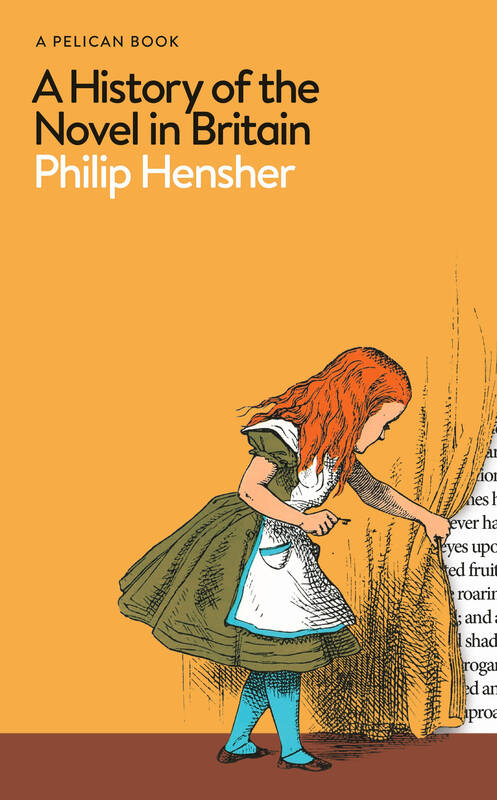
In his opening paragraph, Philip Hensher declares that a novel not only “tells a good story” but is a good story in itself. We could extend that neat formula to include this book, which is not only a masterful account of fiction since 1719, when Daniel Defoe set Robinson Crusoe down on his desert island, but is itself a wonderful read. There is nothing dreary here; no sense of being back in the seminar room taking notes. Instead it is 600 pages of deep pleasure, an excuse to revisit old literary loves and be reminded of ones that have slipped from view.
Hensher is smart enough to know why his book works so well and vain enough to tell us. The usual methodology for a survey is to assemble a roster of academics and invite them to trot out a chapter on their specialism, whether that be “Thomas Hardy” or “High Modernism.” The result is a series of silos, with little sense of historical connection or intellectual unfolding. Hensher, by contrast, gives us a joined-up account of creative call and response. Equally crucial to this project’s success is Hensher’s own experience as a novelist. He brings a practitioner’s informed eye to such questions as why some chapters in Dickens’s Dombey and Son are in the present tense or how Henry James pulls off free indirect speech in What Maisie Knew.
After setting out the novel’s origin story, we are plunged into the inky churn of the middle-18th century. Samuel Richardson writes Pamela in 1740, Henry Fielding shoots back with his snarky parody, Shamela (1741), followed by the more sustained inversion of Joseph Andrews (1742). Richardson, in turn infuriated by the lack of moral purpose in Fielding’s Tom Jones (1749), storms back with The History of Sir Charles Grandison (1754).
Hensher is brilliant on the warring duo’s finances, giving us a forensic account of the risk and reward of their different publishing models. Richardson was a printer before he was an author and hung on to his own copyrights. This allowed him the autonomy to shape the fledgling genre in ways that he wanted which, in the case of Clarissa (1748), meant one million words written entirely in epistolary form. Fielding, no less lucky, had a patron and printer who supported him no matter how eccentric his artistic choices.
Few authors were so favored. Jane Austen chose to sell Pride and Prejudice for a flat fee to Thomas Egerton in 1812, having previously lost money on Sense and Sensibility when she insisted on retaining copyright and paying for the printing. Under the new arrangement, Egerton was under no obligation to spend more than the minimum on production. When Pride and Prejudice eventually appeared in 1813 it was in such tiny print and scrappy paper that disgruntled readers decreed it “almost unintelligible.”
That sort of thing can kill a career, but Austen went on to rise above it, even if it took until the 1940s before the literary establishment caught up with her glory. One of the delights of Hensher’s capacious narrative is being alerted to authors and books that never got their proper due. Hannah More, usually written off as a Sunday school prig, turns out to be “a beautiful and graceful writer,” while Tobias Smollett, who generally gets dismissed these days as an unfunny hack, is rehabilitated as an inventive craftsman with supreme control over narrative voice. Arnold Bennett, characterized as a dreary bore thanks to Virginia Woolf’s unkind take-down of 1924, is lovingly restored as the author of the incomparable Old Wives Tale (1908), which “ought to be acknowledged among the 20 greatest novels in English.”
If Hensher is generous with plaudits, he is equally vigorous in his loathing. Ann Radcliffe, author of the hugely popular and preposterously gothic The Mysteries of Udolpho (1794) “was (and remains) a simply terrible writer.” DM Thomas, Booker nominated in 1981 for The White Hotel, is “patently untalented.” And poor David Lodge, who tried so hard with modish literary pastiche in Changing Places (1975), is simply “not up to the task.”
Hensher never falls into crankiness, but he is unafraid to point out home truths. Such as the fact that so much of the pleased-with-itself “experimentalism” of the 1960 to 1980 period was merely a retread of things that had been done better before. Tickled by the clever wheeze of having central characters with no name? Fanny Burney was already doing that in 1814. Keen on using fragmentary collage to signal modernity? That blustery old fogey Evelyn Waugh got there first with Vile Bodies (1930). As for self-reflexivity, that device by which the novelist comments on the process of writing a novel, you should go back to Fielding.
Hensher doesn’t bring his account right up to date, preferring to stop in 2000 — at Zadie Smith and her “wonderful ear for speech” — on the grounds that it is impossible to form a proper critical judgment until plenty of time has passed. It is a wise decision and a tactful one, underscoring the moral seriousness of this masterpiece, quite aside from its buoyant joy. Reader, I could not put it down.
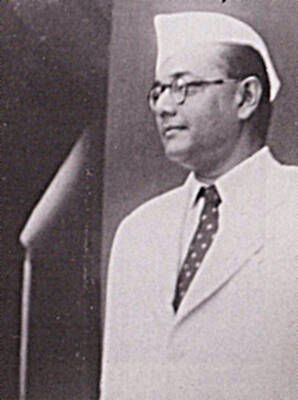
Aug. 17 to Aug. 23 Subhas Chandra Bose was meant to be in Taiwan for no more than two hours. After refueling at today’s Songshan Airport in Taipei, the Mitsubishi Ki-21 bomber carrying the Indian independence leader took off for Japan — and crashed almost immediately. It was Aug. 18, 1945, three days after Japan announced its surrender to the Allies. Bose, who advocated armed struggle to free India from British rule, had worked closely with Imperial Japan. He was attempting to reach the Soviet Union via Manchuria in the hope of gaining support

The Tzu Chi Foundation, the globally known Buddhist charity, announced on July 21, 2021 that it had signed a deal to purchase 5 million doses of the Pfizer-BioNTech (BNT) COVID-19 vaccine. It said that the vaccine doses would be donated to the government’s COVID vaccine program. In October the Centers for Disease Control (CDC) made a public announcement thanking the Buddhist foundation and others for the 889,200 doses of the BNT vaccine they had collectively donated. FRAUD Earlier this month, the public was stunned to learn that prosecutors had indicted former Changhua Bar Association chairwoman, Chen Yu-hsuan (陳昱瑄), and others on suspicion

These few weeks will decide who ends up on the ballot, and who does not, in this year’s elections. Registration closes on Sep. 4, but until then, politicians may drop in or drop out of the race. Both the pan-green Democratic Progressive Party and the its supporters (DPP) and the pan-blue Chinese Nationalist Party (KMT) have nominated 19 candidates for 22 of the top-level mayor and county commissioner posts. The KMT is also promoting a “great opposition alliance” in the remaining three, backing two independents and one candidate from the KMT-aligned Taiwan People’s Party (TPP). For more context and a

Starting dramatically on a historic trail built by the Japanese above a hot springs town and ending unceremoniously on a muddy, leech-infested forest road after what could be your worst night’s sleep ever in the mountains, the Mabolasi Traverse (馬博拉斯橫斷) is full of challenge and reward. For fit hikers who can survive the former and still enjoy the latter, “Mabo” is the route for you. UP, DOWN AND UP AGAIN The first challenge of the trip: three days of uphill walking with a heavy backpack. From the hot springs town of Dongpu (東埔) in Nantou County, the route follows the Japanese-built Batongguan


 RSS
RSS