


At more than 170 hog farms around Taiwan, biogas derived from pig waste is piped into combustion turbines where it’s burned to generate electricity. Economic circularity takes a slightly different shape in hundreds of smaller piggeries. Those farms burn biogas in their brooders to keep newborn piglets warm and reduce their consumption of electricity or propane.
Unfortunately for chicken farmers, turning poultry manure into green energy isn’t straightforward. Obstacles connected to handling this waste (see “Greening Taiwan’s favorite protein,” Jun. 10, 2026, Taipei Times) have prevented the widespread application of the relevant technology.
In modern pig farms, pens are frequently flushed with water. The manure is diluted into a thinnish slurry which can easily be pumped into an anaerobic digester (a reactor in which bacteria break down organic matter in the absence of oxygen).
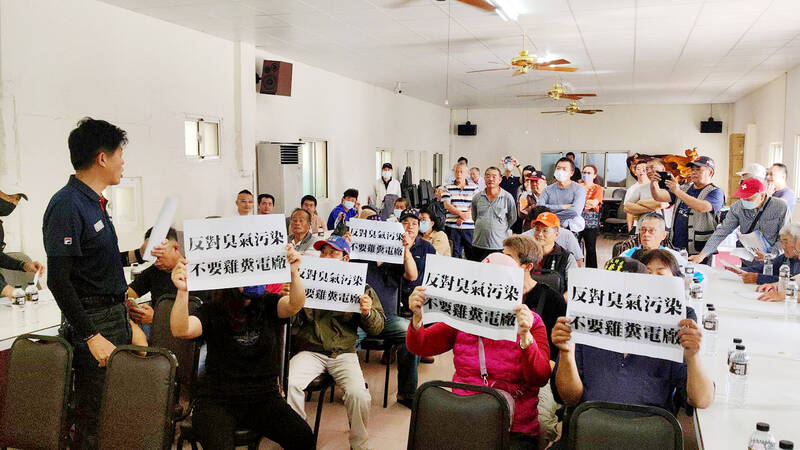
Photo: CNA
By contrast, chicken litter is mostly dry matter. Manure typically drops onto belts or to the floor where it dries out and gets mixed with dander, feathers, leftover feed and bedding materials such as rice hulls. To liquify it enough to pump it into a digester, a lot of water must be added. It doesn’t need to be pristine H2O, however, and enterprises that wash eggs on site — such as Shih An Farm (石安牧場) in Kaohsiung’s Alian District (阿蓮) — reuse wastewater generated by that process.
A COMPLEX PROCESS
Shih An Farm is one of the few poultry businesses in Taiwan producing biogas. In a 2017 article for City Development (城市發展), a journal published by Kaohsiung City Government’s Research, Development and Evaluation Commission, the farm’s general manager Hsieh Chung-han (謝宗翰) outlined some of the complexities involved in his farm’s manure-to-electricity operation.
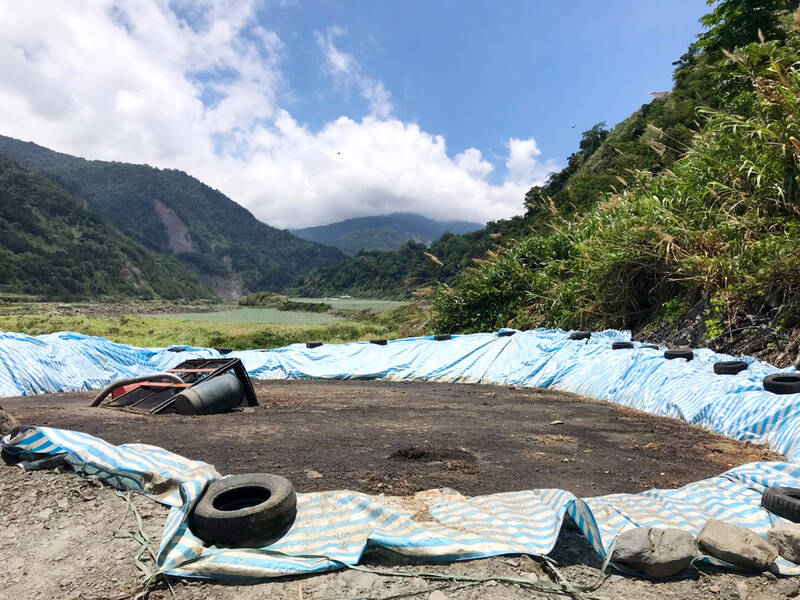
Photo: CNA
Like other granivorous and herbivorous birds, chickens ingest grit to aid digestion, so their waste contains sand, Hsieh explained. Consequently, before the 80 metric tons of manure collected daily can be mixed with wastewater and pumped into the digester, these particles must be removed to prevent abrasion and accumulation from degrading the system’s efficiency.
Conditions inside the continuous stirred tank reactor are carefully regulated. If the temperature exceeds 38 degrees, there’s a risk the ammonium in the mix will turn into free ammonia, which is highly toxic to the methane-producing bacteria that play an essential role. But so long as everything goes to plan, the plant — which has been in operation since 2014 — can produce 8,000m3 of biogas per day.
Because raw biogas contains hydrogen sulfide, which dissolves in water droplets to form machinery-destroying sulfuric acid, the gas has to be desulfurized before it can be burned to generate power. The danger of corrosion is so great that Hsieh stressed “the success or failure of desulfurization is crucial to the success or failure of the system.”
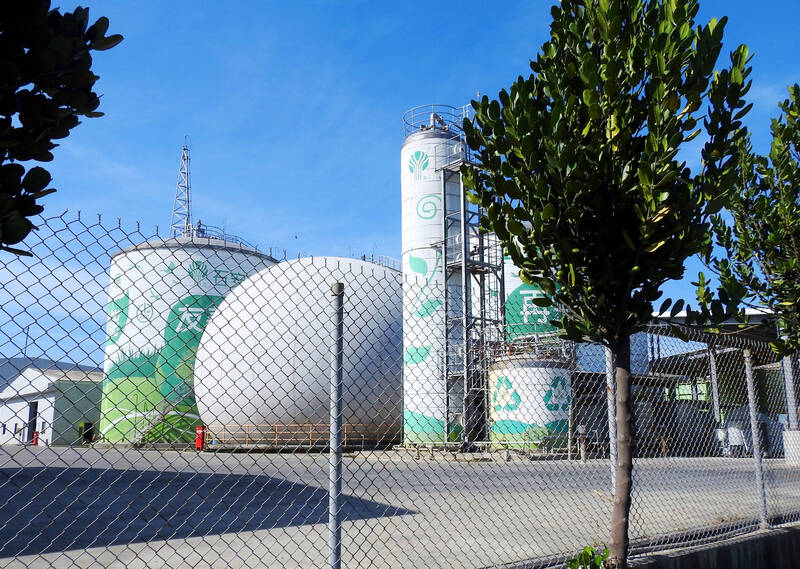
Photo: Steven Crook
CRUNCHING THE NUMBERS
Daily power output averages 16,800 kWh, enough for 1,732 households. By generating almost two-thirds of the electricity it consumes, Shih An Farm reportedly saves nearly NT$2 million in utility fees per month, as well as NT$3.2 million in annual manure disposal costs. Any surpluses produced by the system are sold to Taipower, earning feed-in-tariff (FIT) payments of approximately NT$5.11 per kWh.
Shih An Farm’s bioreactor also yields around 210 metric tons of liquid fertilizer daily. According to Hsieh, because the business doesn’t use veterinary drugs or antibiotics, and any pathogens are destroyed during the anaerobic digestion process, the fertilizer is “safe, rich in the nitrogen, phosphorus and potassium essential for crop growth and rapidly effective.” Selling it generates additional income for the farm, although recouping the capital investment of NT$400 million took several years.
Hsieh noted that intense competition between food producers “has led to a long-term reliance on pesticides and antibiotics in order to gain advantages in production volume and product appearance. These substances contaminate both the food and the environment. Eventually, problems caused by humans appear throughout the food chain.”
We must confront climate change, he argued, because its consequences — namely heat waves, droughts, and floods — drive up the cost of food.
Addressing the issue of scale that prevents all but the largest poultry enterprises from setting up green-energy infrastructure, Hsieh wrote: “From an investment return perspective, it’s difficult for individual livestock farms to make profits. Independent renewable-energy plants can only achieve economies of scale through collective processing of agricultural and livestock waste.”
ABeC (艾貝科農業科技), a startup launched in 2020 by researchers at Feng Chia University, pitched a system capable of processing 2 metric tons of chicken manure per day. The company claimed farmers could recover the initial NT$12 million setup cost within eight to nine years, offering a return on investment comparable to photovoltaic panels. However, ABeC has since gone quiet; unanswered messages and abandoned social media channels suggest the venture failed to gain commercial traction.
GOVERNMENT SUPPORT
On Jun. 9, Minister of Environment Peng Chi-ming (彭啟明) attended the launch of the Biogas & Biomass Energy Industry Alliance (沼氣生質能資源產業聯盟). By integrating the efforts of the public sector, industry and academia, the alliance aims to “break through existing bottlenecks” and “properly manage and utilize biomass resources such as agricultural waste, wastewater with high organic content, livestock manure, sludge and kitchen waste.”
The ministry hopes Taiwan can eventually produce 1.36 billion kWh of green electricity per year — equal to about half of 1 percent of the power dispatched through the country’s grid last year.
But not all environmentalists are fans of manure-to-biogas initiatives. Zeroing in on concentrated animal feeding operations — farms which may raise over 2,000 pigs on one site, or upward of 50,000 hens — a Feb. 20, 2024 report by Friends of the Earth US presents what it describes as “evidence that manure biogas will further entrench inherently unsustainable and unjust systems of industrial animal agriculture and fossil fuel energy for decades to come.”
“Incentivizing manure biogas production increases the competitive advantage for large-scale producers, contributes to industry consolidation, and crowds out funding for truly effective conservation practices,” the report states.
Whether or not the Biogas & Biomass Energy Industry Alliance will be able to overcome Taiwan’s rampant NIMBYism isn’t clear.
On Mar. 28 last year, the Central News Agency reported that a plan to build a chicken-waste biogas power plant in Changhua County’s Fangyuan Township (芳苑) had run into opposition from those living near the proposed site. Residents expressed fears that manure from farms throughout Changhua would be concentrated in one place, leading to air and water pollution.
The county government’s Department of Agriculture later announced that because the original plan hadn’t been sufficiently detailed, and required revisions weren’t made before the deadline they had set, the application was finally rejected.
As an article published on the 2025 Taiwan Smart Agriweek (a major farm-focused trade expo) Web site conceded, “This situation reflects the need for [waste-to-biogas entrepreneurs] to fully consider community sentiment when selecting sites, strengthen environmental protection measures, and establish good communication mechanisms with local residents” if they’re to be trusted.
While the county’s refusal to green light the project shows that environmental and safety reviews for waste-to-energy facilities are strictly enforced, the article points out that these same rules act as a chokepoint, blocking the rapid adoption of clean technologies that Shih An Farm and other businesses have already proven to be effective.
Steven Crook, the author or co-author of four books about Taiwan, has been following environmental issues since he arrived in the country in 1991. He drives a hybrid and carries his own chopsticks. The views expressed here are his own.

I was 18 and a naive US Air Force airman when I first set foot on Taiwan in 1968. I left as a more mature, somewhat wiser 23-year-old. Despite transitioning to an adult in those important, formative years, I didn’t think much about coming back. Until recently. Last month, I returned to Taiwan for the first time in 53 years. It was not even remotely like the country I left in 1973. When I departed, Taiwan was a slow-moving, impoverished developing nation under martial law. Outside of the cities, people in conical bamboo hats hand-tilled expansive rice fields that dominated the countryside.

The last time Taiwan’s foreign correspondents were invited to a special briefing with a sitting president was in 2015. That was two presidents ago under Ma Ying-jeou (馬英九). But Thursday morning, President William Lai (賴清德) welcomed the nation’s international press corps warmly, speaking specifically to the theme of press freedom. Lai addressed Taiwan’s foreign press corps saying, “You live, work and report in Taiwan.” “Thank you for your professionalism and upholding the spirit of press freedom,” he continued. “As you engage in your work of journalism, you let the world see Taiwan.” The timing of this event, hosted by the Taiwan Foreign

Chinese Nationalist Party (KMT) Chairwoman Cheng Li-wun’s (鄭麗文) recent trip to the US highlighted her party’s anti-Taiwan defense policies. Disapproval of their policies was strong among those who met with her. Republican Senator Dan Sullivan, said that the KMT was “playing with fire.” Democratic Representative Tom Suozzi reportedly said that Cheng’s party was “weakening deterrence.” Foreign policy maven David Sacks observed in Asia Nikkei that “many Americans struggle to see the logic behind the KMT’s refusal to fund the portion of the special defense budget pertaining to indigenous defense production.” The logic of the KMT’s decision to purchase only US
June 22 to June 28 “There are no good civilians within Yunlin’s jurisdiction,” declared Yunlin subprefecture head Yunoshin Matsumura before launching a bloody suppression campaign. Between June 19 and June 22, 1896, thousands of unarmed villagers were killed. Official reports recorded 4,947 houses burnt down in 55 settlements spanning today’s Douliu (斗六), Dounan (斗南), Gukeng (古坑), Tapi (大埤), Cihtong (莿桐), Linnei (林內) townships, as well as Jhushan (竹山) in Nantou County. Angukeng Village (庵古坑), located near the resistance’s mountain headquarters, suffered the heaviest destruction, with 505 households affected. Even Japanese accounts noted the


 RSS
RSS