


Faced with a highly polarized US political landscape, Leo XIV, the first American pope, has opted for discreet and indirect criticism while also keeping channels of communication open.
Since he was elected in May last year, the Chicago-born pontiff has taken a clear stand against some decisions by US President Donald Trump’s administration.
He has denounced the “inhuman” treatment of migrants, urged dialogue in Venezuela and lamented a “diplomacy of force.”
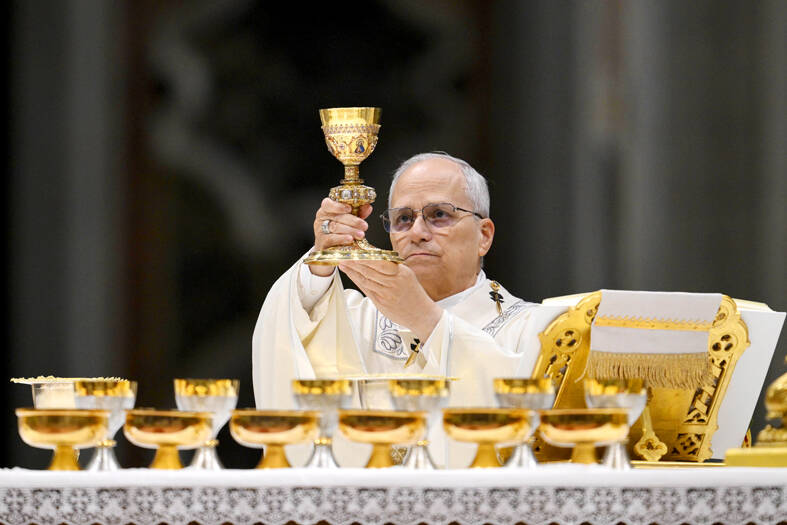
Photo: EPA
But, in recent weeks, Leo has favored restraint.
He has made no reference to a possible US intervention in Iran, nor to Trump’s designs on Greenland, nor to the volatile situation in Minneapolis after two protesters were shot by federal agents.
His weekly statements carefully avoid these subjects, while his Tuesday evening comments to the press outside his Castel Gandolfo country residence have become increasingly rare.
He briefly broke his silence on Sunday to voice “great concern” about rising tensions between Cuba and the US, calling on all sides to “avoid violence.”
“Leo is very cautious. He knows his voice is universal. As an American, he is somewhat the natural opponent of Trumpism,” a Vatican source said on condition of anonymity. “On the United States, he’s walking on eggshells.”
“He understands that the American Church is also targeted by ICE, people are afraid,” the source said, referring to the Immigration and Customs Enforcement agency currently in the spotlight for its immigration crackdown.
The pope is operating in a context that is “hyper-polarized, where the Church is also targeted through the populations it helps, like migrants or the Hispanic community,” the source added.
BISHOPS ON THE FRONT LINE
But despite increasing concerns within the corridors of the Holy See at the Trump administration’s actions, the pope prefers to rely on the American Catholic hierarchy rather than wade into the fray himself.
“I think he thinks the first response should come from the country’s bishops themselves,” said Christopher White of Georgetown University in Washington and author of the book Pope Leo XIV: Inside the Conclave and the Dawn of a New Papacy.
Last week, Archbishop Paul Coakley, president of the US bishops’ conference, reacted forcefully to the “killing” of Renee Good and Alex Pretti in Minneapolis, denouncing “failures in our society to respect the dignity of every human life.”
Bishop Anthony Taylor (Little Rock, Arkansas) pointed to “obvious parallels” between the US now and Nazi Germany, although he said that “Trump is no Hitler.”
“We are doomed to repeat failures of the past if we are not willing to remember them and learn from them,” he wrote.
The same approach applies on the international stage: in a joint statement, three leading cardinals — Blase Cupich (Chicago), Robert McElroy (Washington) and Joseph Tobin (Newark) — condemned America’s interventionist drift, the erosion of the multilateral framework and the risks to world peace.
‘REPUTATION’
At the end of December, the Vatican Secretary of State, Italian Cardinal Pietro Parolin, tried in vain to dissuade Washington from launching a military operation in Venezuela during a meeting with the US ambassador.
“The aim was to avoid a bloodbath and bring the actors back to reason,” a senior Vatican source said.
Invited to Trump’s new “Board of Peace” on Gaza, the Vatican is biding its time, saying it is “reflecting” on its response — another sign of an increasingly deliberate caution.
Leo has yet to meet Trump, although he received Vice President JD Vance two weeks after his election in May last year.
The challenge is to avoid exacerbating the divisions of an already split American Church and to prevent his words from being read through a partisan lens.
For the Vatican, the broader goal is “to prevent historians from writing in five, 10, or 20 years that the American Church was tied to Trumpism”, said Italian historian Massimo Faggioli, a professor at Trinity College Dublin and author of the book From God to Trump: Catholic Crisis and American Politics.
“The risk is a disintegration, even a collapse, of the reputation and historical role of the American Church,” he said.
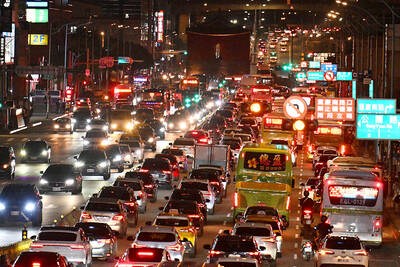
By global standards, the traffic congestion that afflicts Taiwan’s urban areas isn’t horrific. But nor is it something the country can be proud of. According to TomTom, a Dutch developer of location and navigation technologies, last year Taiwan was the sixth most congested country in Asia. Of the 492 towns and cities included in its rankings last year, Taipei was the 74th most congested. Taoyuan ranked 105th, while Hsinchu County (121st), Taichung (142nd), Tainan (173rd), New Taipei City (227th), Kaohsiung (241st) and Keelung (302nd) also featured on the list. Four Japanese cities have slower traffic than Taipei. (Seoul, which has some
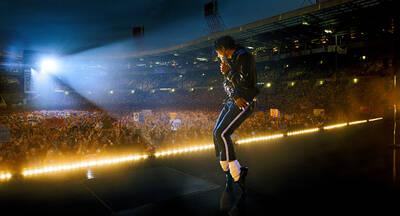
Michael slides a sequin glove over the pop star’s tarnished legacy, shrouding Michael Jackson’s complications with a conventional biopic that, if you cover your ears, sounds great. Antoine Fuqua’s movie is sanctioned by Jackson’s estate and its producers include the estate’s executors. So it is, by its nature, a narrow, authorized perspective on Jackson. The film ends before the flood of allegations of sexual abuse of children, or Jackson’s own acknowledgment of sleeping alongside kids. Jackson and his estate have long maintained his innocence. In his only criminal trial, in 2005, Jackson was acquitted. Michael doesn’t even subtly nod to these facts.
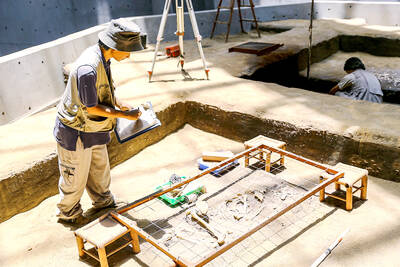
Writing of the finds at the ancient iron-working site of Shihsanhang (十 三行) in New Taipei City’s Bali District (八里), archaeologist Tsang Cheng-hwa (臧振華) of the Academia Sinica’s Institute of History and Philology observes: “One bronze bowl gilded with gold, together with copper coins and fragments of Tang and Song ceramics, were also found. These provide evidence for early contact between Taiwan aborigines and Chinese.” The Shihsanhang Web site from the Ministry of Culture says of the finds: “They were evidence that the residents of the area had a close trading relation with Chinese civilians, as the coins can be
During her 2015 trip to Taiwan, Sophia J. Chang (張詠慧) got fewer answers than she’d hoped for, but more revelations than she could have imagined. “That was the year I last saw my grandmother. She was in hospice care in Tainan, and it was painful to see her in bed, barely able to open her eyes,” says Los Angeles-born Chang. “The grandma I’d known, a fantastic cook and incredibly kind, was already gone.” After their visit, Chang and her grandfather went back to his apartment. There she asked him how he’d met her grandmother. “He hesitated, then started talking a bit.


 RSS
RSS