


In an early scene from Spinal Tap II: The End Continues, the blisteringly obtuse Nigel Tufnel asks his wife a question after he and his bandmates have reunited after many years: “I don’t know whether this was a good idea or not.”
Fans may ask that very same question after an albeit mercifully short sequel hits theaters from the mother of all rock mockumentaries, 1984’s This Is Spinal Tap. Forget about going to 11. This one barely registers at 4.
Despite some great starry cameos — Paul McCartney’s is easily the best — Spinal Tap II leans into the old favorite bits too needily and is suffocated by the constantly looming presence of death, a downer. The improv-based comedy is forced and the laughs barely register. This is a movie only for die-hard Tappers.
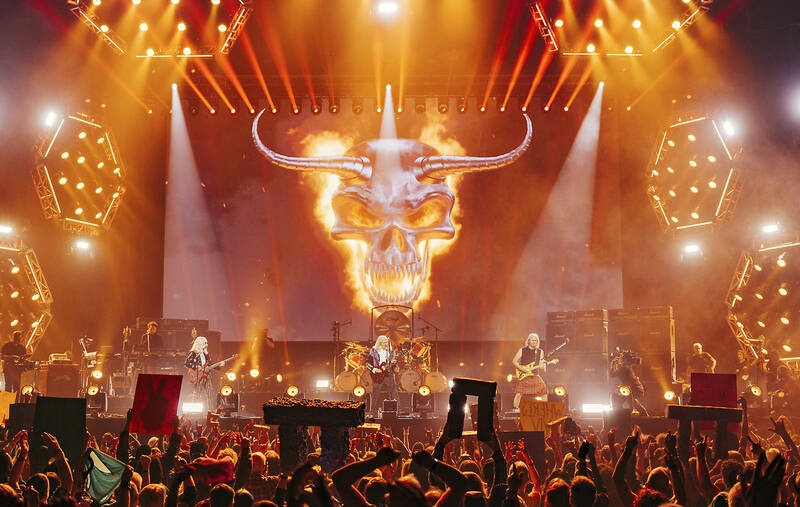
Photo: AP
The structure is the band reunion and countdown to a final concert by Spinal Tap, who we are told disbanded 15 years ago. They’ve not agreed to reform out of love, but contract. (They owe one more live set.) The venue is in New Orleans, because a Stormy Daniels appearance fell through. (That was probably really funny in 2017.) There are simmering intra-band tensions.
Rob Reiner — who directed, starred and co-wrote the original with Christopher Guest, Michael McKean and Harry Shearer — has once again directed the sequel, faithfully playing his role as filmmaker Marty DiBergi, complete with military baseball cap and a director’s viewfinder around his neck. All the guys get screenwriting credit.
We learn where the trio has landed after all these years — one runs a cheese-and-guitar shop, another is the proprietor of a glue museum and a third writes soundtracks to podcasts and the hold music for phones.
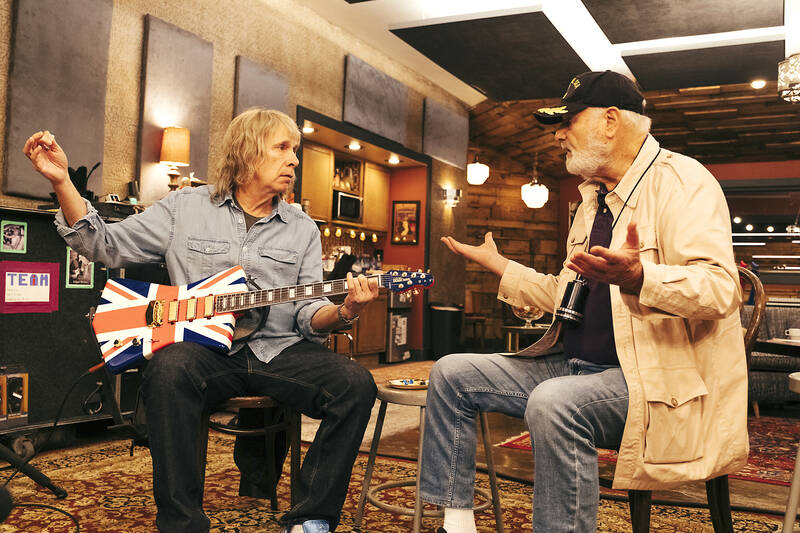
Photo: AP
Mortality is a constant theme, from the concert promoter who suggests one or two of the three members die onstage for good publicity — “Would you settle for a coma?” one band member offers — to the Shearer song Rockin’ in the Urn to a photo shoot in a cemetery to the whole thing ending in a hospital. Bones creak when they settle into chairs; paunches are hard to hide and reading glasses are necessary. This is a movie that celebrates those whose “candles cost more than the cake.” Yum, dig in.
CAMEOS
Death obviously stalks the search for a drummer, who has the habit of coming to an abrupt demise whenever they join. That was a kind of background joke in the original, but here the comedians lean in too much, with cameos from reluctant suitors, including Metallica’s Lars Ulrich, Red Hot Chili Peppers’ Chad Smith and Questlove — “You’re legendary, but I don’t want to die,” he begs off — all landing flat. Just including famous people isn’t funny enough.

Photo: AP
Valerie Franco eventually steps behind the drum kit, bringing a vitality and effervescence to a movie that sorely lacks it. But you’ll cringe when Shearer’s Derek Smalls hits on her, a woman four decades his junior. Shearer also at one point gets a vial stuck up his nose, a desperate bit of physical comedy that shouldn’t have made the cut.
Guest’s Tufnel tries cloyingly to recreate his “up to 11” from the original film when he and DiBergi discuss various guitar pedals — one “is like someone singing through a duck” — and he reveals a secret compartment of cheese in a guitar. It falls apart like brie on a warm day.
‘THAT’S LITERATURE’
The high point is when McCartney happens to stop by the recording studio. He praises the band for their ability to rhyme “flesh tuxedo” with “pink torpedo” on the song Big Bottom. (“That’s literature,” says the ex-Beatle in admiration.) But soon things grow testy between him and McKean’s David St. Hubbins over a song’s direction. “We’ll take it under advisement,” McKean curtly tells McCartney about his suggestion. Later, he grouses about the sunny McCartney: “He’s got this sort of toxic personality.”
There are also appearances by Elton John, Garth Brooks and Trisha Yearwood. Fran Drescher and Paul Shaffer reprise their old roles in blink-and-you’ll-miss-them moments. Henry Diltz, one of rock’s great photographers, also gets a cameo.
John, whose natural comedy instincts are sadly untapped here, sits in with the band twice, for (Listen to the) Flower People and Stonehenge. The movie often stalls in the second half as it loads up on performances leading up to the final concert.
One of the bits that doesn’t work is that the band’s apartment in New Orleans is constantly interrupted by a walking tour of haunted spots. But that’s fitting, perhaps: Spinal Tap II is filled with ghosts. It’s like watching a cover band playing the hits but then realizing it’s actually the original band onstage after all.

By global standards, the traffic congestion that afflicts Taiwan’s urban areas isn’t horrific. But nor is it something the country can be proud of. According to TomTom, a Dutch developer of location and navigation technologies, last year Taiwan was the sixth most congested country in Asia. Of the 492 towns and cities included in its rankings last year, Taipei was the 74th most congested. Taoyuan ranked 105th, while Hsinchu County (121st), Taichung (142nd), Tainan (173rd), New Taipei City (227th), Kaohsiung (241st) and Keelung (302nd) also featured on the list. Four Japanese cities have slower traffic than Taipei. (Seoul, which has some

Michael slides a sequin glove over the pop star’s tarnished legacy, shrouding Michael Jackson’s complications with a conventional biopic that, if you cover your ears, sounds great. Antoine Fuqua’s movie is sanctioned by Jackson’s estate and its producers include the estate’s executors. So it is, by its nature, a narrow, authorized perspective on Jackson. The film ends before the flood of allegations of sexual abuse of children, or Jackson’s own acknowledgment of sleeping alongside kids. Jackson and his estate have long maintained his innocence. In his only criminal trial, in 2005, Jackson was acquitted. Michael doesn’t even subtly nod to these facts.
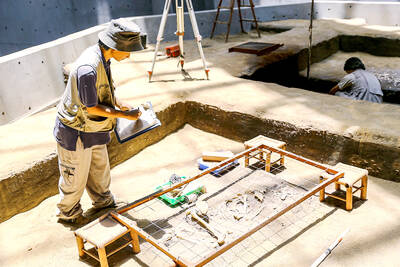
Writing of the finds at the ancient iron-working site of Shihsanhang (十 三行) in New Taipei City’s Bali District (八里), archaeologist Tsang Cheng-hwa (臧振華) of the Academia Sinica’s Institute of History and Philology observes: “One bronze bowl gilded with gold, together with copper coins and fragments of Tang and Song ceramics, were also found. These provide evidence for early contact between Taiwan aborigines and Chinese.” The Shihsanhang Web site from the Ministry of Culture says of the finds: “They were evidence that the residents of the area had a close trading relation with Chinese civilians, as the coins can be
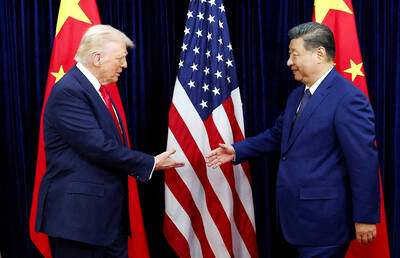
The March/April volume of Foreign Affairs, long a purveyor of pro-China pablum, offered up another irksome Beijing-speak on the issues and solutions for the problems vexing the People’s Republic of China (PRC) and the US: “America and China at the Edge of Ruin: A Last Chance to Step Back From the Brink” rang the provocative title, by David M. Lampton and Wang Jisi (王緝思). If one ever wants to describe what went wrong with US-PRC relations, the career of Wang Jisi is a good place to start. Wang has extensive experience in the US and the West. He was a visiting


 RSS
RSS