


I am kneeling quite awkwardly on a cushion in a yoga studio in London’s Shoreditch on an unseasonably chilly Wednesday and wondering when exactly will be the optimum time to rearrange my legs. I have an ice-cold mango and passion fruit kombucha beside me and an agonising case of pins and needles.
The solution to pins and needles, I learned a few years ago, is to directly confront the agony: pull your legs out from underneath you, bend your toes up as high as they can reach, and yes, it will hurt far more initially, but then the pain subsides. I’d like to do this very much, but sitting opposite me is a man — sitting all around me are men — and it is his turn to talk.
He has eight minutes to tell us — all men, all strangers — what has been bothering him lately, or this week, or today or for his entire lifetime, and right now he is on a roll.
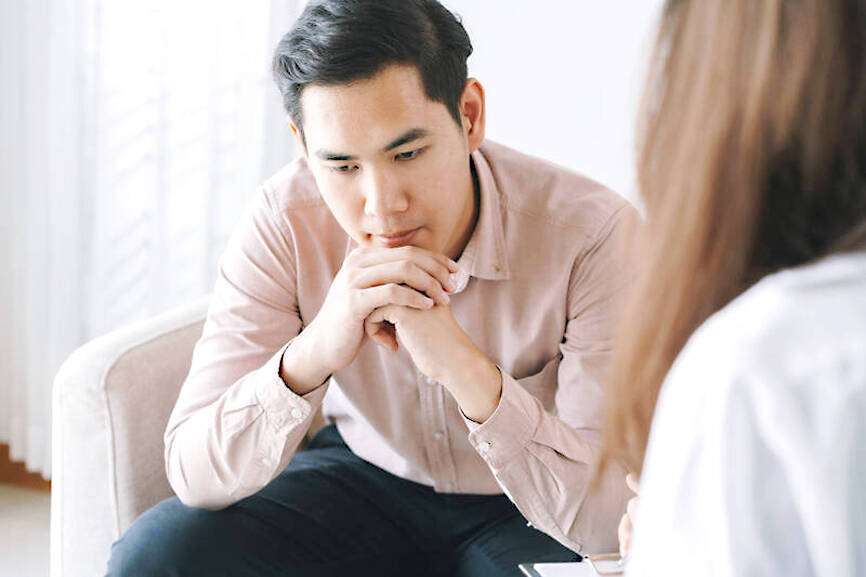
Photo: Taipei Times
Here in Men’s Circle, if you go over your allotted eight minutes, the facilitator of the group is meant to give a polite little “wrap it up now, mate” cough, so everyone can have a fair turn, but nobody wants to do that with this particular man: after a slow, shy start he’s on a tear and words and feelings and secrets I’m not even sure he knew he was going to say are tumbling out, and it feels rude (and possibly destructive) to do anything to stop him. So I’m just going to keep my legs tucked up until he runs out of breath.
As ever, my own mental health is currently a work in progress.
Sometimes my mood is calm and balanced, and sometimes it sinks to the bottom of the sea with no notice, and sometimes it’s hard for me to personally notice that my psyche is underneath the Titanic until it’s been there for a couple of weeks.
Photo: AP
I’ve done a lot of things to try to get my mood under control. I’ve also gone long periods where I’ve been very obstinate and done nothing to help myself. Nevertheless, I’m reasonably open-minded when it comes to, well, the mind. But when I heard about men’s circles, regular group therapy-like sessions aimed specifically at men, which gently cajole sometimes reluctant blokes into talking about their problems, I was quietly cynical: What will talking to a group of men do that any other traditional form of therapy won’t?
OPENING UP
Two, or maybe two and a bit hours later, I emerge on to the same weirdly cold street.

Photo: Taipei Times
People are laughing outside pubs, and bars are lit up in neon blurs. Normally, I’d be drawn to go in for a quick drink and maybe text someone to see if they want a pint, but I feel floaty and clear and new.
I was convinced I wasn’t going to speak tonight, but when my turn clicked round and it was my time, I did eight full minutes, thoughts falling out of me before I could really even think them, and now I feel lighter, better, unclenched and relieved.
I walk all the way home for some reason, a little over an hour, no headphones or checking my texts, just turning thoughts over in my brain. There’s a smile on my face. When I get in I go straight to bed and sleep like a baby.
At Men’s Circle, the group I killed my legs in, each man has eight minutes to say whatever’s on his mind; once I started speaking, I was sure I only had about four minutes of agony in me, max, but it turns out, no: I filled the time until I got the polite cough, and sat back amazed while we moved on to the next man’s eight.
“Most men talk in their first circle,” says Men’s Circle executive director Pasco Ashton.
“It’s actually really rare that we have a man that comes into a circle new and doesn’t share.”
MENTAL HEALTH MATTERS
Men’s talking circles aren’t a new idea — there have been meetings in the US, Australia and just generally “Scandinavia” for years — but they are a fairly recent development in the UK.
Men’s Circle started in 2020, first as a Covid-necessary Zoom and then a real-life meeting in a park. It has since run for more than 1,000 circles in person and online.
Andy’s Man Club, a free weekly Monday night meeting that has more than 200 groups all over the UK, takes its name from Andrew Roberts, a 23-year-old father who died by suicide in 2016, started in a community hall in Halifax the same year.
There are others — Man Academy, Unmasked Man, Inner Outer Journeys, MenSpeak, Talk Club — all with slightly different approaches along the holistic-mental-health axis, and all of which promise to redefine and reapproach the idea of “masculinity,” which is so often linked to the word “toxic.”
Masculinity comes with its own issues: according to the Office for National Statistics, three out of four people who take their own lives are men. It’s the biggest killer of men under the age of 50.
A10-year study by Mind found that men were twice as likely as women to participate in hazardous drinking and are more likely to self-medicate with drugs and alcohol. Men’s circles offer a space and time for men to actually speak about these things. Which they are famously bad at.
Pasco and I grab a quick coffee a few hours before my own initial session.
He found his way to Men’s Circle for a number of reasons — answering the call from the women in his life to be a better man in the wake of #MeToo; losing two of his male friends to suicide; looking for a way to be more altruistic as he moved into his 30s, but what really got him sitting in a park in a circle over lockdown was feeling disconnected from male company.
“I didn’t feel close with any of my male friends. I didn’t have a richness to those relationships.”
Being around Pasco is calming, even just over coffee. He chats elegantly and carefully, lets you speak, then takes his own time talking.
After four years and hundreds of sessions, it’s a recurring joke in his friendship group that he can’t really “do” small talk any more.
“I think now I naturally step into that level of depth,” he says. “Like, I just got back from a festival. I went for a coffee on the last morning and ended up making the woman who was serving cry, because of where the conversation went.”
At every session I’ve been to, I have been surprised by at least one thing a man has said out loud in the room and also surprised myself by what I’ve admitted.
“I found that in the circle it’s a practice of telling the truth,” Pasco explains. “It’s saying what’s going on inside. There’s an innate vulnerability to it.”
As well as in-person sessions, Men’s Circle offers weekly Zoom sessions; closed circles where the same group of men meet regularly for a six-month period and are able to explore edgier topics, such as sex and intimacy.
“Sometimes, I wonder whether the majority of the men are just looking for a social connection. Lots of our members have met up independently, outside circles, face-to-face.”
But crucially, it’s rare that a man turns up for one or two sessions and then never again. So many men who experience circles instantly recognise their value, and then they come back, and back, figuring stuff out and building support along the way.
IMPORTANT WORK
“Men’s mental health” has become a bit of a buzzword in recent years, in a way that, arguably, has emptied the phrase of a little of its meaning.
There have been a number of campaigns that urge men to talk, to reach out, to open up — high-profile sportsmen such as Ultimate Fighting Championship (UFC) fighter Paddy Pimblett, boxer Tyson Fury and soccer player Richarlison have all shared their own stories of seeking help and therapy and told men it’s OK to do the same — but the practicalities of doing so can still be a stumbling block.
At Andy’s Man Club, the start of the session entails some jangling legs and avoiding of eye contact. By the time I’ve left, long after I’ve listened and shared, I’ve given at least five strangers completely unnecessary handshakes.
In one circle I sat in, two men had experienced almost exactly the same breakup: it must have felt good to see another ship on the sea.
It’s all very well seeing a poster telling you to “talk to a mate,” but sometimes the reality is it feels more soothing to go to the pub with a familiar friend and spend a couple of hours absolutely not looking directly at what is bothering you than it does opening up in front of Monday Night Football. and sometimes the reality is, you don’t have a mate to talk to.
There’s a loneliness epidemic among men, and a suicide one, too, and there’s no doubt talking can help, despite the strange stigma attached to the idea of men, in a room full of men, talking about men’s things.
It’s hard to know the exact cause of the mental-health gender disparity between men and women — though women are more likely to be diagnosed with depression, men are less likely to seek that help in the first place; women are more likely to attempt suicide, but men are more likely to complete it; men are more likely to self-medicate with drugs and alcohol, and less likely to make a doctor’s appointment — but one definite solution would be to get over the difficult hurdle of communication.
The day after my first session, I go on a morning walk and send a voicenote to a mate.
“Hey can’t be bothered to type,” I say, and they remark on how oddly calm I sound.
And I feel it.

Ajay Verma, a consultant gastroenterologist at Kettering general hospital in Northamptonshire, says our gut is a “complex machine.” “It is constantly providing us with the nutrition we need, initially to grow and develop, and then for us to survive, thrive and repair from injury and illness.” How can we keep it functioning well? Put simply: “Make sure what you put into it is balanced, and that you clear out its waste products adequately,” Verma says. “In a general gastroenterology clinic, the most common conditions we see are irritable bowel syndrome (IBS), gastroesophageal reflux disease, inflammatory bowel disease and constipation,” says Nisha
The arithmetic is straightforward and uncomfortable. By the end of 2025, Taiwan had committed itself to a 50-30-20 electricity mix — half natural gas, 30 per cent coal, 20 per cent renewables. The Ministry of Economic Affairs’s (MOEA) own monthly energy reports tell a different story. Natural gas reached 47.8 per cent of generation last year. Coal stood at 35.4 per cent, comfortably above its target ceiling. Renewables came in at 13.1 per cent, well short of the 20 per cent Taipei had pledged a decade earlier. Installed renewable capacity reached roughly half of the 12 gigawatts (GW) the government

Last week US President Donald Trump was asked by a reporter whether he would speak on the phone to the President of Taiwan. “l’ll speak to him. I speak to everybody. We have that situation very well in hand,” Trump said. This marked the second time in a couple of weeks he had said he would talk to the President of Taiwan. In 2016 he famously took a call from then-president Tsai Ing-wen (蔡英文), when he was president-elect. Despite warnings that the apocalypse was nigh because of a phone call, the world quickly forgot about the conversation between two democratically-elected presidents.

May 25 to May 31 Few believed that apples could be cultivated on a commercial scale in Taiwan’s high mountains. When horticulturalist Cheng Chao-hsiung (程兆熊) first proposed the idea in 1955, both American and Taiwanese colleagues dismissed it as implausible, arguing that temperate fruit could not be reliably grown on a subtropical island, especially on rugged terrain. However, it was this terrain in the Central Mountain Range where many Chinese Civil War veterans were resettled in the late 1950s. With limited job prospects and no family in Taiwan, they were placed on cooperative farms aimed toward self-sufficiency. Some say the conditions


 RSS
RSS