


Popeye can punch without permission and Tintin can roam freely starting next year. The two classic comic characters who first appeared in 1929 are among the intellectual properties becoming public domain in the US on Jan. 1. That means they can be used and repurposed without permission or payment to copyright holders.
This year’s crop of newly public artistic creations lacks the landmark vibes of last year’s entrance of into the public domain of Mickey Mouse. But they include a deep well of canonical works whose 95-year copyright maximums will expire. And the Disney icon’s public domain presence expands.
“It’s a trove! There are a dozen new Mickey cartoons — he speaks for the first time and dons the familiar white gloves,” said Jennifer Jenkins, director of Duke’s Center for the Study of the Public Domain. “There are masterpieces from Faulkner and Hemingway, the first sound films from Alfred Hitchcock, Cecil B. DeMille and John Ford, and amazing music from Fats Waller, Cole Porter and George Gershwin. Pretty exciting!”
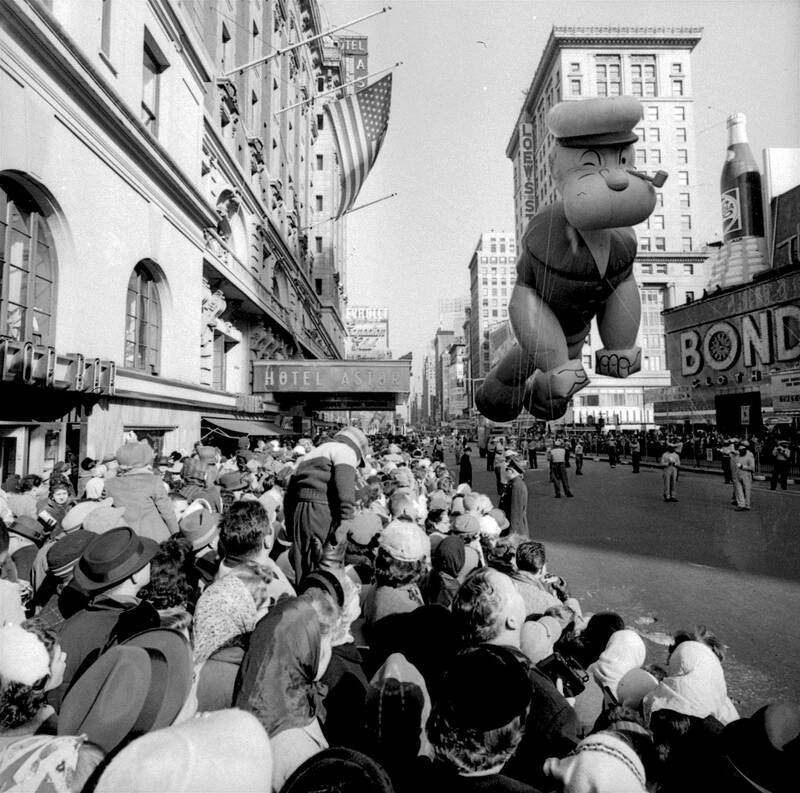
Photo: AP
Here’s a closer look at this year’s crop.
COMIC CHARACTERS LOOM LARGE
Popeye the Sailor, with his bulging forearms, mealy-mouthed speech and propensity for fistfights, was created by E.C. Segar and made his first appearance in the newspaper strip Thimble Theater in 1929, speaking his first words, “‘Ja think I’m a cowboy?” when asked if he was a sailor. What was supposed to be a one-off appearance became permanent, and the strip would be renamed Popeye.

Photo: AP
But as with Mickey Mouse last year and Winnie the Pooh in 2022, only the earliest version is free for reuse. The spinach that gave the sailor his super-strength was not there from the start, and is the kind of character element that could spawn legal disputes. And the animated shorts featuring his distinctive mumbly voice didn’t begin until 1933 and remain under copyright. As does director Robert Altman’s 1980 film, starring Robin Williams as Popeye and Shelley Duvall as his oft-fought-over sweetheart Olive Oyl.
That movie was tepidly received initially. So was director Steven Spielberg’s Adventures of Tintin in 2011. But the comics about the boy reporter that inspired it, the creation of Belgian artist Herge, were among the most popular in Europe for much of the 20th century.
The simply drawn teen with dots for eyes and bangs like an ocean wave first appeared in a supplement to the Belgian newspaper Le Vingtieme Siecle, and became a weekly feature.
The comic also first appeared in the US in 1929. Its signature bright colors — including Tintin’s red hair — didn’t appear until years later, and could, like Popeye’s spinach, be the subject of legal disputes.
And in much of the world, Tintin won’t become public property until 70 years after the 1983 death of his creator.
THE HEIGHT OF AMERICAN LIT
The books becoming public this year read like the syllabus for an American literature seminar.
The Sound and the Fury, arguably William Faulkner’s quintessential novel with its modernist stream-of-consciousness style, was a sensation after its publication despite being famously difficult for readers. It uses multiple non-linear narratives to tell the story of a prominent family’s ruin in the author’s native Mississippi, and would help lead to Faulkner’s Nobel Prize.
And Ernest Hemingway’s A Farewell to Arms joins his earlier The Sun Also Rises in the public domain. The partly autobiographical story of an ambulance driver in Italy during World War I cemented Hemingway’s status in the American literary canon. It has been frequently adapted for film, TV and radio, which can now be done without permission.
John Steinbeck’s first novel, A Cup of Gold, from 1929, will also enter the public domain.
The British novelist Virginia Woolf’s A Room of One’s Own, an extended essay that would become a landmark in feminism from the modernist literary luminary, is also on the list. Her novel Mrs. Dalloway is already in the US public domain.
MAKING MOVIE LEGENDS
While a host of truly major movies will become public in the coming decade, for now early works by major figures from the not-always-stellar early sound era will have to suffice.
A decade before he would move to Hollywood and make films like Psycho and Vertigo, Alfred Hitchcock made Blackmail in Britain. The film was begun as a silent but shifted to sound during production, resulting in two different versions, one of them the UK’s — and Hitchcock’s — first sound film.
John Ford, whose later Westerns would put him among film’s most vaunted directors, also made his first foray into sound with 1929’s The Black Watch, an adventure epic that includes Ford’s future chief collaborator John Wayne as a young extra.
Cecil B. DeMille, already a Hollywood bigwig through silents, made his first talkie with the melodrama Dynamite.
Groucho, Harpo and the other Marx Brothers had their first starring movie roles in 1929’s The Cocoanuts, a forerunner to future classics like Animal Crackers and Duck Soup.
The Broadway Melody, the first sound film and the second film ever to win the Oscar for best picture — known as “outstanding production” at the time — will also become public, though it’s often ranked among the worst of best picture winners.
And after Steamboat Willie made the earliest Mickey Mouse public, a dozen more of his animations will get the same status, including The Karnival Kid, where he spoke for the first time.
1929 MUSICAL CLASSICS
Songs from the last year of the Roaring Twenties are also about to become public property.
Cole Porter’s compositions What Is This Thing Called Love? and Tiptoe Through the Tulips are among the highlights, as is the jazz classic Ain’t Misbehavin’, written by Fats Waller and Harry Brooks.
Singin’ in the Rain, which would later forever be associated with the 1952 Gene Kelly film, made its debut in the 1929 movie The Hollywood Revue and will now be public domain.
Different laws regulate sound recordings, and those newly in the public domain date to 1924. They include a recording of Nobody Knows the Trouble I’ve Seen from future star and civil rights icon Marian Anderson, and Rhapsody in Blue performed by its composer George Gershwin.

It seems every few days one bumps into one of those “real man” comments in which Taiwan is urged to “face reality” or similar, and “make a deal,” with the speaker implying that soon it will be too late. “Deal” advocates always present themselves as having a superior grip on reality, and the manly ability to make the “hard choice.” Their testosterone-laden language often echoes that of Taiwan sellout advocates. Note that such commentary always specifies a process (“make a deal, work with, make progress”), never the end state of what occupation by a violent authoritarian colonialist state will entail. In

There are shadowy cabals plotting to sell out Taiwan to be annexed by China, by invasion if necessary. Fortunately, they are buffoons. In 2019, former Bamboo Union gangster and founder of the China Unification Promotion Party (CUPP), Chang An-le (張安樂, colorfully known as “White Wolf”), led a protest at the Legislative Yuan against comments made by then-premier Su Tseng-chang (蘇貞昌) that in the event of an attack by China, he would never surrender, but would protect the nation by fighting to the end, even if he only had a broom. Chang had party members bring a wooden casket that they
June 1 to June 7 "If all Taiwanese were as afraid of dying as you, then what would happen?” Physician Shih Chiang-nan (施江南) reportedly said this to his wife Chen Chiao-tung (陳焦桐) after she urged him to stop intervening on behalf of Taiwanese soldiers stranded overseas after serving in the Japanese Army during World War II. Shih had clashed with high-ranking officials over the issue, engaged in several heated arguments with Taiwan governor-general Chen Yi (陳儀) and allegedly shouted at general Ko Yuan-fen (柯遠芬), chief of staff of the Taiwan Garrison Command, over

Food prices have often played a major role in Taiwan’s history. The first major wave of migration from China occurred in 1628. A moderate drought, the Ming Dynasty maritime ban that prohibited fishing and trading (intended to reduce piracy) and a temporary tax, conspired to exhaust local resources, leading to famine in Fujian Province. The famed pirate and trader Zheng Zhilong (鄭芝龍), scooped up starving people from Fujian and transported them across the Taiwan Strait, where they settled under the Dutch. Two factors enabled Zheng. First, by 1624 he had settlements around today’s Beigang (北港) in Yunlin County with a small


 RSS
RSS