

Invisible Nation by American film director Vanessa Hope is the first major documentary on Taiwan’s political situation in decades. But at an advanced screening last November, the question that flummoxed an audience of journalists –– including writers from the New York Times, the Guardian and Bloomberg –– was how the filmmakers had gained so much access to President Tsai Ing-wen (蔡英文).
“We’ve been trying to get her for the last seven months,” Taiwan Foreign Correspondents Club president Chris Horton asked Hope in a post-screening Q&A, “and we haven’t gotten anywhere.”
Hope filmed Invisible Nation from 2017 to 2022, and during that time she scored five interviews with Tsai. Her cameras were invited into Tsai’s home, where the president’s cats interrupt twice with their purring. (The film also lets us know that Tsai has dogs.)
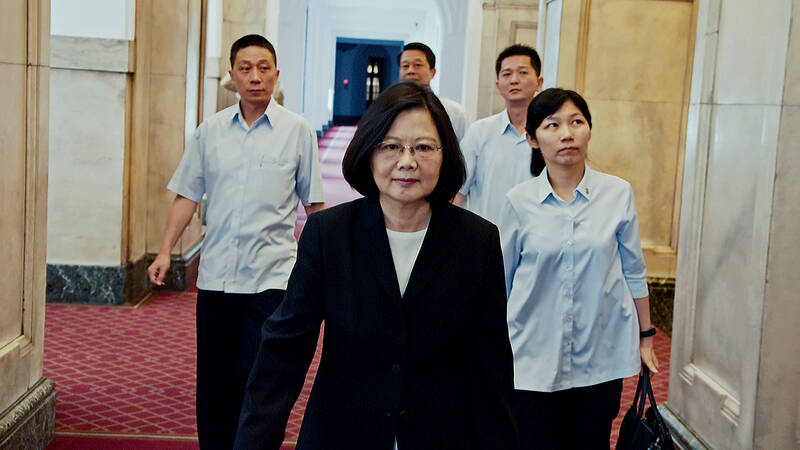
Photo courtesy of Laura Hudock and Invisible Nation
The film team flew with Tsai on her presidential jet, the short hop from Taipei to Kaohsiung, showing her at her office in the air. (Like America’s Air Force One, Taiwan maintains a converted passenger jet for top politicians.)
Hope was also allowed to set up shots in Taiwan’s Presidential Office, including one of Tsai striding heroically down a corridor and towards the camera.
“Every time I got an interview with her, it was always scheduled for the day before I left the country,” said Hope, when I interviewed her in Taipei last November. “Basically, I’d tell the Presidential Office when I was leaving, and then they’d somehow squeeze me in.”
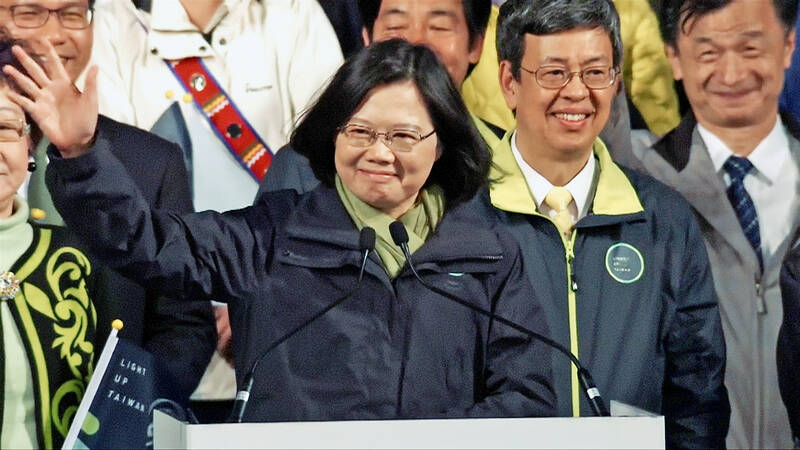
Photo courtesy of Michael Geier and Invisible Nation
“I don’t think anyone had ever proposed anything like this before,” Hope continued. “But to be honest, I can’t say for sure why they granted our requests. The sense I got was that they appreciated that we were showing an interest in Taiwan.”
Allowing a foreign film team into the Presidential Office may be unprecedented in Taiwan, but it is hardly out of line with Tsai’s priorities.
If anything, Tsai’s presidency was Taiwan’s greatest PR campaign in modern history, broadcasting an image of Taiwan as Asia’s most progressive and liberal-minded society.
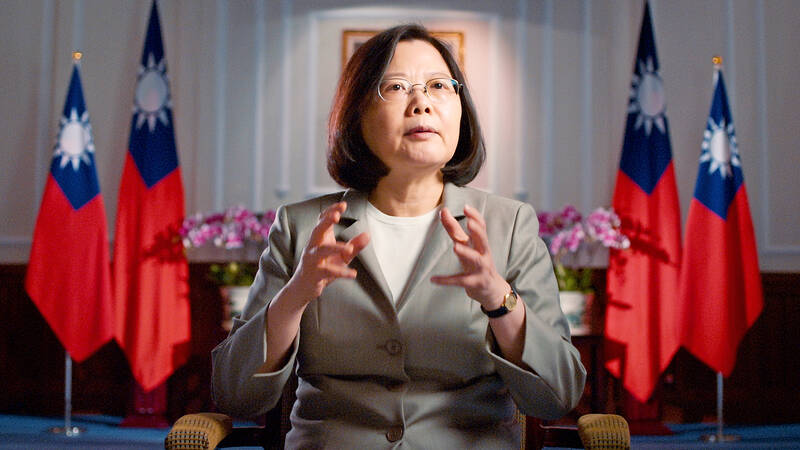
Photo courtesy of Laura Hudock and Invisible Nation
The eight years of her presidency saw Taiwan recognized as a world leader in the handling of COVID-19 and the first nation in Asia to legalize same-sex marriage, stories which all generated huge amounts of positive international press, while also posing alternative takes to the standard fare reporting on Taiwan’s military tensions with China and semiconductor manufacturing.
Tsai’s administration also in 2021 launched an English-language television network with global reach, TaiwanPlus. And as Taiwan’s representative in Washington, DC, she appointed Hsiao Bi-khim (蕭美琴), who has been lauded for her ability to communicate Taiwan’s story to the world.
VETERAN DOCUMENTARY FILMMAKER
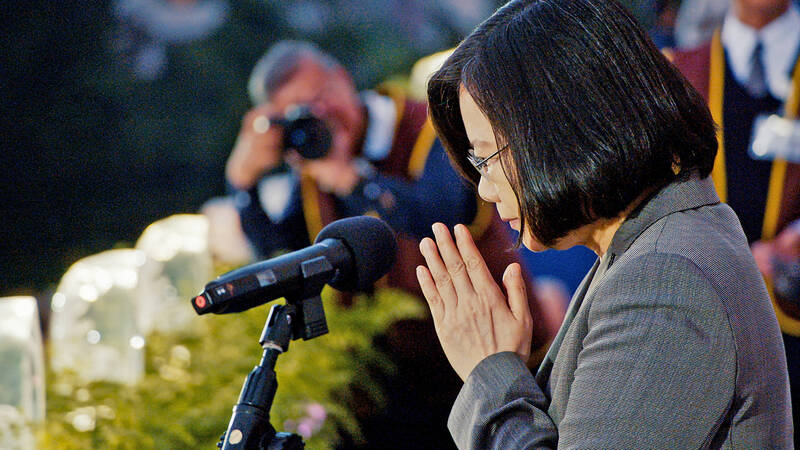
Photo courtesy of Laura Hudock and Invisible Nation
When Hope approached the Tsai administration as a filmmaker, she also offered near perfect credentials as a creative who could get Taiwan’s message out.
A native New Yorker, Hope has so far worked on more than a dozen feature documentaries, including films that played at major festivals in Berlin and Cannes. Her most recent, All Eyes and Ears (2015), looked at the US-China relationship by following US ambassador to China, Jon Huntsman.
Before stepping behind the camera, Hope built her career working in US think tanks, where she focused on East Asia. At a non-partisan think tank called the Council on Foreign Relations, she worked under Jerome Alan Cohen, a Harvard Law professor who taught Taiwan’s former president Ma Ying-jeou (馬英九), and former vice-president Annette Lu (呂秀蓮). (Both are interviewed in Invisible Nation.) She also helped research two books on China for highly regarded author Elizabeth Economy.
The decision to make Invisible Nation, however, was born out of Hope’s personal experience. After studying in Beijing in the early 1990s, she continued studying Chinese in Taiwan in 1995 and 1996, where she witnessed one of the most intense political moments in Taiwan’s history, the first direct presidential election of March 1996.
“I really didn’t have enough of a sense of the real history here, or why it was such a significant election,” recalls Hope. “I just thought it was exciting. And it was huge!”
As a student recently arrived at Taipei’s Mandarin Training Center, I witnessed that historic moment as well. I remember that cheaply printed, vertical political flags were posted with such density that the entire city of Taipei seemed to flutter with their colors. Walking bridges over major intersections were a chaos of political advertisement. And crowds at political rallies roared with a fervency that had been bottled up by four decades of martial law, an intensity in Taiwan politics that has not been seen since.
In 2016, Hope returned to Taiwan for more election watching, this time tagging along with an international delegation of election monitors. Seeing the election of Tsai at first hand, she was struck by her presence as both a woman and a leader.
“It was a really fascinating trip that I still cannot get out of my mind,” she said.
Later that same year, Hope submitted her proposal for filming to Taiwan’s Presidential Office. Her first interview was granted in May 2017, roughly one year after Tsai took office.
Invisible Nation is framed as a “portrait of Taiwan and its first female president,” but even after five shoots with the president, the film does not manage to probe deep into what drives Tsai or how her decisions are made.
We learn that Tsai was a top-of-the-class student at National Taiwan University. And later when she went to study law at Cornell University in New York State in 1980, her mother told her that if the weather was too cold, she could come home any time.
In the 1990s, Tsai became a legal advisor to Taiwan’s team for international trade negotiations, which eventually allowed Taiwan to join the WTO in 2002. We hear anecdotes about Tsai’s painstaking preparations. Following some sessions, she even suggested to the opposing side questions they probably should’ve asked.
CROSS-STRAIT DIFFERENCES
But Tsai’s story only takes up a relatively small fraction of the film’s taut 85-minute length. The rest is a sort of greatest hits of China-Taiwan international news stories from recent decades. For avid Taiwan watchers, there is not much new here, but it is a very credible recap.
In rapid fire fashion, reports cover Taiwan’s first direct presidential election of 1996 (to which China responded with missile launches), the election of Taiwan’s first DPP president in Chen Shui-bian (陳水扁) in 2000 (which angered China), Ma Ying-jeou’s reestablishment of direct air and postal links to China (which appeased China), Taiwan’s half-million strong Sunflower movement protests of 2014 (which resisted a trade deal with China) and Nancy Pelosi’s 2022 visit to Taipei (which gave China occasion to respond with huge military drills).
The film also addresses the squashing of Hong Kong’s democracy by the Chinese Communist Party (to which Taiwan voters reacted by handing Tsai a 2020 landslide reelection), and the recent daily incursions by Chinese warships and planes into Taiwan’s air defense zone.
Hope does not delve much into the nuances of Taiwan’s domestic politics, or even the two-party rivalry between the KMT and DPP which has defined Taiwanese politics since the late 1980s. Instead, the primary opposition she paints is that between Taiwan and China, contrasting images of Taiwan’s flourishing, democratic society (festive scenes from music festivals and gay pride parades) with ominous images of Chinese rockets, aircraft and warships.
Tsai, the hardworking, personable bureaucrat, is meanwhile posed against stiff, authoritarian Xi Jinping (習近平) addressing the Peoples Congress of stone faced, and robotic apparatchiks. In one key speech from July 2021, Xi declared that any foreign power who dares to interfere in China’s internal politics –– and here he clearly means Taiwan –– “will crack their heads and spill blood on a Great Wall of steel built from the flesh and blood of 1.4 billion Chinese.”
Hope, as a documentarian, says that she does not want to impose her own views through the film, and for this reason is holding the film’s release until after the presidential election. Though she has spoken with several Taiwanese distributors, at this moment there still are no firm plans for a Taiwan release.
“The film should not serve as a propaganda tool,” she said.
Invisible Nation has, however, since its premier in October last year at California’s Mill Valley Film Festival, screened at a number of film festivals, including five sold-out screenings at Europe’s biggest documentary market, International Documentary Film Festival Amsterdam (IDFA).
In terms of Taiwan-China relations, Hope accepts Tsai’s framing of the relationship.
“President Tsai said it many times, Taiwan is open to dialogue with Xi Jinping. They want dialogue. They just don’t want to sacrifice all that Taiwan has built — their democracy, their sovereignty, their autonomy. And it’s a mis-portrayal to suggest that by trying to defend what they’ve built that they’re provoking China. It’s so clear, and you see it in those cuts. The aggressor is China, is Xi Jinping,” she said.
The film includes interviews with top Taiwanese politicians and political watchers, including politicians Chen Chu (陳菊), Freddy Lim (林昶佐), Audrey Tang (唐鳳), United Microelectronics Corp (UMC) founder Robert Tsao (曹興誠) and author Shawna Yang Ryan.
From festival screenings, Hope’s major takeaway is that people who rely on headlines in the world press tend to have a poor understanding of Taiwan and its recent political history.
“I think it’s high time we learn what’s going on Taiwan’s point of view,” she said.
“And that’s what I wanted to catch.”
The Nuclear Safety Commission (NSC, 核安會) on Sept. 24 approved the re-operation plan that Taiwan Power Co (Taipower, 台電) filed in March for the Ma-anshan Nuclear Power Plant in Pingtung County, after three rounds of review and 589 comments. Taipower now has to carry out the work in the plan and its own inspections on ageing, radiation and seismic resistance, then report back to the commission for review and on-site checks. Minister of Economic Affairs Kung Ming-hsin (龔明鑫) has named 2028 as the earliest restart. The NSC has given no date. THE DEBATE No challenge has been identified as to whether Ma-anshan

Oct. 12 to Oct. 18 After 11 years in prison on Green Island, Yen Shih-hung (顏世鴻) was finally due for release when a camp guard asked him for NT$20,000 to help pay his bride price. Yen refused. The next day, officials deemed that he had “failed to improve his thinking” and ordered him to undergo further political reeducation on Siaoliouciou (小琉球), where prisoners were also subjected to forced labor. He spent another 19 months there before regaining his freedom in January 1964. Yen’s punishment stemmed from his joining the Taiwan Provincial Student Affairs Committee

Cognitive warfare, says the Ministry of National Defense (MND), is the People’s Republic of China’s (PRC) use of “political, economic, cultural, military and legal means, with the intent to divide internal unity and undermine social stability” in Taiwan. Last week offered several examples. PRC media in October last year reported that the Chongqing Municipal Public Security Bureau had opened an investigation into Democratic Progressive Party (DPP) Legislator Puma Shen (沈伯洋), the DPP’s mayoral candidate for Taipei in next month’s election, for “Taiwan independence” activities. This was a cognitive warfare ploy, designed to unsettle the targeted person and to establish the idea
In pandemic preparedness work, scientists like to focus on the technical challenges: identifying pathogens, diagnosing infections, understanding their effects and developing vaccines and treatments. Each step promises progress through human innovation, investment and planning. The WHO, for example, brings experts together to identify and prioritize emerging disease threats and collect the evidence needed to prepare for them. But preparedness depends on more than scientific innovation. As the past week has shown, politics is the elephant in the room in all of this. No one could have predicted we would be talking about pneumonic plague, and that the death of a single


 RSS
RSS